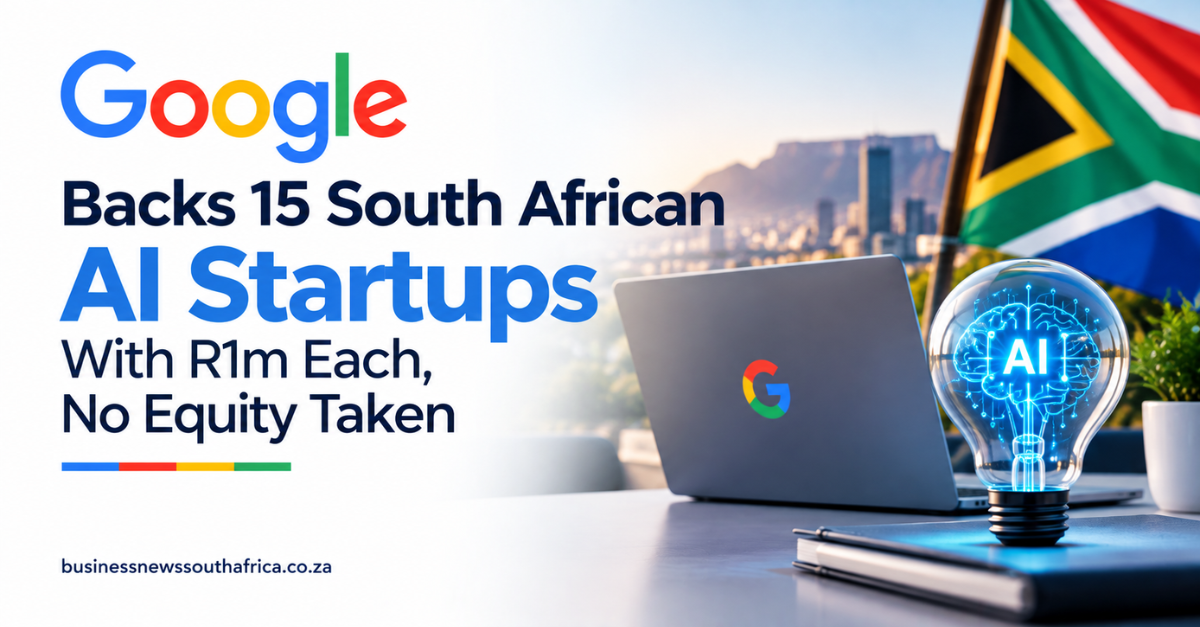
Fifteen South African startups building artificial intelligence products are about to spend three months inside Google’s own accelerator programme, each walking away with up to R1 million in funding that costs them nothing in equity. According to Google’s own announcement, the 2026 Google for Startups Accelerator: South Africa runs from 28 September to 4 December, with a graduation and demo day closing out the cohort in December.
The programme targets growth-stage, AI-driven startups with a South African-led team and a product already shipping to real customers, not a pitch deck still looking for its first user. Google has said it is prioritising historically disadvantaged person-owned or controlled businesses among applicants, a deliberate tilt toward founders who have historically had a harder time raising early capital in South Africa’s venture ecosystem. Applications closed on 28 August, meaning the 15 companies now preparing to start the programme were selected from whatever pool of qualifying founders applied over the preceding weeks.
What the funding buys beyond the cheque is arguably the more interesting part of the package. Selected founders get hands-on access to Gemini, Google’s family of AI models, along with the company’s cloud infrastructure and a curriculum built around product roadmapping and growth strategy rather than generic startup theory. Each startup is also paired with one-to-one mentorship from specialists inside Google’s own AI and cloud teams, and gets folded into a network of more than 25 local alumni from earlier cohorts plus Google’s global accelerator community.
Siya Madikane, Google’s communications and public affairs manager, framed the programme’s ambition plainly: “When these companies grow, they hire here, and they prove that AI built on the continent can compete anywhere.” It is a line that doubles as a rebuttal to a persistent complaint in African tech circles, that AI development happens elsewhere and Africa’s startups are left building thin wrappers around someone else’s foundation model rather than genuinely competitive products.
Why non-dilutive funding matters here
The equity-free structure is worth dwelling on. South African AI startups raising a first serious funding round typically give up a meaningful equity stake to secure the capital, diluting founders at exactly the stage when they can least afford to lose control of their own roadmap. A grant-style R1 million from Google does not replace a Series A, but it can extend a startup’s runway by months at a moment when local venture capital for AI-specific products remains thin compared with fintech, historically the country’s most heavily funded startup category.
That imbalance is part of why programmes like this one matter beyond the individual startups involved. If AI-focused founders keep finding it harder to raise than their fintech peers, the country risks building strong payment rails and lending apps while genuinely novel AI products, the kind aimed at agriculture, healthcare diagnostics or public sector efficiency, struggle to find a first backer willing to underwrite the technical risk.
Google is not new to running startup programmes in the country, and past cohorts have produced graduates that went on to raise larger institutional rounds after finishing the accelerator, using the programme as much for credibility with future investors as for the funding itself. Whether this cohort follows the same pattern will only be clear well after December’s demo day, once the 15 founders are back trying to convert three months of mentorship and cloud credits into paying customers and a defensible product.
There is also a harder-edged commercial logic behind why Google, and its competitors, keep running programmes like this one. Every startup that builds its product on Gemini and Google Cloud during the accelerator is a startup that will find it more expensive, in engineering time as much as money, to rebuild on a rival’s infrastructure later. Google is not disguising this: access to its own models and cloud tooling is the headline benefit alongside the cash. For founders, that trade-off is usually worth taking at the growth stage the programme targets, since the alternative, evaluating and integrating several competing AI platforms from scratch with no funding cushion, is a slower and more expensive way to reach the same starting point.
The emphasis on historically disadvantaged ownership also reflects a specific, well-documented gap in South African venture funding. Local data on startup funding has repeatedly shown that black-owned and women-owned startups raise smaller rounds, less often, than founders from other backgrounds, even controlling for sector and stage. A programme that screens for this at the application stage does not fix that imbalance on its own, but it does mean the 15 companies in this cohort are more likely to be founders who would otherwise have struggled to get a first serious institutional backer to take their pitch meeting at all.
For South Africa’s broader AI ecosystem, itself still working out what a credible national policy framework should look like, a programme of this scale from one of the world’s largest AI companies is also a signal of where at least one major foreign investor sees enough promise to put real money behind it, even without taking a stake. It also sits alongside a busier calendar of AI-focused events and programmes launching in the country this year, including this site’s coverage of the Singularity Summit SA 2026 programme.