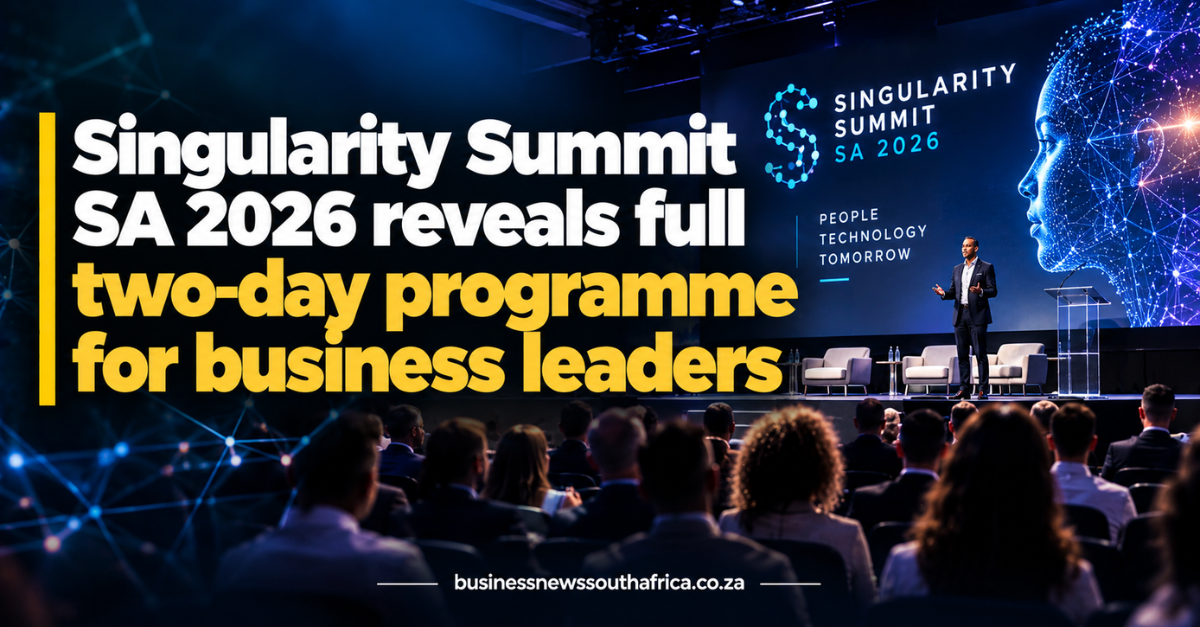
At the Sandton Convention Centre, the buzz of last-minute registrations hints at a familiar dilemma for many South African entrepreneurs: how to turn the hype around artificial intelligence into a concrete advantage for their businesses. The answer the organisers hope to provide arrived on Tuesday, when the full programme for Singularity Summit South Africa 2026 was published.
The summit, scheduled for 21 and 22 October, is being presented in collaboration with Old Mutual, and is sponsored by Google Cloud, the Industrial Development Corporation (IDC) and metaverse platform UBU. It will bring together more than 40 speakers from around the world, ranging from AI specialists to biotech founders, to discuss how exponential technologies are reshaping markets and workplaces.
For small- and medium-size enterprises, the stakes are clear. Mic Mann, co-CEO of Singularity South Africa, says the conversation has moved beyond “if” AI will affect organisations to “where” to invest and “how” to implement it. That shift matters to owners who must decide whether to allocate scarce capital to new software, retrain staff or partner with technology providers.
Among the newly announced speakers are Felix Cheung, founder and CEO of China’s Bairong Group; Kim Hulett, biotech entrepreneur behind Next Biosciences; and Ran Neuner, founder of Crypto Banter. Their presence signals that the summit will not only cover classic AI topics but also emerging fields such as digital finance and biotech, areas where South African SMEs are beginning to experiment.
The programme also retains previously confirmed names such as AI specialists Amanda Manna and Dario Fanucchi, robotics pioneer Tilly Lockey, and South African inventor Fana Shabane. Acclaimed poet and broadcaster Lebo Mashile will return as the event’s poet and MC, adding a cultural dimension to the technology-heavy agenda.
According to Shayne Mann, co-CEO of Singularity South Africa, the two-day schedule is designed to help delegates leave “better informed, better connected and with a clearer sense of where the opportunities lie”. The event will feature keynote presentations, panel debates, and a series of AI workshops and masterclasses aimed at upskilling participants. For an SME owner, a hands-on masterclass could be the difference between a vague idea of machine learning and a practical pilot project.
Why the summit matters for South African businesses
Celiwe Ross, group chief human capital and corporate affairs officer at Old Mutual, stresses that technology alone will not define the future; how people use it will. She urges business leaders to consider not just the tools but also the cultural changes required to adopt them. This perspective aligns with a broader national push: the IDC has earmarked billions of rand for technology-focused projects, and the South African government has recently released a draft AI strategy aimed at boosting local innovation.
In practical terms, the summit offers a rare chance for local entrepreneurs to meet global investors and technology partners without leaving Johannesburg. The interactive expo will showcase emerging products, while networking sessions are scheduled throughout both days. For a small firm looking to secure a pilot partnership with a cloud provider, a conversation at the summit could open doors that would otherwise require months of outreach.
Registration details are available on the summit’s website. With the programme now finalised, the organisers are urging interested parties to book early, as space for the workshops is limited.
Interest in artificial intelligence adoption among South African businesses has grown quickly over the past two years, with local companies experimenting with the technology across customer service, logistics and financial risk management. The World Economic Forum’s own research on AI adoption carries further detail. For related coverage, see this site’s Tech and Telco coverage.
Business schools and industry bodies in South Africa have increasingly built AI literacy into their own executive education offerings over the same period, reflecting demand from companies that want their leadership teams to understand the technology’s practical limits as well as its potential.