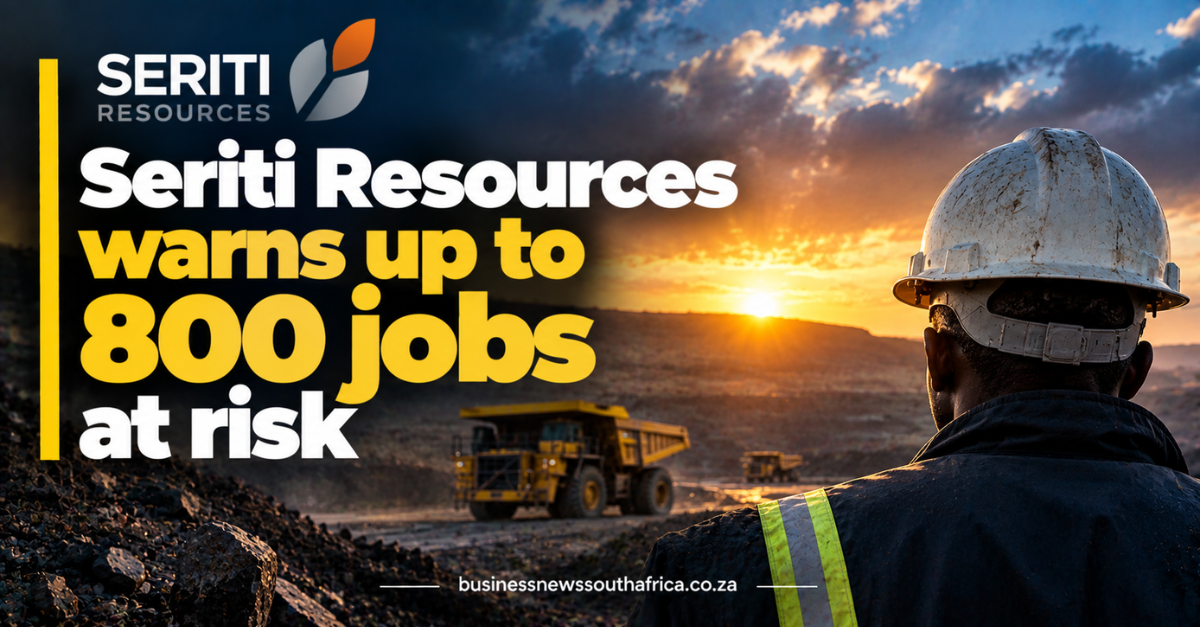
According to ewn.co.za, Seriti Resources, a coal supplier to state utility Eskom, has indicated that up to 800 jobs could be at risk. The company made the statement without providing further detail on the reasons behind the potential cuts.
Seriti Resources extracts and processes coal that feeds Eskom’s power stations, a role that has traditionally supported a sizable workforce in the mining regions of Mpumalanga. The announcement arrives at a time when Eskom has been grappling with supply constraints, recurring load-shedding and a broader push to diversify South Africa’s energy mix away from coal.
Why the coal sector matters to South African businesses
The coal mining industry has long been a pillar of the national economy, providing direct employment, generating tax revenue and sustaining a network of ancillary services. Small-scale suppliers of equipment, transport firms, catering businesses and local retailers have all depended on the steady flow of activity generated by mining operations. When a major supplier signals a reduction in its workforce, the ripple effect can be felt across this ecosystem. For a business owner in the region, the prospect of job losses translates into reduced household income, lower consumer spending and a potential decline in demand for locally sourced goods and services.
Beyond the immediate economic linkages, the sector also shapes the regulatory environment in which all firms operate. Energy policy decisions, environmental licensing requirements and labour regulations that were originally designed to support a thriving coal industry continue to influence the cost structure and compliance obligations of businesses that are not directly involved in mining. Understanding how changes in coal supply affect these broader frameworks is therefore essential for strategic planning.
Regulatory and policy context
South Africa’s energy policy has evolved in response to both domestic challenges and international climate commitments. The government has articulated a long-term vision that includes a gradual reduction in reliance on coal, an increase in renewable capacity and a focus on energy security. While the transition is intended to create new opportunities, it also introduces uncertainty for companies that have built their models around coal-centric demand. State regulators oversee the issuance of mining licences, environmental permits and safety standards, and they are tasked with balancing economic imperatives with sustainability goals. When a supplier such as Seriti signals potential job cuts, regulators may review the underlying causes, whether they relate to market demand, operational efficiency or compliance costs.
In addition, the broader financial environment is shifting. Global investors are applying stricter criteria to projects with high carbon footprints, and many financial institutions are reducing exposure to coal-related assets. This trend can affect the availability of capital for expansion or modernization, which in turn may influence employment decisions at the operational level. For South African entrepreneurs, awareness of these financing dynamics is crucial when evaluating partnerships, seeking credit or planning expansion in sectors that intersect with energy production.
Potential drivers of the announced risk
Seriti Resources has not disclosed whether the risk to jobs stems from reduced coal orders, operational restructuring, or other factors. The timeline for any potential workforce reductions also remains unclear, leaving employees and local communities without a clear picture of what to expect. Several plausible drivers can be considered based on the current environment. A decline in coal orders could arise from Eskom adjusting its generation mix, from maintenance outages that temporarily reduce demand, or from strategic decisions to procure coal from alternative sources. Operational restructuring might involve the adoption of new technologies that increase productivity while requiring fewer hands, or the consolidation of processing facilities to achieve economies of scale. External pressures such as rising input costs, stricter environmental compliance or shifts in export markets could also play a role.
Each of these possibilities carries distinct implications for the local labour market. A demand-driven cut would suggest that the underlying mining activity may contract, potentially affecting not only Seriti but also other contractors and service providers. A technology-driven restructuring could indicate a longer-term shift toward more capital-intensive processes, which may create new types of jobs that require different skill sets. Understanding the nature of the driver helps business owners anticipate whether the impact will be short-term or part of a more structural change.
Implications for small-business owners and entrepreneurs
For small-business owners operating in the same regions, the news highlights the importance of monitoring energy-sector developments and considering diversification strategies. Enterprises that rely heavily on the spending power of mining households may need to explore alternative customer bases or expand their product lines to mitigate the risk of reduced demand. Those that provide specialised services to the mining supply chain could benefit from assessing whether their offerings can be adapted for other industries, such as renewable-energy projects, infrastructure development or agribusiness.
Proactive engagement with local chambers of commerce, industry associations and training institutions can provide early warnings about sectoral shifts and open channels for collaboration. By staying informed about policy updates, funding opportunities and market trends, entrepreneurs can position themselves to capture emerging demand while protecting existing revenue streams. In many cases, the same logistical expertise, equipment maintenance capabilities or workforce management experience that support coal operations can be redeployed to support new projects, provided that owners are willing to invest in the necessary re-skilling and market research.
Support mechanisms for affected workers
If the risk materialises, affected workers may seek support through retraining programmes or government assistance, underscoring the need for proactive labour-market planning. South Africa has a range of initiatives aimed at upskilling displaced workers, including vocational training centres, apprenticeship schemes and adult education programmes. Access to these resources often depends on coordination between employers, unions, training providers and government agencies. Business owners who anticipate a reduction in their own workforce can benefit from early engagement with these programmes, ensuring that employees have a clear pathway to acquire new competencies that match emerging industry needs.
Community organisations and local NGOs also play a role in providing counselling, job-search assistance and micro-enterprise support. By partnering with such groups, companies can help smooth the transition for former employees and maintain social stability in the area. This collaborative approach not only mitigates the immediate impact of job losses but also contributes to a more resilient local economy that can adapt to the broader energy transition.
Strategic considerations for the future
In a landscape where energy policy, global investment trends and environmental imperatives intersect, business owners must adopt a forward-looking mindset. Conducting scenario analyses that factor in possible reductions in coal demand, changes in regulatory requirements and the pace of renewable-energy adoption can inform capital-allocation decisions and risk-management strategies. Diversification does not necessarily mean abandoning the mining sector altogether; rather, it can involve expanding into complementary activities such as equipment leasing, renewable-energy maintenance or supply-chain logistics that serve multiple industries.
Building strong relationships with local authorities and staying abreast of policy consultations can give businesses a voice in shaping the regulatory environment. Participation in public-consultation processes, submission of position papers and attendance at stakeholder meetings enable owners to convey the practical implications of proposed changes and to advocate for measures that support economic stability while meeting environmental goals.
Ultimately, the announcement from Seriti Resources serves as a reminder that the coal sector, while still a significant component of South Africa’s energy mix, is undergoing a period of transformation. The potential loss of up to 800 jobs highlights the vulnerability of communities that depend on a single industry and underscores the importance of strategic agility for all businesses operating in the region. By understanding the broader context, monitoring policy developments, exploring diversification opportunities and engaging with support mechanisms, South African business owners can better navigate the challenges and seize the opportunities that arise from this evolving landscape.