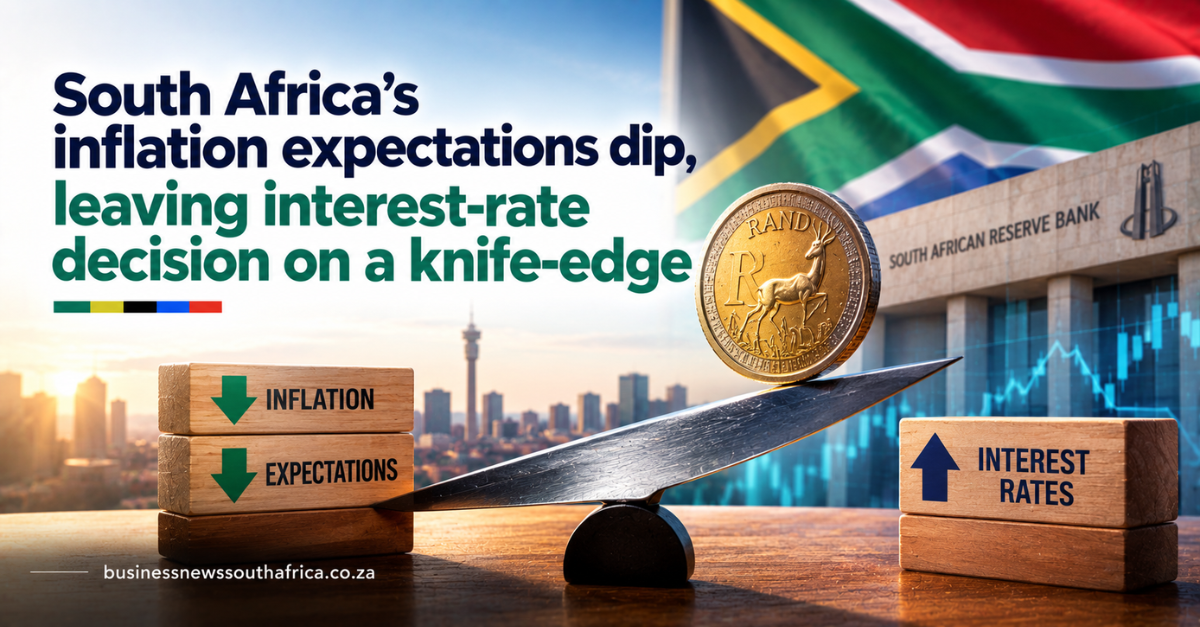
When a small retailer in Johannesburg checks the cost of a new loan, the headline number that matters most is the Reserve Bank’s benchmark interest rate, the rate that sets the price of most borrowing in the economy. A fresh survey released on Wednesday by the Stellenbosch-based Bureau for Economic Research shows that the public’s inflation expectations for the next two years slipped to 3.8% from 3.9% in the previous quarter. That tiny shift could give the monetary policy committee (MPC) room to leave the benchmark rate at 7% when it meets on 23 September, as first reported by BusinessTech.
Inflation expectations are a forward-looking gauge of what households and businesses think price levels will rise by in the future. The Reserve Bank prefers these expectations to hover around its 3% inflation target because lower expectations usually translate into lower actual inflation. A drop to 3.8% is still above the target, but it is the first decline in the third quarter after a period of steady upward pressure.
Why the number matters to small businesses
For an SME owner, the benchmark rate is more than a statistic, it directly influences loan interest, lease payments and the cost of credit cards. If the MPC holds the rate at 7%, borrowing costs stay high, keeping cash flow tight for businesses that rely on short-term finance to stock shelves or purchase equipment. A further rise, even by a quarter of a percentage point, would push those costs higher and could squeeze profit margins, especially for retailers already feeling the pinch of rising energy and fertiliser prices.
Conversely, a hold also signals that the central bank is not rushing to tighten policy despite a recent slowdown in the economy. South Africa’s gross domestic product (GDP) contracted 0.2% in the second quarter, ending a six-quarter streak of growth. The contraction reflects the combined impact of soaring energy costs and fertiliser price spikes that have been linked to geopolitical tensions in the Middle East.
Market participants are already pricing in the odds of a rate change. Forward rate agreements, contracts that lock in a future interest rate for speculation or hedging, show a 52% chance of a 25-basis-point increase at the upcoming meeting, down from 56% earlier in the week. Those numbers suggest that traders see the drop in inflation expectations as a modest but real signal that the Reserve Bank may be comfortable keeping rates steady.
Amundi SA’s Nicolas Dahan warned that another hold could damage the central bank’s credibility after the surprise pause in July. That comment is a market-watcher’s opinion, not a proven outcome, but it highlights the delicate balance the MPC must strike between anchoring inflation expectations and maintaining confidence in its policy framework.
Reserve Bank Governor Lesetja Kganyago has said the committee will remain measured in dealing with “polyshocks”, a string of external pressures such as higher oil prices and the El Niño weather pattern that could raise food costs later in the year. The governor’s remarks reinforce the idea that the central bank is watching a range of risks, not just headline inflation.
For entrepreneurs, the practical takeaway is to prepare for a continuation of high borrowing costs in the near term. Those who can lock in fixed-rate financing now may avoid the risk of a rate hike later in the year. Retailers should also monitor consumer price trends, as any resurgence in inflation could erode disposable income and dampen sales.
On the flip side, the modest easing in expectations may give some breathing room for price-sensitive consumers, potentially supporting demand for non-essential goods if wages keep pace. Small businesses that can align inventory purchases with this tentative optimism may find a small but useful lift in sales.
In the broader picture, South Africa’s inflation trajectory remains above the Reserve Bank’s 3% goal, and the economy is still wrestling with external shocks. The next decision on 23 September will therefore be watched closely by anyone who depends on credit, from a farmer buying fertiliser to a boutique owner leasing a storefront.
SME owners who need to model different interest-rate scenarios can use the Commercial Funding Suite to see how a 25-basis-point rise would affect monthly repayments. Keeping an eye on the Reserve Bank’s statements and the next inflation-expectations survey will be essential for planning cash flow and pricing strategies in the months ahead.
For now, the slight dip in expectations offers a hint of relief, but the benchmark rate is likely to stay at 7% unless new data pushes the MPC toward a tighter stance.