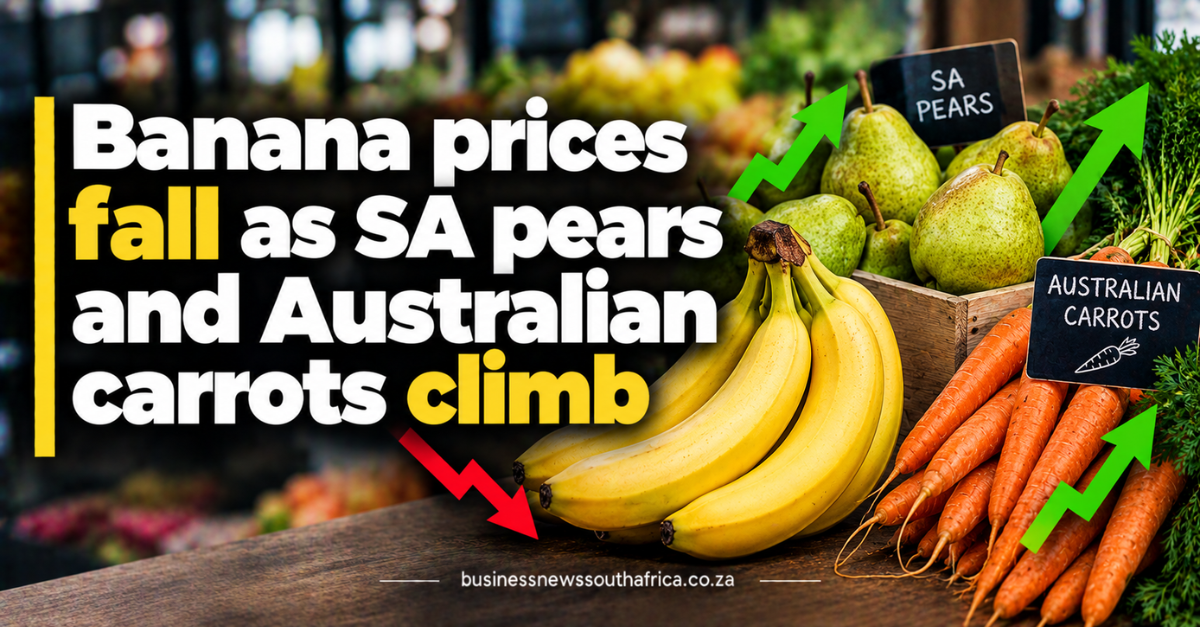
Crates of bananas sit under a dim warehouse light while a digital board flashes a falling price per kilogram; a few metres away, glossy pears from South Africa and bright orange carrots from Australia are listed at higher rates. According to Fruitnet, banana prices have slipped while South African pear and Australian carrot prices have surged.
When Fruitnet says “banana prices drop” it means the average wholesale price that growers receive has decreased compared with the previous month. A “price surge” for pears or carrots indicates the opposite, the average price paid by buyers has risen.
Bananas are a staple export for South Africa, with most of the crop destined for European markets. Global supply has been steady, but recent bumper harvests in Latin America have added volume, pushing world prices down. For South African growers, a lower price means tighter profit margins, especially when production costs, labour, fuel and irrigation, remain high.
South African pears are entering their peak season, and domestic supply has outpaced demand. The excess has driven up farmgate prices as growers compete for limited export slots, mainly to the Middle East and Europe. This seasonal surge benefits pear growers but also raises the cost of mixed fruit boxes that retailers assemble.
Australian carrots have benefited from a strong harvest and favourable exchange rates, allowing exporters to offer competitive prices in Asian markets. The surge reported by Fruitnet reflects higher demand for carrots as a healthy snack, which in turn lifts the price that Australian growers receive.
For South African banana growers, many of whom operate as small to medium enterprises, the price drop creates a dilemma. Lower revenue may force some to cut back on planting or seek additional financing. The commercial funding suite could help growers bridge cash-flow gaps, but higher borrowing costs could further erode margins.
Fruitnet’s observation is a snapshot; it does not confirm how long the price trends will last. Monitoring export data from the Department of Agriculture, Forestry and Fisheries will be essential for growers planning the next planting season. In the meantime, banana exporters may need to renegotiate contracts or diversify into other fruit varieties to protect earnings.
How South African fruit exports are certified
Every consignment of South African fruit destined for export, whether bananas, pears or citrus, must pass inspection by the Perishable Products Export Control Board (PPECB), a statutory body that certifies quality and cold-chain compliance before cargo leaves South African ports. That certification process adds a fixed cost per pallet regardless of the price the crop eventually fetches, which is one reason growers feel a wholesale price dip more sharply than a retailer several steps down the supply chain. For smaller fruit farms weighing whether to expand pear plantings while banana returns soften, understanding those fixed export costs against a shifting price per kilogram is part of the same planning exercise as watching Fruitnet’s monthly price data.
Where South Africa’s bananas actually grow
Most South African banana production is concentrated in two areas: the Levubu valley in Limpopo and the Kiepersol district near Sabie in Mpumalanga, both chosen for their subtropical climate and reliable irrigation. That geographic concentration means a price move like the one Fruitnet reported affects a relatively small, identifiable group of growers rather than a dispersed national industry, which is also why regional weather events, a dry spell in Limpopo or flooding near Sabie, can move South African supply figures more sharply than equivalent events would in a country with banana production spread across a wider area.
What buyers can do with this information
Retailers assembling mixed fruit boxes for South African supermarkets typically renegotiate supplier pricing on a rolling basis rather than fixing contracts far in advance, which means a wholesale swing like the one Fruitnet reported tends to reach shelf prices within a few weeks rather than months.