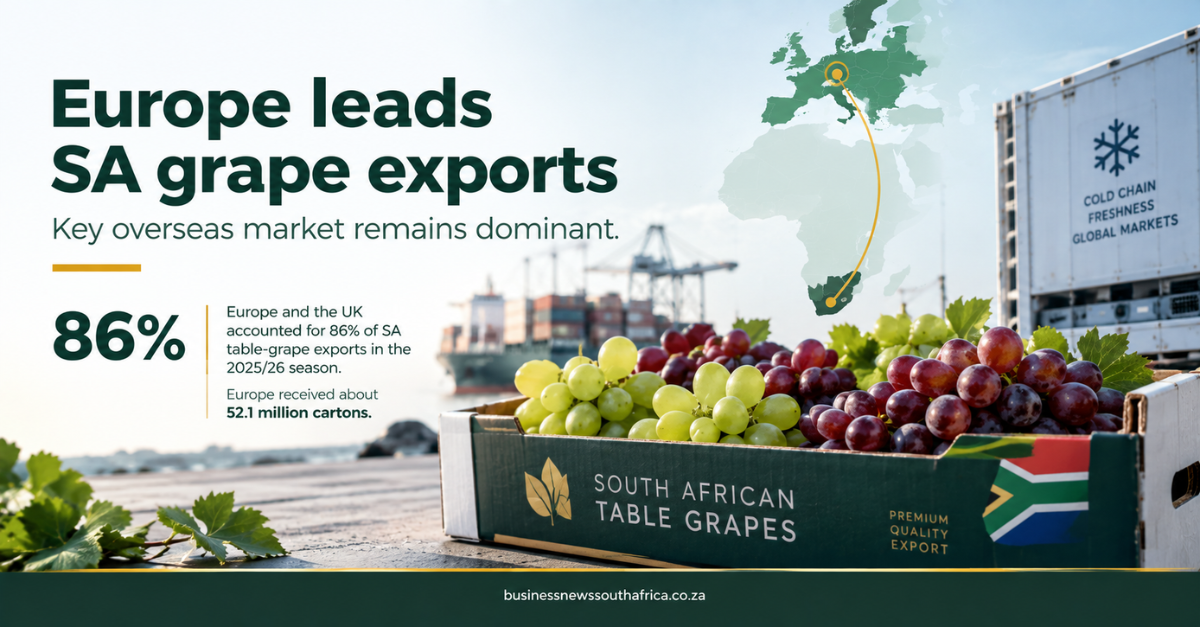
Containers of bright red and green table grapes are being rolled onto ships at the Port of Cape Town, bound for the cool aisles of European supermarkets. Fruitnet reported that Europe still commands the largest share of South Africa‘s fresh grape exports, a pattern that has persisted for years.
For growers and exporters, “table grapes” (fresh grapes sold for direct consumption rather than wine production) this means that the bulk of their sales strategy is still aimed at meeting European standards and taste preferences. The statement from Fruitnet is a claim by the trade publication; it reflects the latest market observation but has not been independently verified by a government source.
Why Europe matters
Europe’s dominance matters because the region offers high price points and a well-developed distribution network for premium fruit. According to the Department of Agriculture, South Africa ships the majority of its table grapes to the European Union, where consumers value the fruit’s quality and seasonality. This reliance on a single market can be a double-edged sword: while it provides a stable outlet, any shift in EU import policy or consumer trends could ripple through the sector.
SME growers, many of whom operate on thin margins, must therefore keep a close eye on European market requirements, from phytosanitary certificates to packaging standards. The need to comply can increase costs, but the payoff is access to a market that consistently pays above the global average for fresh produce.
At the same time, the sector faces broader challenges that could affect its European focus. Load-shedding interruptions, water scarcity in key growing regions, and competition from other Mediterranean exporters are all factors that growers monitor. While these issues are not new, their impact on export volumes can be felt in the next shipping season.
For entrepreneurs looking to enter the table-grape value chain, the continued European appetite suggests opportunities in niche segments such as organic or specialty varieties. However, success will depend on meeting the rigorous standards that European buyers enforce.
Overall, the news from Fruitnet underscores that, for now, Europe remains the cornerstone of South Africa’s table-grape export strategy, shaping decisions from the vineyard to the shipping dock.
South Africa’s table grape industry has built its European market position over decades around counter-seasonal supply, timing exports to reach European retailers during the northern hemisphere’s own off-season when local European grape production is unavailable, a natural advantage that has made the relationship less about price competition and more about filling a supply gap European retailers cannot otherwise close domestically. That structural advantage has made the industry more resilient to currency swings than many other agricultural exports, since European buyers have limited alternative sources during the relevant months regardless of exchange rate movements. The South African Table Grape Industry’s own export statistics track seasonal volumes and destination markets in detail. For related coverage, see this site’s Agri-Business coverage.
South African grape exporters have also had to adapt to increasingly strict European food safety and traceability requirements over the past decade, including detailed record-keeping on pesticide use and cold-chain handling from the point of harvest through to the retail shelf, compliance costs that smaller producers have found harder to absorb than larger, vertically integrated exporters.
Freight costs for perishable exports like table grapes have also risen alongside global shipping disruptions in recent years, adding pressure on margins even where the underlying demand from European retailers has remained strong.
Currency movements still matter at the margins even for a structurally advantaged export like table grapes, since a stronger rand reduces the rand value exporters receive for the same dollar or euro sale price agreed with European buyers.