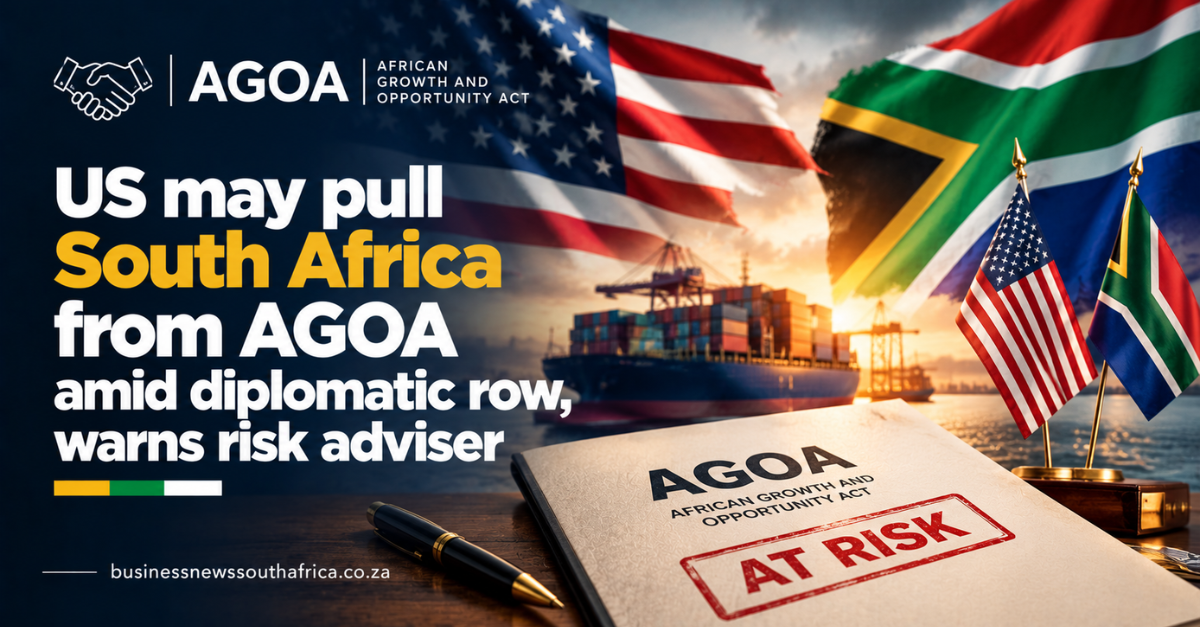
In a Moneyweb podcast, risk adviser Kingsley Makhubela warned that the United States could use the African Growth and Opportunity Act (AGOA, a trade programme that gives eligible African countries duty-free access to the US market) as a “stick” in the escalating diplomatic dispute with South Africa.
Makhubela, speaking to host Jeremy Maggs, said the US has already imposed visa restrictions over alleged racial discrimination, land policy and incitement to violence, and that the White House could now move to exclude South Africa from AGOA. He cited a Hudson Institute article that suggests the US is weighing the political cost of targeting South Africa’s farming constituency.
South Africa’s foreign affairs minister Ronald Lamola has pushed back, calling the US actions an interference in sovereign affairs. US ambassador Brent Bozell, however, warned that the visa restrictions are “only the first step” and hinted at further economic pressure.
Why AGOA matters to South African exporters
AGOA, signed into law in 2000 and extended several times, allows qualifying South African firms to ship goods such as apparel, automotive parts and agricultural products to the United States without paying import duties. For many small and medium-size exporters, the duty-free status is a key competitive advantage that helps them win contracts with US retailers and distributors.
If South Africa were removed from AGOA, those firms would face higher costs and could lose market share to competitors from other African countries that remain eligible. The impact would be felt most strongly in sectors that rely on US demand, such as textile manufacturers in Gauteng and fruit exporters in the Western Cape.
For SME owners, the risk advisory suggests two practical steps: first, review the proportion of revenue that comes from the United States and assess how quickly a tariff increase would affect profitability; second, explore diversification into other markets, using tools such as the commercial funding suite to finance new market entry.
The broader strategic backdrop includes South Africa’s geostrategic position at the Cape of Good Hope, which the adviser says has long attracted interest from global powers. He noted past US interest in establishing a military presence at Simon’s Town Naval Base and recent overtures from Russia and China, adding another layer to the diplomatic tension.
While the US has the legal prerogative to set visa and trade conditions, the ultimate decision on AGOA eligibility will depend on political calculations in Washington. Until an official announcement is made, the claim that South Africa could be kicked out of AGOA remains a forecast rather than a confirmed policy move.
AGOA itself is running on borrowed time
The wider AGOA programme, not just South Africa’s place in it, is a live concern for every eligible country. AGOA technically expired on 30 September 2025, and Congress only passed a one-year extension in February 2026, backdated to cover the lapse, that keeps the trade programme alive until 31 December 2026. Unless Congress acts again before then, AGOA expires for all 32 currently eligible African countries regardless of any bilateral dispute, which means South African exporters face two separate risks stacked on top of each other: a possible early, targeted removal tied to the diplomatic row, and a later, general expiry if Washington’s political appetite for renewing the programme again runs out.
What South African exporters typically ship under AGOA
South Africa has historically been one of AGOA’s largest beneficiaries by export value, with the automotive sector, citrus and other agricultural products, and wine among the categories that rely most heavily on duty-free access to the US market. A sudden change in that status would not affect all exporters equally: a large vehicle manufacturer with an established US distribution network has more room to absorb a new tariff than a smaller agricultural exporter operating on thin margins, which is why industry bodies representing citrus and wine producers have been among the most vocal in past AGOA renewal debates.