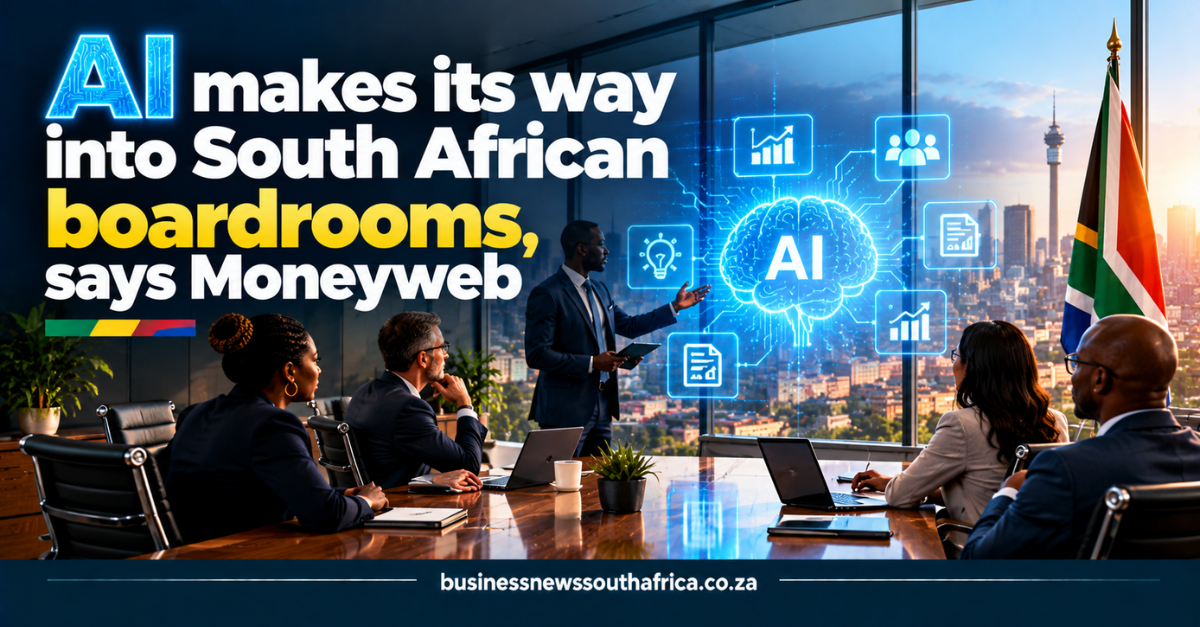
According to Moneyweb, artificial intelligence (AI) has arrived in South Africa’s boardrooms. The brief statement marks the first public acknowledgement that senior directors are turning to machine-learning tools for strategic input.
What does that mean for the average company? In practice, AI can sift through massive data sets, from market trends to supplier performance, and surface insights that would take a human team weeks to compile. For a board, that translates into faster scenario modelling, more granular risk assessment and, potentially, a stronger grip on the numbers that drive shareholder value.
South African firms are not inventing the idea. Globally, boards have been experimenting with AI-enabled dashboards, predictive analytics and natural-language processing to turn quarterly reports into actionable narratives. The United Kingdom’s Financial Conduct Authority, for example, has warned that directors must understand the models that feed their decisions, a sentiment echoed by the Department of Science and Innovation in its national AI strategy.
In the local context, the move reflects a broader push to embed advanced technology across the economy. The government’s AI roadmap, released last year, encourages private-sector adoption while flagging the need for robust data-governance under the Protection of Personal Information Act (POPIA). Boards that embrace AI now will have to balance the upside of data-driven insight with the regulatory requirement to protect customer information.
For small and medium-sized enterprises (SMEs), the headline may feel distant, but the ripple effects could be felt soon. Larger companies that adopt AI often set procurement standards that cascade down the supply chain. An SME that supplies a mining conglomerate, for instance, might be asked to provide data in a format compatible with the buyer’s AI platform. Understanding how AI is being used at the top can help an SME anticipate new data-quality expectations and position itself as a reliable partner.
There are also talent implications. Boards that rely on AI will need directors who can ask the right questions about model assumptions, bias and interpretability. The South African government has highlighted the shortage of data-science expertise as a bottleneck for digital transformation. Companies may therefore invest in upskilling their directors or bring in external advisors with AI credentials.
Despite the enthusiasm, the Moneyweb note does not specify which companies have already deployed AI, what tools they are using, or how far along the implementation journey they are. Those details remain unverified, and the practical impact on board deliberations will only become clear as firms share case studies or as regulators issue guidance on AI governance.
What should business owners take away today? First, keep an eye on how your major customers or partners talk about AI in their annual reports, the language often hints at upcoming requirements. Second, review your own data-management practices to ensure they meet POPIA standards; clean, well-documented data is the foundation of any trustworthy AI system. Finally, consider whether a modest AI pilot, perhaps a forecasting model for sales or a risk-scoring tool for credit, could demonstrate value before committing to a larger rollout.
In short, the boardroom buzz is real, but the story is still being written. Companies that move deliberately, with an eye on both opportunity and compliance, will be best placed to turn the AI hype into a competitive advantage.
Board-level AI adoption in South Africa has generally lagged operational adoption, meaning AI tools are often already embedded in a company’s customer service, fraud detection or logistics systems well before the board itself has developed a formal view on AI governance, risk oversight or strategic investment. That gap creates a specific exposure: a board approving AI-driven decisions it does not fully understand the mechanics of is poorly positioned to identify when an AI system’s output should be challenged rather than accepted, a concern echoed in international corporate governance guidance on AI oversight. The Institute of Directors South Africa’s own governance guidance has begun addressing AI oversight specifically as part of director training. For related coverage, see this site’s Tech and Telco coverage.