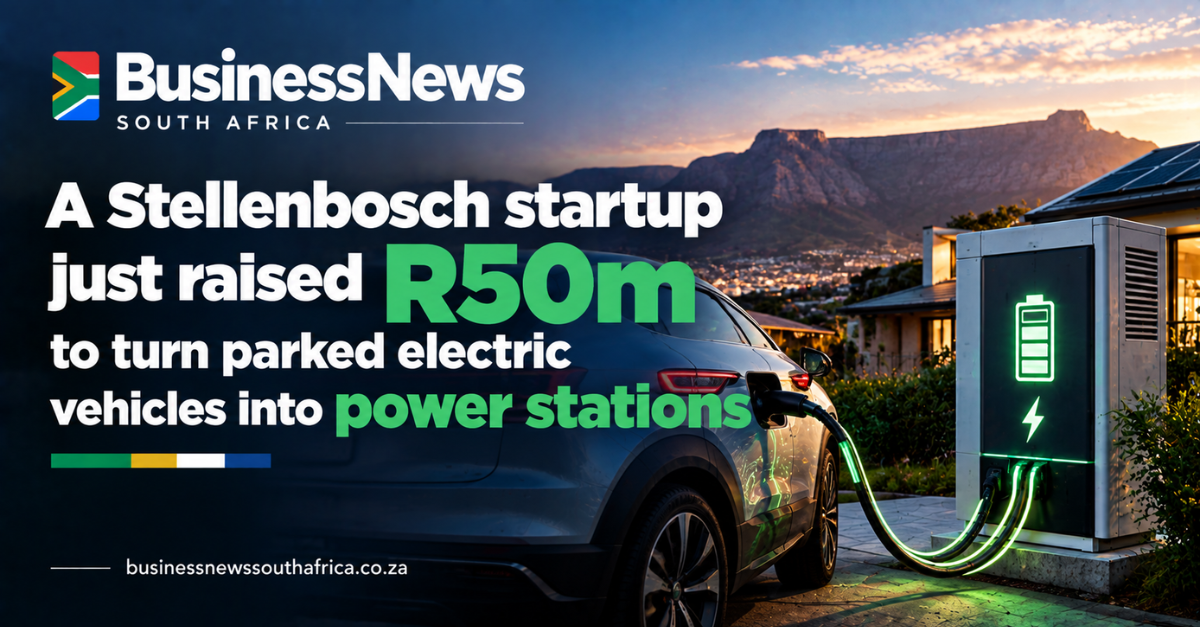
A Stellenbosch startup most South Africans have never heard of just secured one of the more interesting funding rounds in the country’s small but growing electric-vehicle sector: R50 million (roughly $2.6 million), led by the Development Bank of Southern Africa, with participation from Keyo Ventures and a group of angel investors. The company, Zimi, plans to use the money to deploy around 200 fleet charging stations and support the rollout of roughly 2,000 electric vehicles over the next 18 months.
What makes Zimi worth watching is not just the charging infrastructure, that part of the pitch is now familiar across several African EV startups, but a second technology it is piloting alongside it: vehicle-to-grid, or V2G, which allows a parked electric vehicle’s battery to discharge power back into a building, a business, or the national grid rather than only ever drawing power from it. Zimi combines electric vehicles, charging hardware, solar power systems and energy management software into one offering aimed specifically at commercial vehicle fleets, the delivery vans, shuttle services and logistics operators that run predictable routes and spend predictable hours parked.
Why the funding actually matters
This is not Zimi’s first outside capital. In 2025 the company secured a $320,000 grant from the Energy and Environment Partnership Africa Trust Fund, selected as one of just 32 projects funded out of more than 530 applications, specifically to test the vehicle-to-grid concept. The DBSA-led round is a step up in both size and seniority of backer: a development finance institution leading a round signals a different level of due diligence than an early-stage grant, and DBSA has separately continued backing Zimi’s fleet-charging network build-out.
For South African businesses running vehicle fleets, the pitch is straightforward on the charging side: fuel and maintenance costs for an electric delivery fleet are generally lower than for a diesel equivalent over the vehicle’s life, provided the charging infrastructure exists to keep vehicles running on schedule. That infrastructure gap, not vehicle cost alone, has been one of the practical blockers to fleet electrification in South Africa, since most commercial operators cannot rely on public charging networks built around private car owners’ habits.
The vehicle-to-grid pitch is the more interesting bet
Vehicle-to-grid technology matters more in a country with South Africa’s specific electricity problems than it would almost anywhere else. A fleet of electric vehicles sitting idle overnight, plugged in and charged, represents a genuine distributed battery asset, one that could, in principle, feed power back to a depot, a warehouse, or even the grid during a period of strain, then recharge again once demand eases. Whether that actually works reliably at scale, across South Africa’s specific grid infrastructure and regulatory framework for feeding power back into the network, is exactly what Zimi’s EEP Africa-funded pilot is meant to test.
It is worth being precise about what has and has not been proven. Zimi has real funding, a real fleet-charging rollout plan, and a real, funded pilot for vehicle-to-grid technology. It does not yet have a commercially proven, at-scale vehicle-to-grid product generating revenue, and the 200-station, 2,000-vehicle rollout target is a stated plan for the next 18 months, not a completed fact. Fleet operators and municipalities evaluating a partnership with Zimi should treat the V2G capability as a live pilot worth watching rather than an already-proven service to buy today.
What this means for other SA climate-tech founders
Zimi’s funding path, a small grant proving out a specific technical claim, followed by a larger development-finance-led round to scale the proven part of the business, is a template worth noting for other South African climate-tech and energy-tech founders navigating a funding environment where early-stage capital remains scarce. Africa-wide, early-stage startups received only a small fraction of total 2026 funding so far, with debt and later-stage rounds dominating; DBSA’s willingness to lead a round at Zimi’s stage is a data point that development finance institutions can and do step into gaps that pure venture capital has been reluctant to fill for hardware-and-infrastructure-heavy startups.
For a small business owner running a delivery fleet or considering the switch to electric vehicles, Zimi’s rollout is worth watching over the next 18 months as a real-world test of whether the infrastructure gap that has held back commercial EV adoption in South Africa can actually be closed by a locally funded, locally built operator, rather than waiting for the charging networks built for private car owners to eventually catch up to commercial fleet needs.
Source: WeeTracker