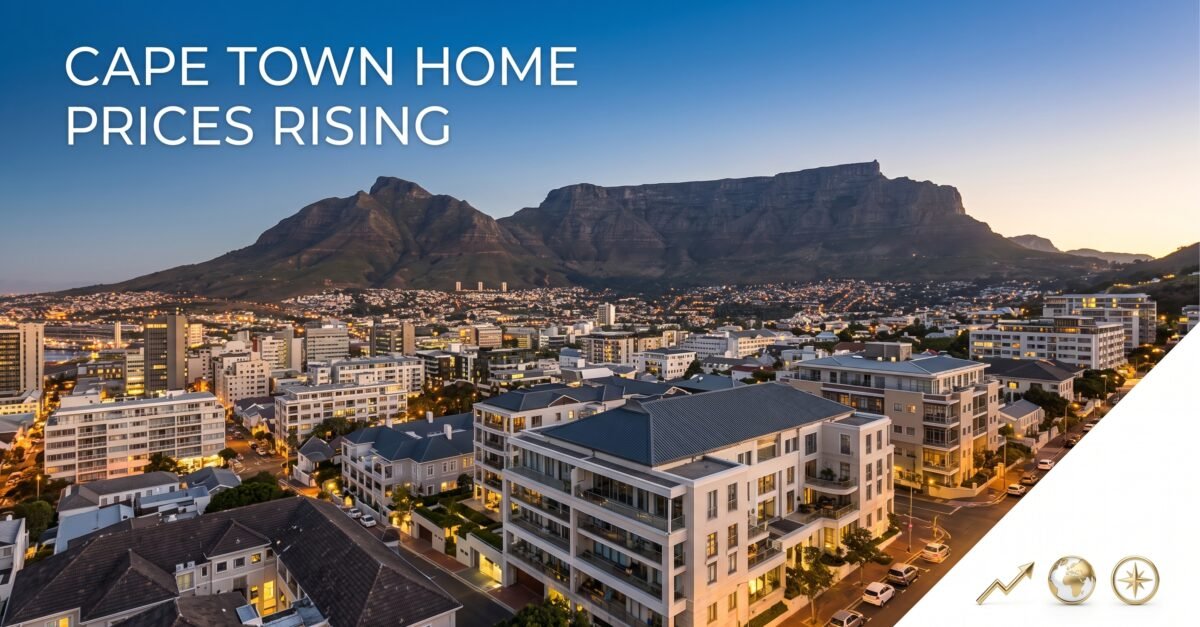
South Africans hoping to buy a home in Cape Town face a tougher market as foreign buyers and inland migrants increase demand, driving prices up faster than wages. Lightstone Property, a research firm that tracks property transactions, says about 6% of all South African home purchases are made by non-South African citizens, and that share climbs to roughly 39% for properties priced above R20 million. Under South African property law, foreign buyers face no restriction on acquiring title deeds, though financial transfers must comply with South African Reserve Bank exchange control regulations. Non-residents financing purchases through local commercial banks are typically limited to borrowing up to 50% of the purchase price, requiring the balance to be brought into the country as foreign currency cleared through authorised financial institutions.
In the city’s most expensive Atlantic Seaboard, the suburb of Sea Point recorded 1,118 sales to foreign nationals at an average price of R5.4 million. Nearby areas such as Bakoven and Camps Bay have close to half of their homes owned by non-South Africans. High-end property transactions in these coastal enclaves frequently involve cash buyers who are less sensitive to South African Reserve Bank interest rate decisions. While the Western Cape leads the country in foreign buyer numbers, Lightstone also notes significant activity in Gauteng, Limpopo and the north-coast of KwaZulu-Natal, including Zimbali, Ballito and Salt Rock.
The term “semigration” describes South Africans moving from inland provinces, especially Gauteng, to coastal cities like Cape Town in search of a different lifestyle and better services. BetterBond, a market analyst, highlighted in March 2026 that this trend concentrates on suburbs with strong municipal services and reputable schools, reinforcing Cape Town’s appeal. This ongoing domestic migration relocates personal capital and tax bases away from Gauteng, the nation’s commercial center. As affluent households relocate, demand shifts decisively toward secure residential estates and well-maintained municipal zones, driving up land values in those specific micro-markets.
Both foreign investment and semigration are adding pressure to an already constrained housing market. The city’s geography, bounded by the ocean on one side and mountains on the other, limits new development, meaning existing homes become scarcer and more valuable. Local planning frameworks and strict urban edge limits further prevent outward physical expansion, steering investment into redevelopment or high-density apartment blocks. In December 2025, property prices in the Western Cape rose 7.5% year-on-year, continuing a pattern of steady increases that outpaces broader economic growth indicators across South Africa.
For local buyers, the combined effect is a rising cost of entry. While existing homeowners may benefit from higher equity, many South Africans are warned they could be priced out of the market, especially in high-value suburbs. The situation is not solely driven by foreign buyers; semigration and limited land supply are equally important factors.
For South African SME owners and business professionals, these structural shifts create tangible economic impacts. Small business owners in Cape Town face escalating wage demands as employees seek higher earnings to offset rising rents and home loan repayments. Business leaders relocating operations from Gauteng must budget for elevated commercial and residential overheads. For working professionals, entering the housing market requires larger cash deposits and lower debt-to-income ratios to qualify for home loans, as property inflation outstrips annual salary adjustments in many corporate sectors.
What this means for prospective buyers
Potential home-buyers should consider a few practical steps: broaden the search to emerging suburbs with better affordability, explore financing options early to lock in interest rates, and monitor policy discussions around foreign ownership limits, which could affect future supply. Engaging bond originators early allows buyers to obtain pre-qualification certificates, establishing their exact borrowing capacity based on debt-service ratios before negotiating with sellers.
Overall, the data suggests that without additional housing supply or policy intervention, Cape Town’s property market will remain challenging for South Africans seeking affordable homes. Balancing international capital inflows with accessible local housing will remain a central point of discussion for property analysts, policymakers, and prospective homeowners across South Africa.