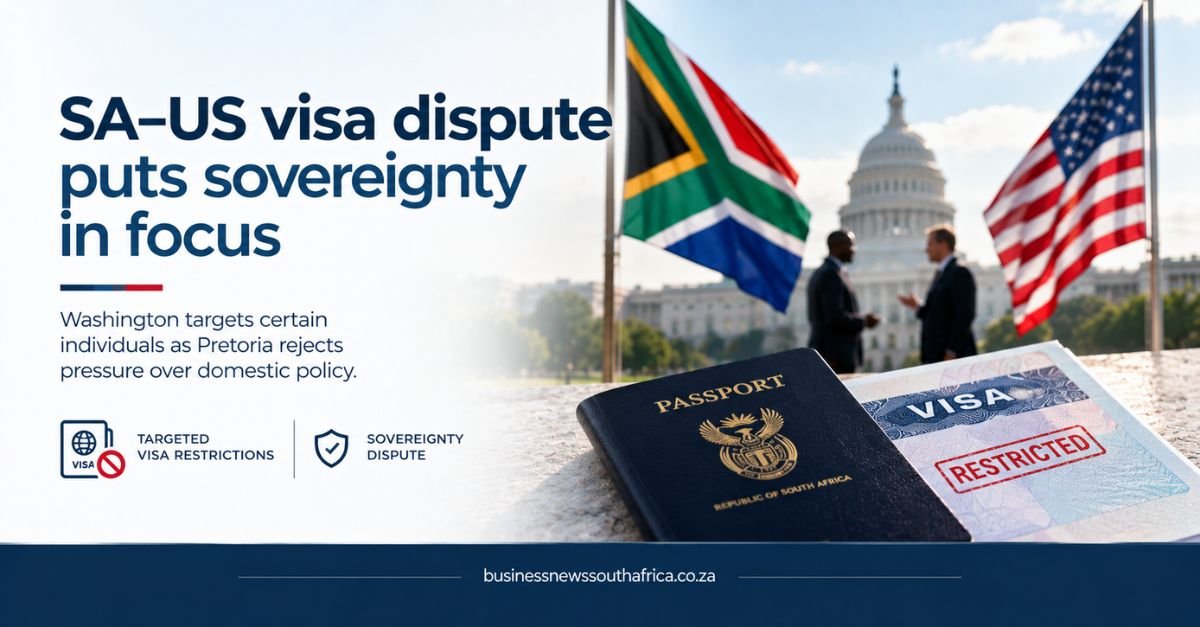
When a small textile exporter in Durban opened the morning briefing, the headline on the screen read: “US threatens visa bans on South Africans over policy disputes.” The news hit a sector that relies on frequent travel to the United States for trade shows, supplier meetings and diaspora sales. For many firms the ability to move staff across borders is not a luxury but a daily operational requirement, and any interruption can quickly turn into lost orders, delayed shipments and weakened customer relationships.
Minister of International Relations Ronald Lamola told the SABC that the South African public needs to prepare for the worst-case scenario because the United States is demanding that South Africa surrender its sovereignty over key policies. He said the demand centres on Black Economic Empowerment (BEE, a programme aimed at redressing historic economic inequality), land expropriation without compensation (the government’s plan to seize land without paying owners) and foreign-policy positions. Lamola framed the United States’ stance as an attempt to dictate South African law, a framing that resonates with a broader narrative of external interference in domestic reform agendas.
According to the source, US Secretary of State Marco Rubio announced visa restrictions that would bar certain individuals, and possibly their families, from entering the United States. The restrictions target people “responsible for, or complicit in, the enactment or implementation” of policies the US deems egregious, including uncompensated land seizures, race-based discrimination and incitement of violence against minority groups. The language of the announcement mirrors previous US statements that link entry eligibility to adherence to internationally recognised human-rights standards.
US Ambassador to South Africa Brent Bozell called the visa move “the first step” and warned that more severe consequences could follow. The minister responded that the United States is acting on misunderstandings and mischaracterisations of South Africa’s policies. This exchange illustrates the diplomatic choreography that often precedes formal sanctions, where public statements are used to signal resolve and to test the reaction of the targeted government.
South African Ambassador to the United States Roelf Meyer echoed Lamola’s concerns, saying the diplomatic channel has become fragmented and that misinformation about South Africa’s constitutional framework is spreading. He stressed that dialogue, not prescription, is the only path to a solution. The ambassador’s call for open communication reflects a standard diplomatic approach that seeks to keep negotiation tables open while each side clarifies its red lines.
For small and medium-size enterprises that depend on US markets, the threat of visa bans raises practical questions: can key staff travel for negotiations, can foreign investors obtain entry, and will the perception of risk deter US partners? While no sanctions have yet been imposed, the warning alone could affect confidence and delay deals. Companies that have already booked travel for upcoming exhibitions may need to re-book or cancel, incurring non-refundable costs and losing the chance to showcase new products to a critical audience.
Visa sanctions are not new in US foreign policy. They have been used against individuals in Russia, China and other countries to exert pressure without resorting to broader economic measures. The United States maintains a list of persons whose activities are deemed contrary to its foreign-policy objectives, and entry bans are applied through the Department of State’s visa-issuance system. The process typically involves a review by inter-agency committees that assess the relevance of each case to the stated policy goal.
South Africa’s trade with the United States totals roughly R30 billion a year, with significant exports of minerals, agricultural products and services. Any disruption to travel or business ties could ripple through supply chains that SMEs rely on. The value of that trade reflects not only direct sales but also the ancillary services that support export logistics, such as freight forwarding, customs brokerage and financial services. A slowdown in any of those supporting activities can have a multiplying effect on revenue streams.
Black Economic Empowerment, introduced after the end of apartheid, requires companies to meet ownership, management and procurement targets that favour historically disadvantaged South Africans. While BEE has opened opportunities for many black-owned enterprises, it also creates compliance costs for firms that must restructure ownership or adjust procurement practices. The United States’ criticism of BEE as race-based discrimination taps into a broader international debate about affirmative-action policies and their compatibility with trade agreements that promote non-discrimination.
Land expropriation without compensation is a cornerstone of the current government’s land-reform agenda. The policy is intended to address the legacy of unequal land distribution that dates back to colonial and apartheid eras. Critics argue that the lack of compensation could undermine property rights and deter investment, while supporters contend that it is a necessary step toward social justice. The US position that such measures constitute a violation of investor rights reflects a common tension between development goals and the expectations of foreign investors.
Foreign-policy positions mentioned in the US statement include South Africa’s stance on certain geopolitical issues that have drawn criticism from Washington. While the specific issues are not enumerated, the reference underscores how diplomatic disagreements can spill over into trade-related measures. For South African businesses, the lesson is that political alignment on global matters can indirectly affect market access, even when the core business activity is unrelated to foreign policy.
In practice, businesses can mitigate the risk of visa restrictions by diversifying their market exposure. Companies that rely heavily on a single destination may consider expanding into the European Union, the Middle East or emerging markets in Asia, where demand for South African commodities remains strong. Diversification does not eliminate the need for US engagement, but it reduces the vulnerability of cash flow to a single regulatory shock.
Another practical step is to strengthen internal compliance programmes. Firms should audit their senior leadership and board composition to ensure that any individuals who could be targeted by visa bans are aware of the potential consequences. Maintaining transparent records of policy decisions, especially those related to land and employment, can help demonstrate good-faith compliance with both domestic law and international expectations.
Companies should review travel plans, keep an eye on official announcements from the Department of International Relations and Cooperation (DIRCO) and the US State Department (State Department), and consider diversifying markets while the diplomatic row unfolds. Staying informed and maintaining open communication with US partners will be essential if the situation escalates. Regular updates from industry bodies and chambers of commerce can provide early warnings and collective advocacy channels.
Finally, the broader business community can play a role by engaging in public-policy dialogue. By articulating the practical impact of visa restrictions on jobs, tax revenue and economic growth, firms can help shape a more nuanced diplomatic response. Constructive engagement with both the South African government and foreign counterparts may open pathways for negotiated exemptions or phased implementation that limit disruption.
What businesses can do now
Companies should review travel plans, keep an eye on official announcements from the Department of International Relations and Cooperation (DIRCO) and the US State Department (State Department), and consider diversifying markets while the diplomatic row unfolds. Staying informed and maintaining open communication with US partners will be essential if the situation escalates.
Read more about how international tensions can affect local businesses in our Retail & Consumer coverage.