When a South African employee opens a medical aid statement and sees a contribution that is noticeably higher than last year, the first question is often “why?” The answer this year may lie in a new set of guidelines released by the Council for Medical Schemes (CMS) for 2027.
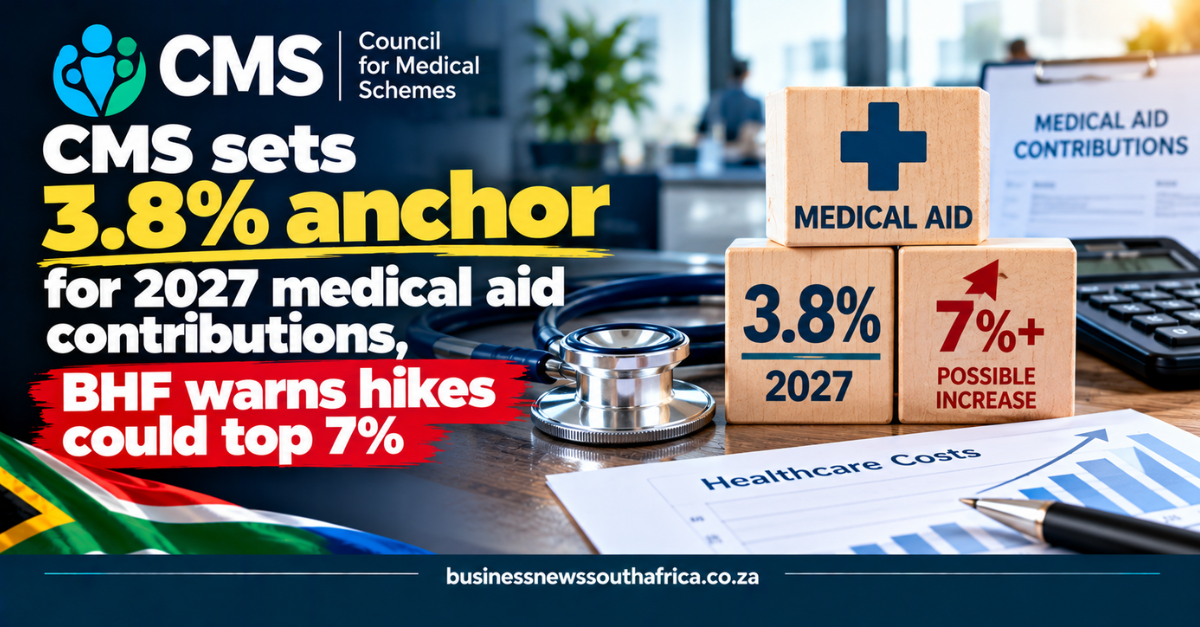
According to BusinessTech, the CMS has set a 3.8% “anchor”, a base point that schemes must use when they calculate any contribution increase. The anchor is tied to the consumer price index (CPI), which is the official measure of inflation. However, the guidance also mentions a “reasonable utilisation estimate” that is added on top of the anchor, but the CMS has not explained what counts as reasonable utilisation.
The Board of Healthcare Funders (BHF) points out that in previous years the reasonable utilisation component added roughly 3.5% to the hikes. Private medical inflation usually runs 2% to 3% above CPI. If the same pattern holds, the total increase for 2027 could fall somewhere between 5.8% and 7.3%. The BHF warns that the final figure could be higher, especially if schemes interpret the utilisation component more aggressively.
Why does this matter to a small business owner or an entrepreneur? Medical aid contributions are a significant part of employee remuneration packages. A 6% rise on a contribution of R1 500 per month adds R90 per employee each month, R1 080 per year. For a company with 50 staff, that is an extra R54 000 in payroll costs annually, a non-trivial amount for a tight budget.
Beyond the raw numbers, the BHF highlights a broader trend: total healthcare benefits paid by medical schemes jumped from roughly R218.4 billion in 2022 to R259.3 billion in 2024, an increase of almost 19% in two years. Meanwhile, the number of beneficiaries grew by just over 1% in 2023 and less than half a percent in 2024. In plain terms, the same pool of members is using more health services, which drives up costs that are ultimately passed on to contributors.
International data reinforce the pressure. The global advisory firm WTW projects medical cost growth of 10.3% worldwide for 2026, with the Middle East and Africa region expected to see an 11.3% rise. Those figures are well above the 3.0% CPI that the CMS used for its 2026 contribution benchmark.
What can employers do? The BHF argues that guidance alone will not curb contribution inflation. It calls for structural reforms, including collective tariff negotiations between medical schemes and healthcare providers. Such negotiations would give schemes, and by extension their members, more buying power, rather than remaining price takers. The need for a transparent tariff-negotiation framework was flagged in the Competition Commission‘s 2019 Health Market Inquiry, but meaningful reform has yet to materialise.
Other reform ideas include modernising Prescribed Minimum Benefits (PMBs) and allowing low-cost benefit options (LCBOs) that give members a cheaper, basic package. The CMS is reviewing the PMB framework with an eye toward turning it into a primary healthcare package, but progress on LCBOs has stalled.
For SMEs, the immediate takeaway is to prepare for higher contribution costs and to engage with the medical aid schemes that cover their staff. Asking the scheme for a detailed breakdown of the utilisation component, and exploring whether a low-cost benefit option is available, can help manage the impact. Employers should also factor the likely increase into their budgeting cycles now, rather than waiting for the final scheme proposals later in the year.
In a market where healthcare costs are rising faster than general inflation, the 3.8% anchor is a modest starting point. Without clearer rules on utilisation and without collective bargaining power, the final contribution hikes could strain payrolls across the private sector.
For more insight on how rising medical aid costs affect small businesses, see our Retail & Consumer coverage.