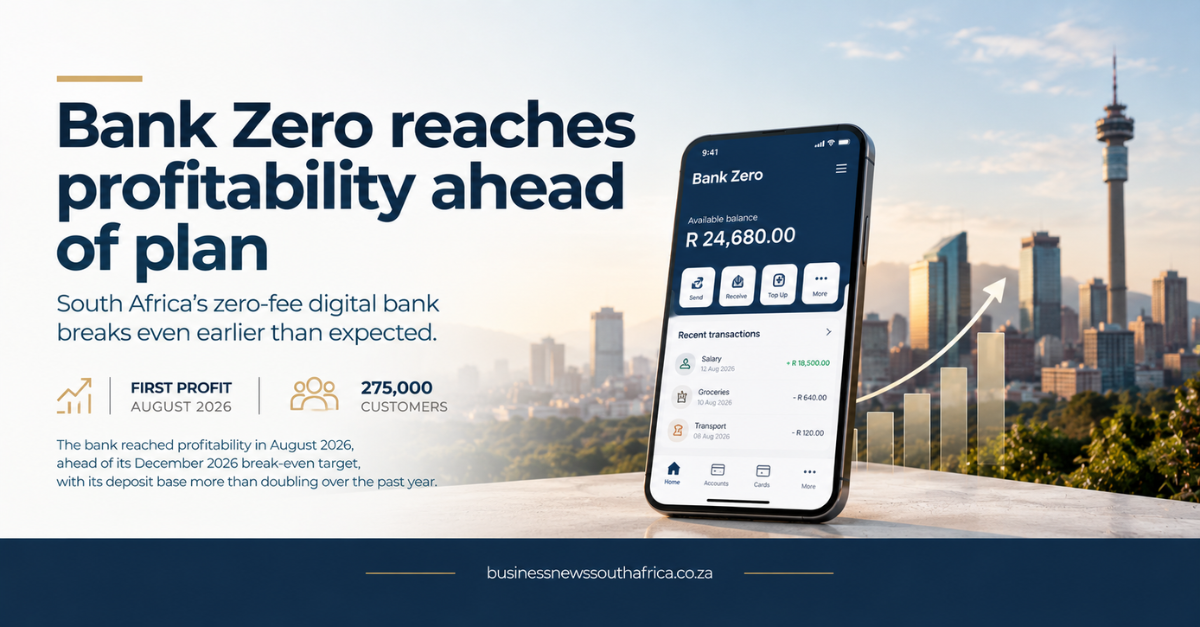
On a typical commuter train, a passenger scrolls through the Bank Zero app, noting that the balance bar is green and the monthly fee line reads “R0”. That quiet moment marks a milestone for the app-only bank: it has turned a profit for the first time since its public launch in 2021.
According to a statement from Bank Zero, the profit comes after the deposit base more than doubled in the past year and the customer count rose to 275 000. The bank also absorbed nearly half a million end customers from the remittance platform Mukuru, a partnership that more than doubled the number of users on its platform.
Bank Zero was founded in 2018 by former FNB executives Michael Jordaan and Yatin Narsai and entered the market in 2021 with a promise of a zero-fee personal account and lower transaction costs. The model relies on a digital-only infrastructure, no head office, no branches, and a lean staff, which allows the bank to keep operating costs low. In banking terms, a “zero-fee account” means the customer does not pay a monthly subscription charge, and “lower transaction costs” refer to reduced fees for things like transfers and card usage.
The bank’s business accounts now make up 18% of total accounts, surpassing the original assumption of 10% in its business case. More than 80% of those business accounts belong to registered companies, which typically hold higher balances and generate more transactions. This shift is significant for small and medium-size enterprises that need affordable banking services without the overhead of traditional banks.
Why the profit matters for SMEs
For an SME owner, the profit announcement signals that a low-cost banking alternative can be financially sustainable. Traditional banks often require large customer bases, sometimes over two million, to cover fixed costs. Bank Zero achieved break-even with roughly 100 000 customers, according to the company, because it outsources many functions to third-party fintechs, retailers and digital platforms through an “alliance banking” model. In this model, partners use Bank Zero’s back-end systems to issue their own branded cards, while the bank earns deposit and transaction fees without having to acquire each customer directly.
The alliance banking approach could open doors for small retailers or niche fintechs that want to offer banking services under their own brand without building a full banking licence. For a small retailer, partnering with Bank Zero could mean offering customers a branded debit card while paying only a share of transaction fees, rather than bearing the cost of a full banking operation.
Bank Zero’s profit also comes at a time when the South African Reserve Bank (SARB) is reviewing applications for new foreign-exchange and lending capabilities. The bank has applied for approval to expand into these areas, which could further broaden its service offering for SMEs that need affordable foreign-exchange solutions or short-term credit.
In April 2026, Bank Zero announced partnerships with several fintechs and retailers, a move the company says helped it reach break-even ahead of its original December 2026 projection. The partnerships are part of a broader trend in South Africa where digital platforms seek to embed banking services directly into their ecosystems, reducing friction for end users.
Bank Zero is also in the process of being acquired by Lesaka Technologies for R1.1 billion, a deal that awaits approval from the Prudential Authority and the Reserve Bank. The acquisition could provide additional capital to fund the bank’s planned expansion into lending, with an estimated R860 million to be sourced from its deposit book and Lesaka’s investment.
While the bank expects monthly earnings to fluctuate in the short term, it projects strong revenue growth in 2027, driven by alliance banking demand and the pending foreign-exchange licence. The company claims a “surprisingly high” return on equity, a measure of profitability that compares net income to shareholders’ equity.
For entrepreneurs watching the banking landscape, the key takeaway is that a digital-only, zero-fee model can reach profitability with a fraction of the customer base required by legacy banks. The success of Bank Zero may encourage other fintechs to explore similar low-cost, partnership-driven approaches, potentially increasing competition and driving down fees across the sector.
Read more about the impact of digital banking on small businesses in our Retail & Consumer coverage.