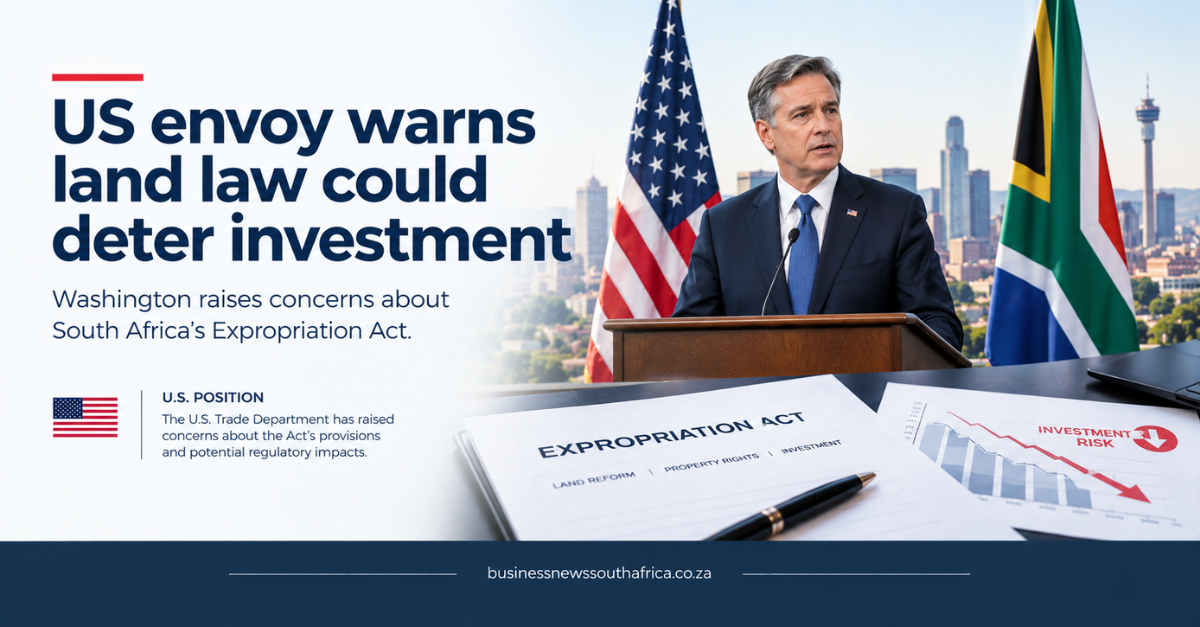
During a live interview on Talk Radio 702, United States Ambassador to South Africa Leo Brent Bozell warned that the country’s Expropriation Act is scaring off American companies and keeping billions of dollars of potential investment at bay. Bozell said the law, which allows the state to take property for “nil” compensation, creates a risk that investors could lose assets without any payment.
The Expropriation Act was signed into law in January 2025. It expands the government’s power to acquire property, not only land but also other assets, without requiring a market-value payout in certain circumstances. Section 25 of the South African Constitution, however, mandates that expropriation must be accompanied by “just and equitable compensation”. Opponents argue that the Act’s nil-compensation provision directly conflicts with that constitutional guarantee.
Bozell told the radio audience that US government agencies such as the Export-Import Bank (Export-Import Bank) and the International Development Finance Corporation (DFC) have earmarked billions of taxpayer dollars for projects in South Africa. Those funds, he said, are being held back until the legal uncertainty around the Act is resolved.
Why the issue matters to South African businesses
For retailers and other consumer-facing firms, foreign capital often underpins expansion plans, supply-chain upgrades and technology adoption. A slowdown in US investment could translate into fewer joint-venture opportunities, tighter credit conditions and delayed infrastructure projects that support retail growth. Small and medium-sized enterprises that rely on imported goods or foreign-owned distribution networks may feel the ripple effects most acutely.
South Africa has been seeking to attract foreign direct investment (FDI) to offset a sluggish domestic economy, high unemployment and recurring power cuts. According to the Reserve Bank, net FDI inflows fell by roughly 30% in 2025, a trend that analysts link to policy uncertainty and the lingering impact of load-shedding. Bozell’s comments suggest that the Expropriation Act could be a further drag on that recovery.
The ambassador also referenced a set of five requests that the United States allegedly presented to President Cyril Ramaphosa in June 2025, one of which calls for the removal of the nil-compensation clause. The source material attributes those requests to US President Donald Trump, who returned to office in January 2025 for a second, non-consecutive term.
Bozell concluded that South Africa is free to pursue its own policy choices, but if it wants to tap US public-funded capital, it must address the legal risk that the Expropriation Act creates. The next step, he said, will be a court ruling on the constitutionality of the nil-compensation provision. Until then, the United States is unlikely to release the billions of dollars it has set aside for South African projects.
For South African entrepreneurs looking to navigate the current investment climate, the Commercial Funding Suite tool can help map out alternative financing options while the legal debate unfolds.
Read more about the impact of policy on investment in our Retail & Consumer coverage.
What businesses should actually watch for next
The pending court ruling on the nil-compensation provision’s constitutionality is the concrete event to track, not further ambassadorial commentary, since Bozell’s remarks describe a policy position rather than an enforceable outcome. Businesses in sectors that depend on Export-Import Bank or DFC-backed financing, infrastructure, energy and select manufacturing projects among them, should treat any pending applications through those channels as subject to delay until that legal question resolves one way or the other, rather than assuming funding already earmarked will necessarily arrive on its original timeline.
Ramaphosa’s office has not publicly responded to Bozell’s characterisation of the June 2025 requests, and South Africa’s own position remains that expropriation without compensation applies only in narrowly defined circumstances, not as a general policy.