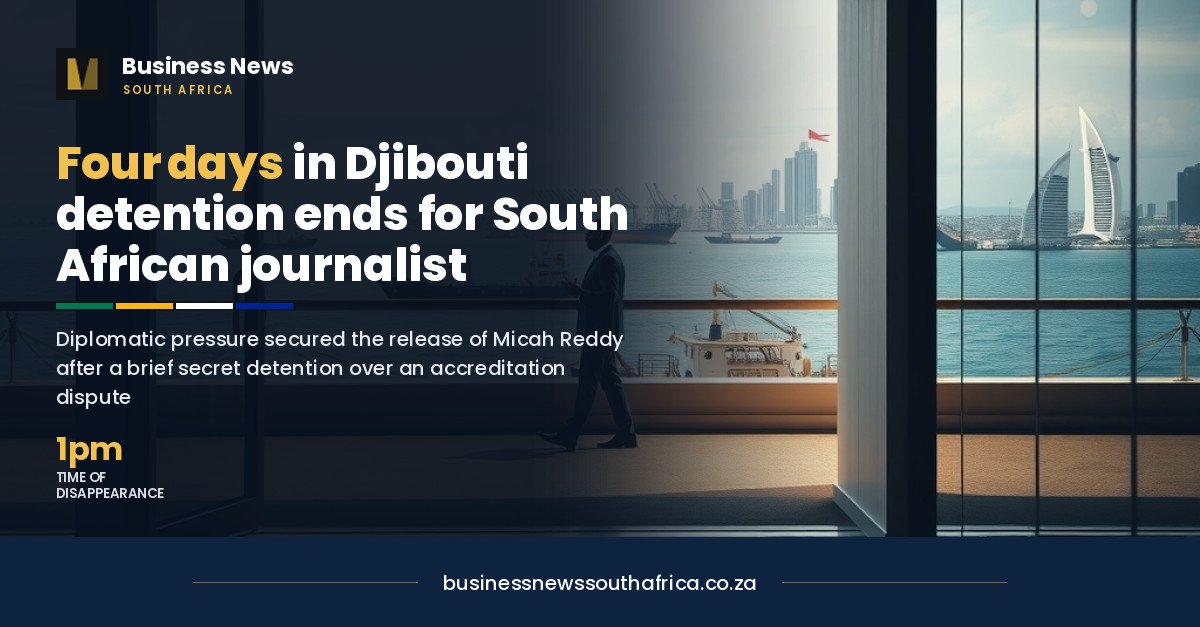
South African investigative journalist Micah Reddy has been released after four days in custody in Djibouti, where authorities held him over what they say was a failure to obtain media accreditation. Reddy, the Africa coordinator at the International Consortium of Investigative Journalists (ICIJ), went missing on Saturday 19 September and was freed on Tuesday 22 September.
Reddy and his local assistant, Mohamed Willo Ismael, known as Kooki Mahmoud, disappeared from the Escale International Hotel in Djibouti City at about 1pm on the Saturday. For most of the following four days neither man’s family, employer nor government was given any official word on where they were or why they were being held. Mahmoud has also been released, without charge.
What Djibouti says, and what the family says
The two accounts of why Reddy was detained do not line up. Djibouti’s Interior Minister, Omar Abdi, said Reddy had deliberately avoided obtaining the necessary accreditation, and a presidential official, Naguib Ali Taher, said he had not registered for media accreditation, the Sowetan reported. The Committee to Protect Journalists said he was deported once released.
His family’s position is that the accreditation question should never have arisen. “At the time he was detained, he was not in Djibouti reporting on the country or its government,” they said, confirming that both men were unharmed. “The past few days of uncertainty and waiting have been interminable and devastating.”
The family thanked the South African, British and US governments, along with diplomatic missions and multilateral bodies, for the work done to locate the men and secure their release. ICIJ has credited all three governments with diplomatic assistance.
Press freedom groups want answers
Relief at the release came with pointed criticism of how it happened. “Four days in secretive intelligence custody is unacceptable treatment of an investigative journalist,” said Angela Quintal of the Committee to Protect Journalists. CPJ welcomed what it called the overdue release, but said serious questions remained about the detention and about Djibouti’s opaque accreditation process.
ICIJ director Gerard Ryle framed the outcome as a product of pressure. “The many calls for press freedom and for the men’s swift release are an example of the solidarity that matters when a journalist’s safety is at risk,” he said.
That criticism lands in a country with a long record of tight control over the media. Djibouti has been led by President Ismail Omar Guelleh since 1999, independent domestic media is very limited, and the country is routinely ranked among the worst in the world by press freedom monitors. An accreditation rule that is loosely defined and enforced through detention without explanation leaves any foreign visitor who might be taken for a journalist exposed.
Why Djibouti matters far beyond one case
Djibouti is small, but it is not a backwater. It sits on the Bab el Mandeb strait at the southern entrance to the Red Sea, one of the busiest shipping chokepoints in the world, on the route between the Suez Canal and the Indian Ocean. It hosts military bases for the United States, China, France, Japan and Italy, and its port is landlocked Ethiopia’s main gateway to the sea, which puts it at the centre of Horn of Africa trade and logistics.
That makes it a place South African business people, consultants, logistics specialists and researchers pass through for reasons that have nothing to do with journalism. The Reddy case is a reminder that in some jurisdictions the line between working and reporting is drawn by the authorities after the fact, and that asking questions, taking notes or carrying recording equipment can be enough to be treated as unaccredited media.
What it means for South Africans working abroad
The practical lesson for employers is to check, before travel, whether any part of an assignment could fall under a host country’s media, research or data-gathering rules, and to get written confirmation where there is any doubt. Staff should also register their travel with the Department of International Relations and Cooperation, carry the details of the nearest South African mission, and make sure someone at home knows their itinerary and when to raise the alarm.
Reddy’s case moved as quickly as it did partly because a well-connected international organisation, three governments and several press freedom bodies were pressing for answers within days. A South African contractor or small-business owner held in similar circumstances would likely have far less support behind them, which is exactly why the preparation matters.
The immediate danger has passed, but the questions CPJ raised about Djibouti’s accreditation process remain unanswered. For more on how policy and regulation shape the environment South African professionals work in, see our Regulatory & Policy coverage. Background reporting is also available from Daily Maverick.