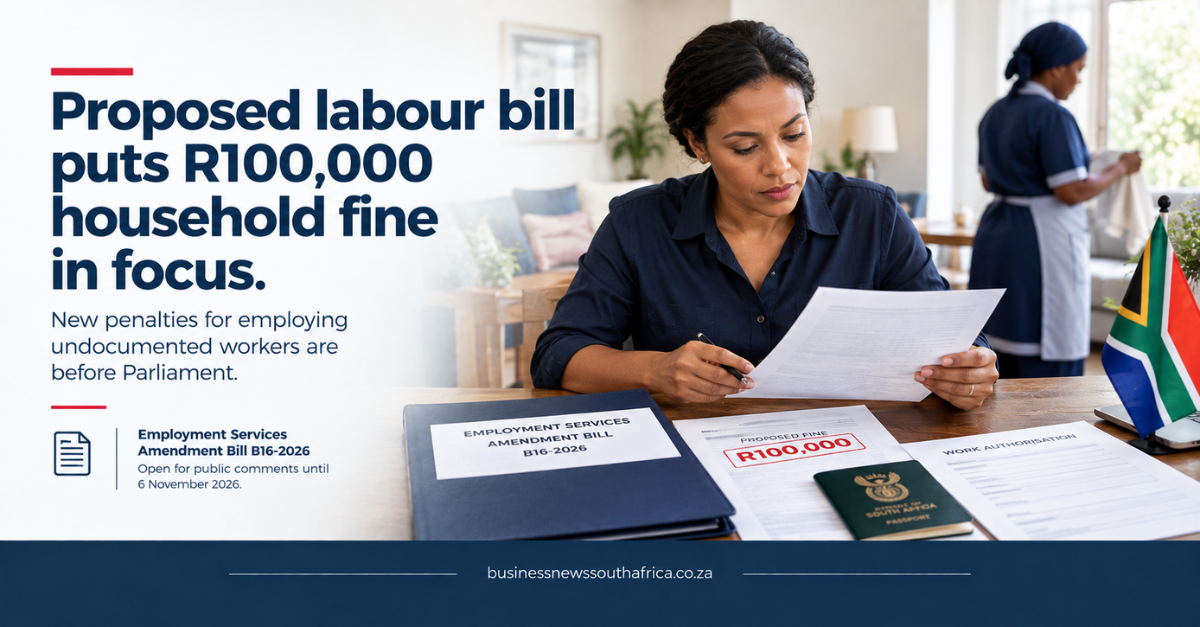
Imagine a middle-class suburb where a family is about to sign a contract with a domestic worker from Mozambique. Under the draft Employment Services Amendment Bill, that same family could be staring at a R100,000 fine for the first offence, a cost that would make most homeowners think twice.
The Portfolio Committee on Employment and Labour has opened the bill for public comment. According to the committee, the legislation would apply to all employers, including private households, and would impose a R100,000 fine per undocumented worker for a first offence, R200,000 for a second offence within three years, and up to R1 million or jail time for repeated breaches.
Employing undocumented foreign nationals is already a criminal offence under Section 38 of the Immigration Act, which can lead to imprisonment. The new bill does not create a new crime; it adds a steep financial penalty to deter “unscrupulous” employers and to level the playing field for those who follow the rules.
The Department of Employment and Labour stresses that the aim is not to punish migrant workers but to protect them from exploitation. Under the proposed framework, foreign domestic workers must hold a valid passport and the appropriate visa or permit authorising work in South Africa. Labour inspectors and bargaining council agents would gain greater powers to monitor compliance, even inside private homes, and could pursue claims on behalf of workers whose rights have been breached.
Why the domestic work sector matters to South African businesses
Domestic work is one of the largest informal employment segments in the country. It provides essential support to households that enable dual-income earners to participate fully in the formal economy. When the sector operates within the law, it creates a reliable pipeline of labour, reduces turnover, and limits the risk of disputes that can spill over into the workplace. For small business owners who also employ domestic staff, the same principles of compliance apply. A breach in a private home can quickly become a reputational issue for a business if it is linked to broader labour practices.
Beyond the immediate financial penalties, non-compliance can trigger investigations that disrupt daily operations. Labour inspectors have the authority to request documentation, interview workers, and, if necessary, issue improvement notices. Repeated findings can lead to higher scrutiny across all of an employer’s ventures, including any registered companies. This ripple effect makes it prudent for entrepreneurs to treat household employment with the same diligence as any other staff appointment.
How the current immigration framework works
Section 38 of the Immigration Act defines the unlawful employment of a foreign national who does not possess a valid work permit. The law requires that any employer, whether a corporation or a private household, verify the status of a prospective employee before the contract is signed. The verification process typically involves checking the passport, the visa label, and any supporting work-authorisation documents. Failure to do so can result in criminal prosecution, which may include a custodial sentence.
In practice, many households rely on informal networks to source domestic workers. These networks sometimes bypass official channels, leading to situations where workers arrive without the correct documentation. The draft amendment seeks to close that gap by attaching a monetary deterrent that is proportionate to the scale of the offence. By targeting the employer rather than the worker, the bill aligns with international best practice that places responsibility on the hiring party.
Enforcement mechanisms and the role of labour inspectors
Labour inspectors are already tasked with monitoring compliance in sectors such as manufacturing, retail, and services. The amendment expands their remit to include private residences, a move that reflects the growing recognition of domestic work as a formalised employment relationship. Inspectors will be able to enter a home with the consent of the employer or, in certain circumstances, with a warrant issued by a magistrate. Their duties will include checking that work contracts are in writing, that pay records are kept, and that the worker’s visa is current.
When an inspector identifies a breach, the first step is usually an advisory notice that gives the employer a chance to rectify the situation. If the employer fails to act, the financial penalties outlined in the bill are applied. The legislation also allows for the recovery of back-pay and other entitlements that may have been withheld from the worker. In extreme cases, the matter can be referred to the courts, where the higher fines and possible imprisonment come into play.
Practical steps for compliance
For households and businesses alike, the safest approach is to adopt a structured recruitment and onboarding process. This begins with requesting a copy of the worker’s passport and any relevant visa documentation. The employer should then confirm the validity of the visa with the Department of Home Affairs, either online or at a local office. Keeping a digital copy of the documents, along with a signed employment contract that outlines duties, hours, remuneration, and leave, creates a clear audit trail.
Record-keeping does not stop at the contract. Employers should maintain a payroll register that shows the amount paid each month, the date of payment, and the method used. If the worker is paid in cash, a receipt signed by both parties is essential. In addition, employers should provide the worker with a copy of the South African labour standards that apply to domestic employees, such as the right to a minimum wage, paid leave, and protection against unfair dismissal.
Technology can simplify these tasks. Our free HR & Labour Relations Document Generator can produce a template employment contract as a starting point, though it does not replace checking a worker’s visa status with the Department of Home Affairs. There are also payroll software solutions that automatically calculate statutory contributions and generate payslips. By integrating these tools, employers reduce the risk of accidental non-compliance and demonstrate good faith in the eyes of inspectors.
Impact on the broader economy
When the domestic work sector operates within the legal framework, it contributes to tax revenues, social security contributions, and the overall stability of the labour market. Formalisation also encourages workers to report abuse, knowing that they have legal protection. This, in turn, reduces the prevalence of exploitative practices that can tarnish South Africa’s reputation as a destination for skilled migrants.
Conversely, heavy fines that are perceived as punitive may discourage households from hiring foreign domestic workers altogether. This could lead to a shortage of affordable childcare and elder-care services, putting additional pressure on formal care providers and increasing costs for working families. The balance between deterrence and practicality is therefore a key consideration for policymakers.
How to participate in the public comment process
Stakeholders can submit written representations to the committee until 6 November 2026 at 16h00. Submissions should be addressed to Mr Zolani Sakasa, the committee’s point of contact, via the email address provided in the notice. Those who wish to present verbally at the upcoming parliamentary hearings may also indicate that preference in their written comments. The public comment period is an opportunity for households, employers, labour unions, and civil-society organisations to voice concerns, suggest amendments, or endorse the proposed measures.
When drafting a submission, it is helpful to focus on three core themes: the feasibility of the proposed fines for ordinary households, the adequacy of the verification process for work permits, and the support mechanisms that could be offered to employers to ensure compliance without undue hardship. Providing concrete examples of how the current system operates in practice can strengthen the argument and help legislators understand the real-world implications.
Conclusion
The draft Employment Services Amendment Bill represents a significant shift in how South Africa regulates the employment of foreign domestic workers. By attaching substantial financial penalties to the act of hiring undocumented staff, the legislation seeks to protect vulnerable workers, promote fair competition, and reinforce the rule of law. For business owners who also employ domestic staff, the message is clear: compliance is no longer optional. Implementing robust recruitment checks, maintaining accurate records, and staying informed about the bill’s progress are essential steps to avoid costly penalties and to contribute to a more equitable labour market.
Read the full notice and submit comments here: BusinessTech. For more coverage of labour law changes, visit our Regulatory & Policy section.