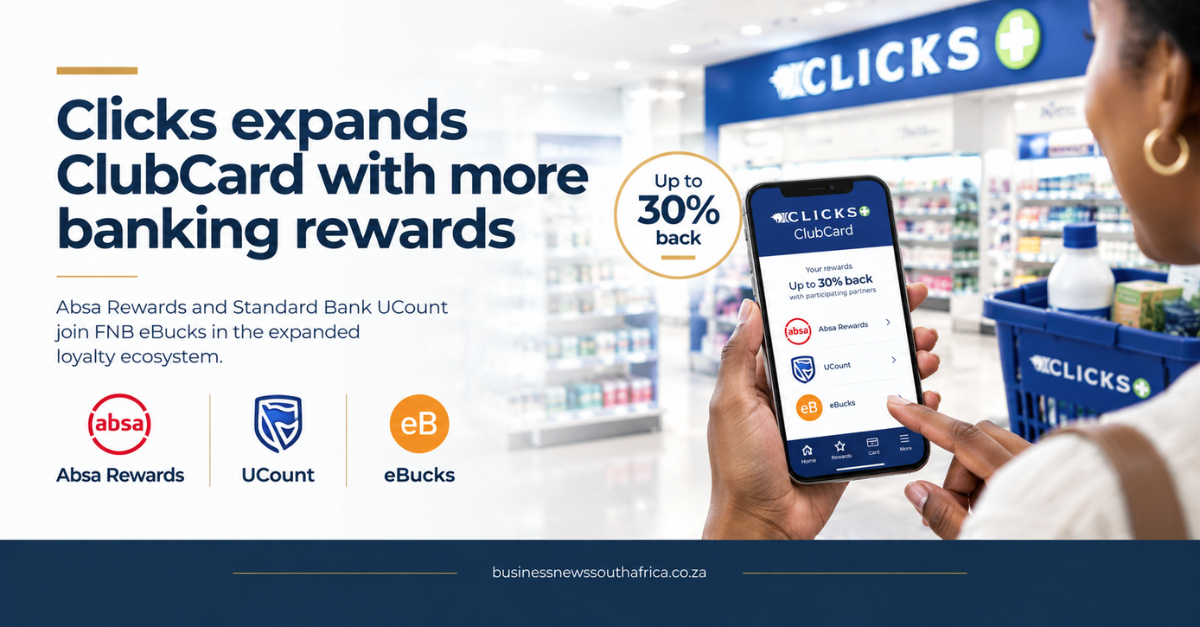
At a Clicks store in Sandton, a shopper swiped her receipt and watched three different reward logos appear on the screen, ClubCard, Absa Rewards and Standard Bank UCount Rewards, a visual reminder that the retailer is now linking its loyalty programme to two major banks.
Clicks announced the expansion in a press release on Bizcommunity. The move adds Absa Rewards and Standard Bank UCount Rewards to the existing partnership with FNB eBucks, creating a broader loyalty ecosystem that gives eligible customers more ways to earn rewards when shopping at the retailer.
ClubCard, Clicks’ long-standing loyalty programme, already offers an immediate 10% discount on more than 2,500 selected products and a 2% cashback on qualifying purchases. Members also enjoy 4% cashback on Baby Club items and on Seniors Club purchases made on Wednesdays. Over the past three decades the programme has paid out R7.5 bn in rewards, including R855 m in cashback during 2025.
Under the new arrangement, FNB eBucks customers can earn up to 50% back in eBucks on selected products. Absa Rewards and Standard Bank UCount Rewards members can earn up to 30% back on their full basket when they shop at Clicks. The retailer says the partnerships expand the reach and frequency of its loyalty proposition without relying solely on ClubCard’s own rewards mechanism.
Clicks also launched a gamified engagement platform for ClubCard members. Shoppers can collect virtual coins by completing activities such as product reviews or social media challenges and then redeem those coins for lifestyle vouchers. More than R10 m worth of vouchers are available through the platform, adding an interaction layer beyond traditional points, discounts and cashback.
The expansion reflects a broader shift in retail loyalty, where programmes aim to keep customers engaged between purchases rather than merely rewarding transactions. For Clicks, the strategy is to use its loyalty platform as a bridge between retail and financial services, giving banking partners another channel to reach their rewards customers.
According to Clicks Group Executive: Retail Bongiwe Ntuli, the goal is to “redefine how loyalty works by connecting value across everyday shopping, banking and lifestyle experiences”. While the company claims the new model will give members more choice and meaningful value, the actual impact on sales and customer retention remains to be seen.
For small retailers watching the development, the key takeaway is that integrated loyalty ecosystems are becoming a competitive differentiator. Replicating a similar model would require partnerships with financial institutions and a technology platform capable of handling multi-source rewards.
Read more about loyalty trends in the Retail & Consumer section.
In South Africa, loyalty collaborations that involve banks are typically governed by the Financial Advisory and Intermediary Services Act and the Protection of Personal Information Act. A retailer must sign a memorandum of understanding with each bank that sets out data-sharing protocols, revenue-share percentages and the duration of the partnership. The agreement also requires the retailer to obtain explicit consent from members before linking their purchase history to a bank’s rewards engine. Compliance officers review these contracts to ensure that any cross-border data flows meet the regulator’s standards, and the Competition Commission may assess whether the arrangement limits market entry for smaller players.
For a business owner, a multi-bank loyalty model can spread acquisition costs across several financial partners, reducing the need for a large in-house rewards budget. The retailer gains access to the banks’ customer databases, which can be used to tailor promotions and improve inventory planning. At the same time, the banks benefit from increased transaction volume and the ability to upsell their own financial products. This shared-value approach often results in a lower marginal cost per reward point, allowing the retailer to maintain attractive discount rates without eroding profit margins.
The retail sector in South Africa has seen a gradual move toward these integrated ecosystems over the past five years. Large chains such as Pick n Pay and Woolworths have already piloted similar programmes with major banks, offering points that can be redeemed for both store credit and banking services. These pilots have demonstrated higher basket sizes and longer repeat-visit cycles, prompting mid-size operators to explore comparable arrangements. Industry analysts note that the trend is driven by consumer expectations for seamless experiences that blend shopping with everyday financial management.
Looking ahead, businesses should monitor potential amendments to the National Credit Act that could affect how banks reward credit-card usage within retail environments. The Department of Trade, Industry and Competition is also reviewing guidelines on the use of artificial intelligence in loyalty analytics, which may impose new transparency obligations. Additionally, any changes to the fees that banks can charge for reward-point conversions could alter the economics of these partnerships. Keeping abreast of these regulatory signals will help retailers adjust contract terms before they impact the bottom line.
Small retailers interested in replicating a multi-bank loyalty framework should start by mapping their existing customer data flows and identifying gaps in consent management. Engaging a fintech provider that specialises in API integration can accelerate the technical rollout, while a legal counsel familiar with banking partnerships can draft the necessary agreements. Piloting the model with a single bank before scaling to additional partners allows the retailer to test operational capacity and measure incremental sales lift. Regularly reviewing performance metrics such as redemption rates and average transaction value will inform whether the programme delivers the expected return on investment.