Zweli Nyathi has a line he reaches for when people ask why Johannesburg’s roads are falling apart: “There is not a road in this city that was meant to carry a 36-wheeler truck.” As the chief executive of the Johannesburg Roads Agency, he is the man who has to keep 13,500km of that network usable anyway, on a capital budget that covers barely six cents of every rand the job actually needs.
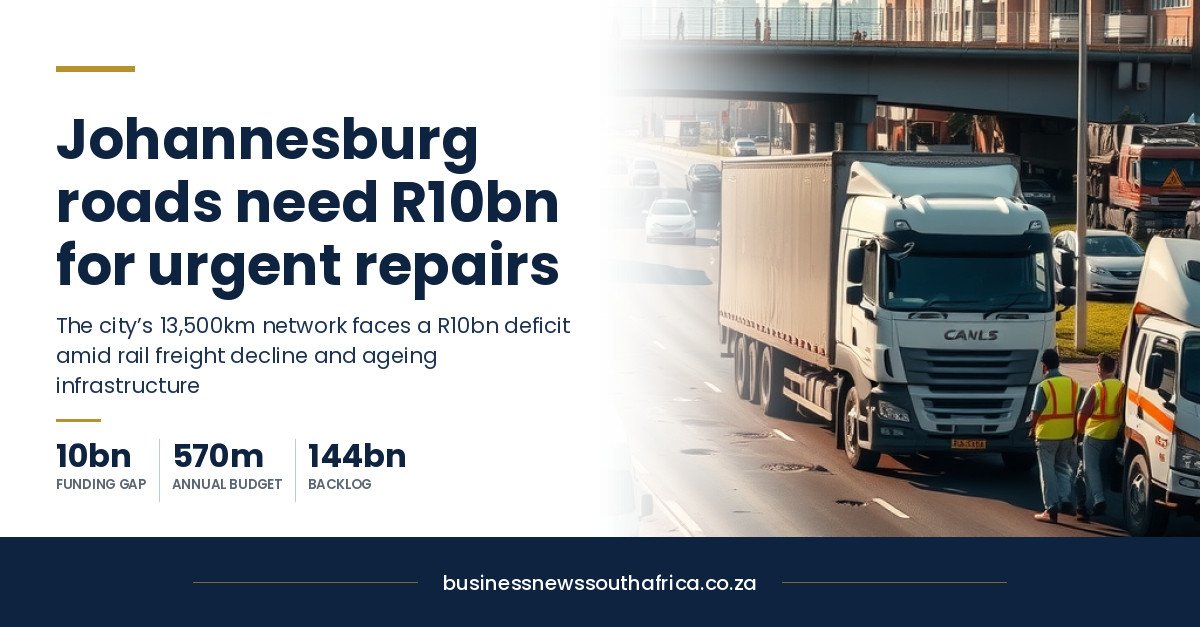
Speaking at a roads infrastructure dialogue this week, Nyathi put a number on the gap that Joburg motorists, freight operators and delivery-dependent businesses already feel in their suspension bills: the JRA needs R10 billion, urgently, to resurface roads and repair bridges across a network he describes as 25 to 50 years old. This year’s capital expenditure budget for that work is R570 million, against a citywide infrastructure backlog Johannesburg itself puts at R144 billion.
“Johannesburg’s infrastructure is old, between 25 and 50 years. Our engineers are doing their best to catch up,” Nyathi said. If the R10 billion materialises, the plan is to resurface 100 roads, repair between 15 and 20 bridges, and rehabilitate stormwater systems that have been quietly failing alongside the tar above them.
Why a roads agency’s funding request is a freight story
The backlog is not simply decades of deferred maintenance catching up with the city, though that is most of it. Nyathi pointed to a more recent pressure: as rail freight volumes have declined since the COVID-era collapse in Transnet’s rail performance, cargo that used to move by train has shifted onto trucks, and onto roads that were never engineered for that load. “There is not a road in this city that was meant to carry a 36-wheeler truck,” as he put it, is not a complaint about heavy vehicles existing. It is an admission that the network’s design assumptions stopped matching reality years ago.
That connects Johannesburg’s roads directly to the freight rail funding fight playing out at the same time: Transnet’s own rail infrastructure arm has separately asked Treasury for R26bn to rehabilitate a network that has been carrying steadily less freight since 2017/18. Every tonne that a struggling rail system fails to move is a tonne some truck, on some municipal road, ends up carrying instead. A logistics business budgeting for vehicle maintenance, tyre replacement and delivery delays in Gauteng is paying, in a roundabout way, for gaps in two different pieces of national and municipal infrastructure at once.
What the JRA has already delivered, and what it has not
The agency is not asking for money on the strength of a plan alone. Precious Nduli, chief operating officer at Discovery Insure, told the same dialogue that the insurer’s Pothole Patrol initiative has fixed more than 365,000 potholes since 2021, working alongside metros including Johannesburg. Her figures were a reminder of what road failure actually costs: “The cost of road accidents is 3% of GDP, roads are critical infrastructure, and it drives the economy,” she said, noting that South Africa has one of the highest road fatality rates in the world, at 22 deaths per 100,000 people.
Lunga Jacobs, a University of Johannesburg lecturer who also spoke at the dialogue, put the harder question on the table: money alone will not fix a governance problem. He called for expert appointments and real accountability in how municipal transport infrastructure is run, arguing plainly that “people have to be held accountable.”
Nyathi did not dispute that framing. Asked to defend the agency’s own performance against a R570 million budget that covers a fraction of what is needed, his answer was less an excuse than a challenge back to whoever controls the purse: “We need to be judged on what we are given and what we are supposed to produce.” He also called ringfenced municipal budgeting for infrastructure “long overdue,” a pointed line for a city where capital allocated to roads has, in the past, been reprioritised toward other pressures mid-year.
What it means for businesses that depend on Johannesburg’s roads
Where the R10 billion would actually come from was not addressed in the reporting on this week’s dialogue, an open question rather than a funding plan already in motion. Until there is a ringfenced allocation or a firm commitment from National Treasury, businesses that route deliveries, staff and stock through Johannesburg should plan around the current reality rather than a repair programme that has not been funded yet: an ageing network, R570 million a year to maintain 13,500km of it, and freight volumes still shifting from rail onto road.
For SME owners running delivery fleets, service vehicles or anything that depends on predictable travel times across the city, that translates into concrete decisions worth revisiting now: building longer buffers into delivery schedules on known trouble routes, budgeting vehicle maintenance costs at levels that assume continued road deterioration rather than improvement, and treating any future JRA funding announcement as a signal to watch rather than one to bank on.