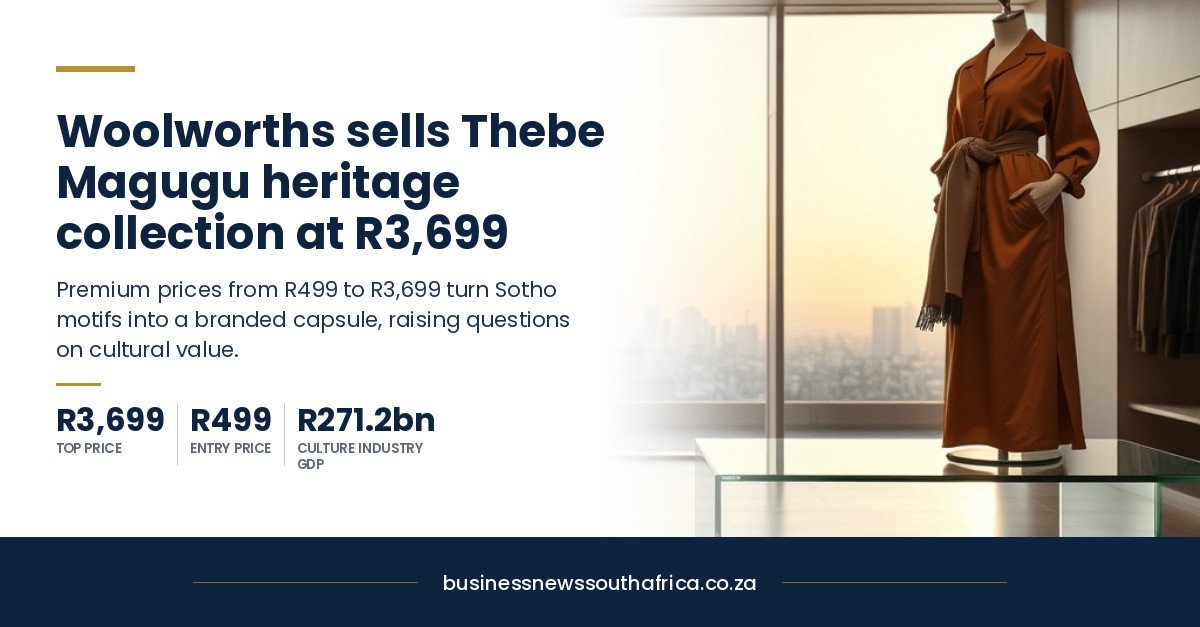
A scarf costs R499 at Woolworths this month. Nothing unusual there, until the pattern on it is traced back to Sotho weaving traditions and a designer’s name attached to the collection is one that shows up on international runway credits rather than a factory tag. Woolworths and Thebe Magugu, the Johannesburg-based designer behind the label that carries his name, have turned a heritage aesthetic into a priced, barcoded retail product, and the prices themselves tell most of the story about where this collection is trying to sit in the market.
The capsule, called Lineage, began rolling out on 10 September in three separate drops, available in selected stores and online. A belted sunset shirt dress runs to R3,699. A printed satin shirt is R1,499, wide leg pants R1,699, the R499 scarf sits at the entry end, and the range extends as far as a signature fragrance carrying the collection’s name. None of those are impulse-aisle prices. They are premium fashion prices, deliberately, on a collection whose entire value proposition rests on a named designer and a cultural story rather than on fabric cost.
Not Woolworths’ first bet on Magugu
This is not a cold introduction. Woolworths has backed Thebe Magugu before through StyleBySA, its incubator platform for South African fashion talent, and Lineage reads as the natural next step in that relationship: from incubated designer to a full capsule collection carrying his name inside a listed retailer’s stores. For Woolworths, it is a way to sell premium fashion with a story a mass-market private label cannot tell. For Magugu, a designer whose reputation was built on international runway credibility, it is distribution at a scale an independent label struggles to reach on its own.
That exchange, credibility for distribution, is the actual transaction underneath the collection, and it is a familiar one in South African retail this Heritage Month. Takealot swapped its own logo for South Africa’s twelve official languages for Heritage Month, a branding move that cost the company nothing but attention. Woolworths’ move costs considerably more: design fees, production runs, marketing, and shelf space for a collection priced to be aspirational rather than everyday, a real financial bet on heritage as a saleable identity rather than a seasonal logo swap.
The bigger number behind the trend
Woolworths and Magugu are not creating a market so much as claiming a share of one that already exists. South Africa’s cultural, creative and sporting industries contributed R271.2 billion to GDP in 2023, roughly 3.9% of the economy, and supported an estimated 1.4 million jobs, figures that make clear heritage-linked commerce is not a niche seasonal gesture but a real and sizeable part of how value moves through the economy. A single capsule collection at one retailer is a small slice of that number, but it is evidence of where large, listed companies now see genuine commercial upside in heritage as a category, not just a September marketing theme.
The question a price tag cannot answer
What a collection like Lineage cannot settle on its own is who actually benefits when a cultural aesthetic becomes a retail product. It is a live tension elsewhere in the same heritage economy: Aranda Textile Mills holds trademark rights over its own version of the Basotho blanket design, and smaller artisan groups working in traditional beadwork have raised the same question about who captures the value once a motif with cultural origins becomes a commercial pattern. Magugu is a named, credited, commercially successful South African designer working under his own name, a materially different arrangement from an unattributed pattern lifted for a mass-produced print, and nothing found in reporting on this collection suggests otherwise. But the broader industry question Lineage sits inside, whether heritage-inspired retail mostly rewards the communities a design traces back to or mostly rewards the brand and designer attached to the final product, remains open, and worth asking of every retailer running a heritage collection this month, not just this one.
For now, the more immediate business fact is simpler: a major listed retailer has decided a named South African designer’s take on heritage is worth premium shelf space and a R3,699 price tag, and is betting that enough shoppers agree.