In August, Airtel Africa began selling Starlink’s satellite connection directly to ordinary LTE phones in the Democratic Republic of Congo. Ten days later, Paratus started offering satellite broadband to enterprise customers in Uganda. In South Africa, the continent’s most advanced economy, Starlink still cannot legally sell a single dish, and the path to changing that looks no clearer than it did a year ago.
Airtel launched the DRC service on 14 August, Daily Maverick reported. “By combining Airtel’s terrestrial network with Starlink’s satellite technology, we are extending essential connectivity beyond the limits of mobile infrastructure,” said Airtel Africa CEO Sunil Taldar. Kenya tested the direct-to-cell model in March and is waiting for regulatory approval.
The rule in the way
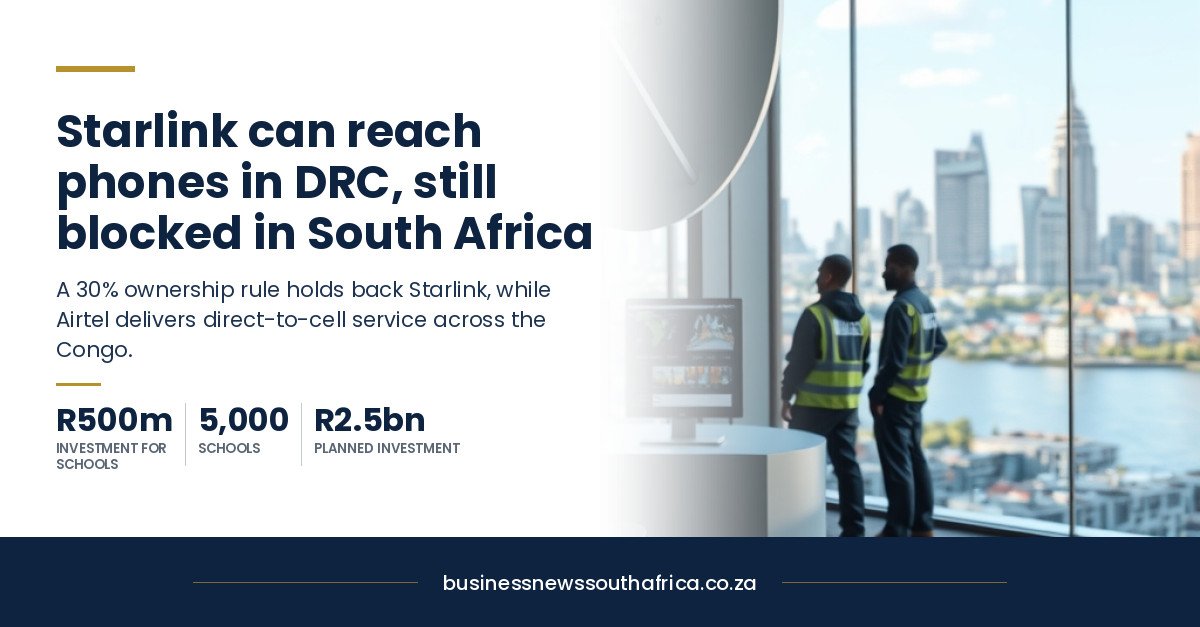
The obstacle in South Africa is section 9(2)(b) of the Electronic Communications Act, which requires holders of individual licences to be at least 30% owned by historically disadvantaged groups. SpaceX, Starlink’s parent, has resisted local equity requirements of this kind globally, and wants to meet empowerment obligations through equity equivalent investment programmes instead, a mechanism already recognised elsewhere in South Africa’s B-BBEE framework.
Communications Minister Solly Malatsi gazetted a policy direction on 12 December 2025 instructing ICASA to recognise such programmes as an alternative to the ownership requirement. ICASA has since said that implementing it would require a legislative amendment to the Act, ITWeb reported. Parliament’s communications portfolio committee chairperson, Khusela Sangoni-Diko, called the policy directives “an affront to the centuries-old fight for equity and redress”.
The latest round
At ICASA’s public hearings on draft amendments to the radio frequency spectrum regulations in August, SpaceX’s senior director for market access and development, Ryan Goodnight, urged the regulator to address the ownership compliance rules that keep Starlink from obtaining a licence, Bandwidth Blog reported. ICASA senior manager Riaan van der Colff said the regulator was open to simplified licensing for terminals but questioned whether SpaceX’s flat-fee model was efficient.
Two facts make a quick resolution unlikely. The Electronic Communications Amendment Bill now in process contains no ownership or equity equivalence provisions, and ICASA has said it has not received a licence application from SpaceX. Each side is waiting for the other to move first.
What Starlink has offered
Starlink has put numbers on its alternative. It pledged R500 million in June 2025 to connect 5,000 schools with free internet and equipment, and SpaceX confirmed in October 2025 a total planned investment of R2.5 billion in South Africa, Connecting Africa reported. In January it emailed South African users a ready-to-send message to ICASA, telling them that “by correcting just four sentences in the licensing regulations, Starlink service could be available nationwide within weeks”. The company operates in more than 24 other African countries.
Why it matters to business
The debate is often framed as one company against one rule, but the practical cost falls on businesses outside fibre and reliable mobile coverage. Farms, mines, lodges, construction sites and logistics operators in remote areas are exactly the customers low-earth-orbit satellite services are built for, and they are also the customers South Africa’s connectivity gaps hurt most. The same applies to any future rival satellite provider that refuses local equity sales, because the ownership rule is not specific to Starlink.
For local operators the picture is mixed. Mobile networks and ISPs face a potential competitor, but the DRC deal shows the other model: an established operator partnering with a satellite provider to reach places its towers cannot. Whether that route opens in South Africa depends on how the licensing question is settled.
What to watch
The signals to follow are whether the amendment bill is changed to address ownership or equity equivalence, whether SpaceX files a licence application to test ICASA’s position, and whether ICASA’s terminal licensing work creates any interim route. Until one of those moves, South African businesses will keep watching neighbouring markets connect first.
For more on telecoms and technology, see our Tech & Telco coverage.