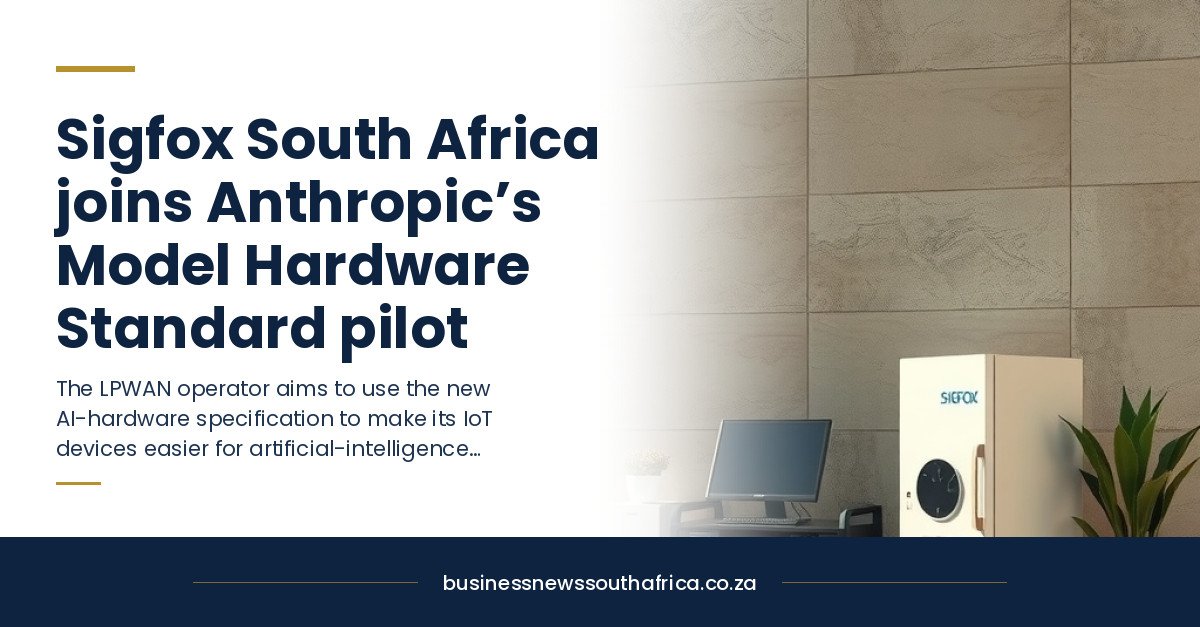
Imagine a water meter that not only sends a reading but also tells an AI system exactly what the reading means, what unit it uses and what safety limits apply. In a future where that information is instantly understood, the AI could spot a leak before it becomes a costly repair.
On 27 August 2026, Anthropic released the Model Hardware Standard (MHS), a shared specification that lets AI agents safely operate and interact with physical equipment. The standard was first drafted together with the HHMI Janelia Research Campus and is now being offered as a limited, application-only research preview to scientific labs and advanced manufacturers.
“AI has changed the way we interact with the data coming out of environments, both from a historical reporting function as well as predicting potential future events,” says Gregory Rood, CEO of Sigfox South Africa. “Therefore the idea of creating a standardised platform that could potentially allow for plug-and-play devices to be integrated into an AI-enabled universe on the go has so many exciting opportunities for business in Africa.”
MHS works by requiring a device to expose a driver that describes itself in a structured format: what it can measure, what actions it can perform, which parameters can be adjusted and any operating or safety limits. An AI agent can discover that description and use the device without writing custom integration code for each piece of hardware.
Sigfox operates a low-power, wide-area network (LPWAN) often called 0G, designed to move small packets of data from millions of sensors to digital platforms. The global Sigfox ecosystem currently connects more than 14 million devices in over 70 countries. With an MHS layer on top, the data those devices send could become readable by AI agents without custom integration work, turning raw payloads into information an agent can act on.
For South African businesses, the combination could simplify the rollout of AI-driven solutions in sectors like utilities, logistics, agriculture and industrial monitoring. A farmer could attach a soil-moisture sensor that not only reports a value but also tells an AI system the sensor’s calibration range, allowing the system to recommend precise irrigation schedules without a developer translating the data first.
Sigfox South Africa has applied to join the MHS research preview, focusing on how the standard might be layered onto its existing device standards rather than replacing them. The company stresses that a Sigfox device will not become AI-enabled merely by using the network; the additional MHS driver is what provides the machine-readable context.
While the preview is still limited, the announcement signals a shift toward making the physical world more understandable to AI. SMEs that rely on sensor data should watch how the standard evolves, as early adopters may gain a competitive edge by reducing integration costs and speeding up AI-powered decision making.
What the standard is, and what it is not yet
MHS is still an early research preview. Anthropic is testing it with a limited group of partners before an eventual open source release, and access for now is by application only, aimed at scientific research laboratories and advanced manufacturers. That matters for anyone reading the announcement as a product launch: there is no general availability yet, and the specification may change before it is finalised.
The standard is designed to be model agnostic, meaning it is not tied to a single AI provider, and devices can be reached through the Model Context Protocol, command line interfaces and APIs, TechCentral reported. For a business, that is the more important detail. A sensor that describes itself in a common format could, in principle, be used by whichever AI system the business chooses, rather than locking the company into one vendor’s analytics platform.
Why Sigfox is interested
Rood describes Sigfox South Africa as the country’s only true open access IoT network, and the company’s pitch rests on the scale of the 0G ecosystem: more than 14 million devices across more than 70 countries. Its application to the preview focuses on how MHS could work within that massive IoT ecosystem, as an abstraction layer over its existing standards rather than a replacement for them.
The use cases the company points to are practical ones: water meters that flag abnormal consumption and possible leaks, temperature sensors, tracking devices and industrial monitoring equipment, across utilities, asset tracking, logistics, agriculture, environmental monitoring, security and industrial operations. These are the sectors where South African businesses already run large numbers of simple sensors and where the cost of turning their data into decisions is often higher than the cost of the hardware.
What to watch
The key question is whether Sigfox South Africa is accepted into the preview, and whether the standard moves to an open release that local device makers and integrators can build on. Until then, businesses weighing an IoT rollout should treat MHS as a direction of travel rather than something to plan procurement around, and ask their integrators how their current platforms would cope if devices start describing themselves to AI agents.
Read the original report on TechCentral. For more coverage of technology trends, visit our Tech & Telco section.