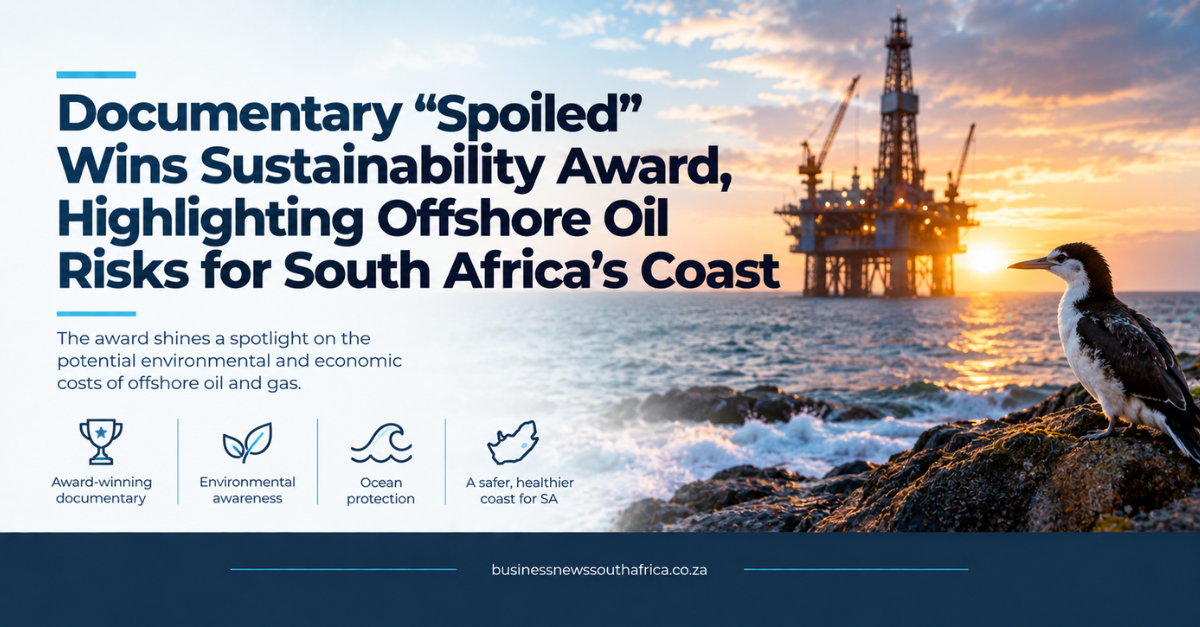
The award ceremony at the Terres festival this week placed the documentary Spoiled in the spotlight, a development that could shift public and policy debate around offshore oil projects along South Africa’s coastline. For fishing cooperatives, small-scale tourism operators and other coastal SMEs, the film’s message about the threat to 90% of the nation’s mainland ocean territory may translate into louder community voices when licences are considered.
Produced by Wildtrust and Love Africa Marketing in partnership with The Green Connection, the film follows fishers, scientists and activists on the Northern Cape and the Wild Coast of the Eastern Cape. It points to flawed Environmental Impact Assessments (EIAs, studies that predict environmental effects of a project) and a lack of meaningful public consultation before ocean space is leased without community consent.
“We are deeply honoured to receive this award for Spoiled,” said Lauren van Nijkerk, campaigns and communications director at Wildtrust. “This film amplifies the voices of coastal communities who are too often ignored in government-level decisions about their ocean.” Co-director Nicola Gerrard of Love Africa Marketing added that storytelling can “build greater public awareness, deepen understanding and inspire people to value and support our natural heritage”.
The timing is notable because Africa Energy Corporation-owned Main Street 1549 Pty Ltd is currently conducting an EIA for Block 11b and 12b off Mossel Bay. The company’s push for offshore oil and gas extraction has reignited community concerns about potential damage to fisheries and tourism-driven businesses that rely on a healthy marine environment.
Since its July 2025 premiere at a marine workshop in Cape Town, Spoiled has amassed more than two million views on social media and has been screened to 20 fishing communities, reaching over 750 people across three provinces. The film also earned a Silver Award at the International Tourism Film Festival Africa 2026.
Viewers can watch the documentary online, and the interactive platform at stopthespoil.co.za provides up-to-date information on active offshore oil applications. For more details, see the original press release here. The story underscores how media can influence regulatory discussions that affect coastal enterprises, a point of interest for anyone operating in the Energy & Infrastructure sector.
Bizcommunity reported that the Terres festival ran from 12 to 18 September 2026 and presented two Great Awards, with Spoiled receiving one of them. The film was chosen from 157 entries submitted by production teams in 29 countries and was shown as one of three “perspectives on nature conservation” during a live screening. This international recognition, described by the producers as the documentary’s biggest to date, adds weight to the community-driven narrative and may encourage other filmmakers to focus on South Africa’s marine challenges, expanding the pool of advocacy tools available to coastal stakeholders.
The award ceremony highlighted that Spoiled was screened alongside two other perspectives, reinforcing the festival’s emphasis on diverse environmental storytelling. By positioning the documentary among a limited set of selected works, the event amplified its reach beyond the 20 fishing communities already engaged. This broader exposure can attract new audiences, including policy makers and investors, who may now encounter the film’s depiction of flawed EIAs and the lack of public consultation, potentially influencing future offshore licensing discussions.
According to the film’s producers, the interactive platform at stopthespoil.co.za now hosts detailed guidance on how affected parties can submit comments during the EIA process for Block 11b and 12b. The site outlines steps for submitting written objections, attending public hearings, and accessing technical reports, thereby lowering the barrier for small-scale operators to participate. For business owners, this means that timely monitoring of the platform can provide a practical avenue to protect livelihoods tied to fisheries and tourism.
The EIA framework in South Africa requires a draft assessment to be published, followed by a 30-day public comment period before a final decision is made. Companies such as Main Street 1549 Pty Ltd must demonstrate that environmental impacts are mitigated and that community concerns are addressed. Failure to incorporate substantive feedback can lead to legal challenges or delays, which directly affect project timelines and investment certainty for offshore ventures.
For coastal SMEs, understanding the EIA timeline is essential because licensing decisions can dictate access to marine resources. A delayed or denied licence may preserve fishing grounds, while approval could introduce competition from offshore activities. Business owners should therefore track the progress of applications on the interactive platform, engage with local NGOs, and consider submitting evidence of economic dependence on healthy marine ecosystems to strengthen their position.
Looking ahead, observers expect the next round of offshore applications to be announced later in 2026, with the Department of Mineral Resources and Energy likely to issue new guidelines on public participation. Stakeholders are advised to stay informed through the film’s website and to prepare concise, data-driven submissions that link environmental health to economic outcomes. Continued media attention, bolstered by the recent award, may keep the conversation alive in parliamentary committees and influence future regulatory revisions.