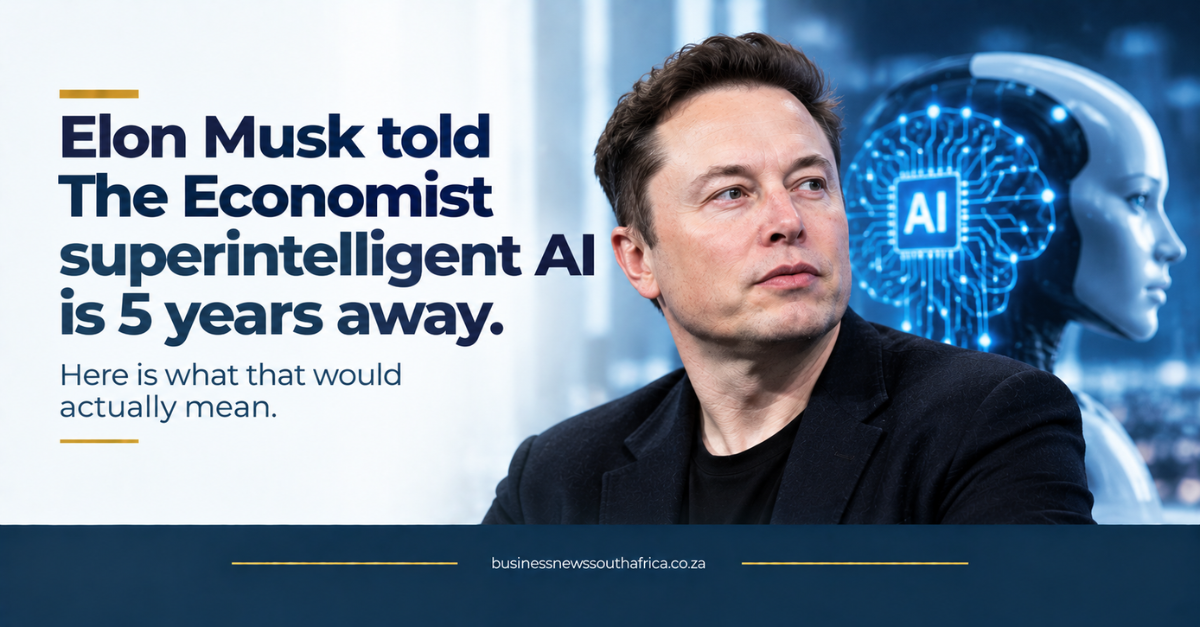
Elon Musk does not do modest predictions, and his latest interview with The Economist is no exception. In an 85 minute conversation with editor-in-chief Zanny Minton Beddoes, recorded at Tesla’s Gigafactory and published on 23 July, Musk said artificial intelligence would exceed the combined intelligence of the entire human race within roughly five years, and that an “age of amazing abundance” would follow by 2036, according to the full interview transcript. “AI may exceed the sum of human intelligence in about five years,” Musk said.
What “abundance” means in his framing
Musk’s argument for why that matters economically is straightforward, and it is also the part most likely to sound implausible to anyone running a real business today: “What do you want money for? You want money for goods and services. If that is so abundant that the robots and AI are providing more than any human could possibly consume, what do you need money for?” One write-up of the conversation described the picture Musk painted as an economy rendered “quasi-infinite” by humanoid robotics. That is a genuinely radical claim, not a footnote, and it is worth treating as exactly that: one billionaire’s prediction, not a forecast with any independent verification behind it.
He was more careful, to his credit, about the risk on the other side of that prediction, though his own framing of it is telling. Asked again about a figure he had previously given, a 10 to 20% chance of “killer robots” wiping out humanity, Musk said: “I still think there’s risk associated with AI and robots. It’s not zero… I can’t see any way to really stop this incredible momentum of AI and robots. And at times I sort of think, well, perhaps even if there was a stop button, we probably shouldn’t press it because the most likely outcome is incredible abundance for all.” That is a man who has quantified a real chance of catastrophe, and concluded the honest response is to keep building anyway.
The parts with an immediate South African angle
Musk also discussed Starlink’s role in Ukraine’s defence, which he described as decisive, while arguing for a negotiated settlement given how little the front lines have moved over two to three years. That is worth noting here specifically because Starlink’s other major regulatory fight, over selling into South Africa, remains unresolved: our coverage of Starlink’s South African licensing standoff covers where that stands. A company willing to negotiate the terms of its presence in an active war is not obviously going to move faster on an equity-equivalence dispute with ICASA.
On the broader AI race, Musk ranked Anthropic’s models as “clearly the smartest,” with China’s Kimi K3 “almost as good,” and pointed to China’s electricity production, already exceeding the US, Europe and India combined and still growing, as the resource advantage that could decide who actually wins the AI race, regardless of which country has the better models on paper.
What to actually do with a prediction like this
A five year timeline to superintelligence and an eleven year timeline to post-scarcity abundance are the kind of claims that generate headlines and are functionally useless for a business trying to plan the next 18 months. The more useful signal in the interview is not the date, it is the direction: the people building frontier AI increasingly believe capability is accelerating faster than expected, a view echoed almost simultaneously by Anthropic’s own chief executive in a separate, far more cautious essay published the following month. When the industry’s most aggressive optimist and its most prominent safety advocate are both saying the pace has changed, that is worth a business owner’s attention even without buying either one’s specific timeline.