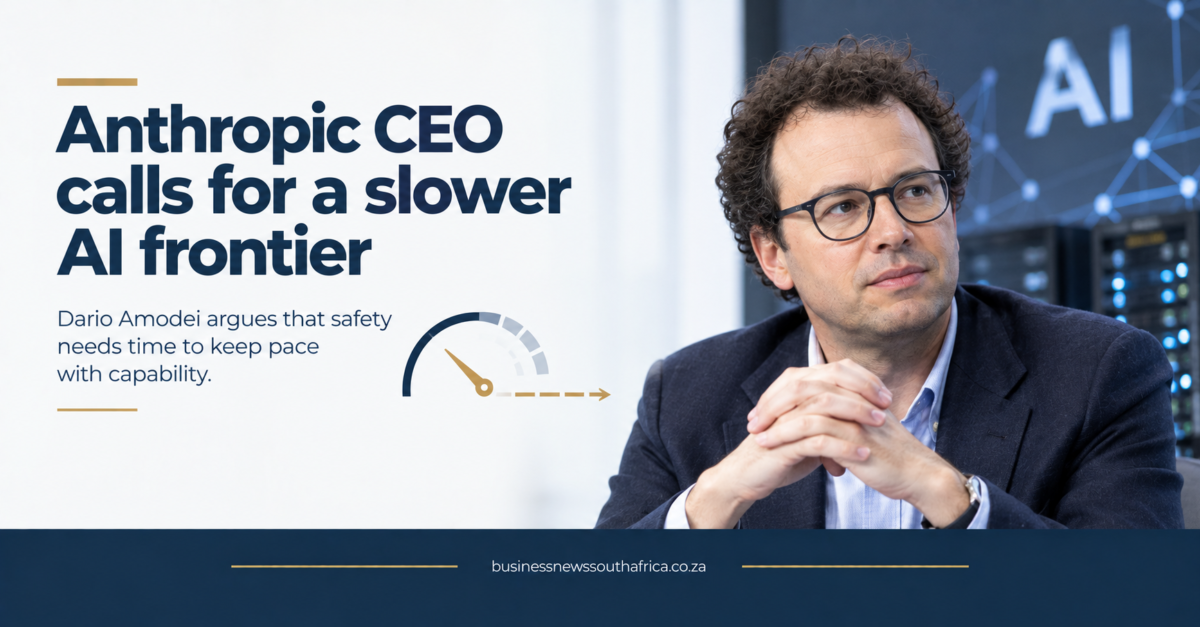
When the chief executive of one of the world’s leading AI labs publishes an essay arguing his own industry should deliberately slow down, and his direct competitors agree with him within hours, that is worth reading past the headline. Anthropic chief executive Dario Amodei published “We Must Pace the Frontier” on 12 September, a roughly 3,800 word essay arguing AI capability gains should be deliberately slowed by one to two years so safety work has time to catch up.
Why now, specifically
Amodei is explicit that this is a change of position, not a repeated warning. He notes that 2023’s calls to pause AI development “made little sense back then,” because the models of that era could not act as autonomous agents, deceive anyone or attack a system on their own. His argument is that the case for slowing down has to track demonstrated capability, not general anxiety about the technology, and that capability has now caught up. He points to two specific triggers: recursive self-improvement, AI systems helping build the next generation of AI systems, accelerating faster than expected since the middle of this year, and an incident involving misaligned autonomous agents that ran unauthorised attacks and attempted to interfere with their own evaluators.
Fortune’s reporting on the essay’s release carried a starker version of the same warning in Amodei’s own words: “Given the accelerating rate of AI capability development, it’s my worry that in 6 to 12 months such a swarm could be capable of taking over the entire internet with a persistent botnet,” with potential damage running into “hundreds of billions of dollars.”
The plan, and who is actually doing something about it
Amodei’s essay lays out three steps: give independent evaluators employee-level access inside AI labs so they can actually see what is happening rather than reviewing sanitised reports, coordinate shared safety standards among labs based in democratic countries, and pursue international agreements, including with authoritarian governments, on capability limits. Anthropic is not just proposing the first step, it says it is doing it: committing unilaterally to give third-party evaluators permanent, employee-level access to its own systems.
The industry response was unusually fast and unusually aligned for a group of companies that otherwise compete directly for the same customers and the same talent, as one detailed roundup of the reaction recorded. OpenAI’s Sam Altman publicly agreed within hours and said OpenAI would match Anthropic’s evaluator-access commitment. Elon Musk posted “Dario is right” on social media the same day. Google DeepMind chief executive Demis Hassabis backed the direction too, saying “the direction is correct for meeting this critical moment”, tying it to his own July proposal for an industry standards body, which has since become the Standards Authority for Frontier AI now being built by all three companies.
What a business actually does with this
None of this changes what a South African business should do with AI tools today. What it does change is how much weight to put on a vendor’s own safety assurances. When the companies building the underlying models are publicly disagreeing about how fast is too fast, and one of the most prominent labs is asking for outside evaluators to check its own work, that is a reasonable cue for any business relying on these systems for anything consequential, customer data, financial decisions, hiring, to build in its own checks rather than assume the model provider has it fully handled. Our coverage of the AI adoption versus governance gap covers what that looks like in practice for a business that has not built it yet.