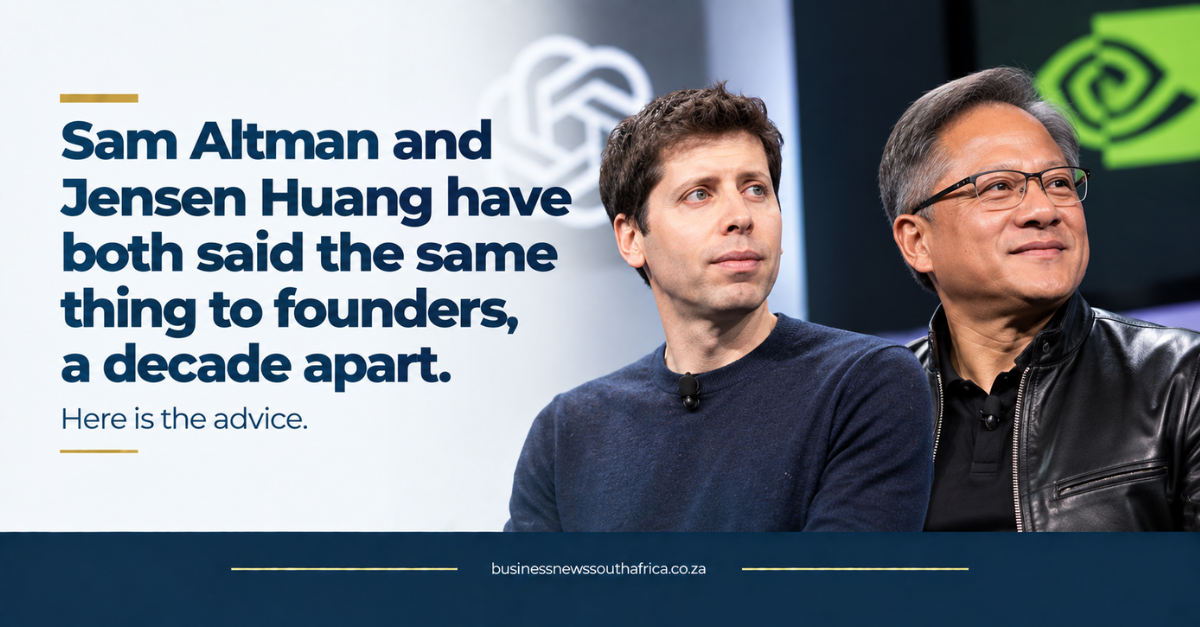
Ten years and two very different companies apart, Sam Altman and Jensen Huang have given founders close to the same advice. Altman delivered his in a 2014 Stanford lecture series, “How to Start a Startup”, recorded while he was still president of Y Combinator, years before OpenAI existed. Huang delivered his in July 2026 on stage at Y Combinator’s Startup School, Fortune reported, three decades into building Nvidia into a company worth close to $4.7 trillion. Neither man needed to say any of this for career reasons. Both said it anyway, because it is apparently what they actually believe made the difference.
Huang: confront reality, then learn your way through it
Huang’s framing at Startup School was blunt: “This is absolutely the single greatest time to start a company.” His reasoning was not about market timing so much as about a mindset: “How hard can it be?” is, in his telling, a genuinely useful question to ask before a problem paralyses a founder with anxiety about its difficulty. He described the discipline behind it as “let the suffering come to you a little bit at a time” rather than trying to solve every future problem before it arrives.
The line that matters most for a founder without a technical head start: “The big lesson for me is that technology is changing all the time, and so long as you’re able to confront the reality, so long as you are able to learn, the technology itself actually doesn’t matter.” Huang also told the phrase he says he has used for 33 years: that his company is always “30 days from going out of business.” Nvidia’s own founding story backs that up. Huang, Chris Malachowsky and Curtis Priem sketched the company’s first vision over coffee at a Denny’s in 1993, and when an early bet on the wrong graphics technology threatened to sink the company, Huang’s response was to buy three technology textbooks from Fry’s Electronics so his engineers could learn what they needed to know from scratch.
Altman: the idea still has to be good, and the product comes first
Altman’s 2014 lectures pushed back directly on a fashionable belief of the time, that ideas do not matter and only execution counts. His argument, as recorded in notes from the lecture, was that a bad idea stays bad no matter how well it is executed, and that a good startup idea should solve a problem the founders are genuinely passionate about, in a market that will keep growing. He also made a case that sounds counterintuitive until you sit with it: it is often easier to start a hard startup than an easy one, because a hard problem screens out casual competitors and gives a founder a real reason to keep going when things get difficult.
On product specifically, his advice to Y Combinator founders was almost aggressively narrow: until a company has built something users genuinely love, almost nothing else matters, and founders in that stage should be spending their time working on the product, talking to actual users, and otherwise doing very little else. Underneath both pieces of advice sits the same warning: without real belief in what is being built, a founder does not have what it takes to get through the pain a startup guarantees.
What this means for a founder building in South Africa right now
Neither man was talking about South Africa, and neither man’s advice accounts for load shedding, currency risk, or a market a tenth the size of the one either of them was building for. But the core claims travel well regardless: the idea still has to solve a real problem for people who will pay for the solution, the product has to earn genuine use before anything else gets built on top of it, and the founder has to actually believe in the problem enough to survive the part where it is hard. Our Business Idea Generator and Validator is built around exactly that first test, whether an idea holds up against real demand, real competition and real numbers, before a founder spends a year finding out the hard way. If Altman and Huang are right about anything specific and portable, it is that the test is worth running honestly before the harder work starts, not after.