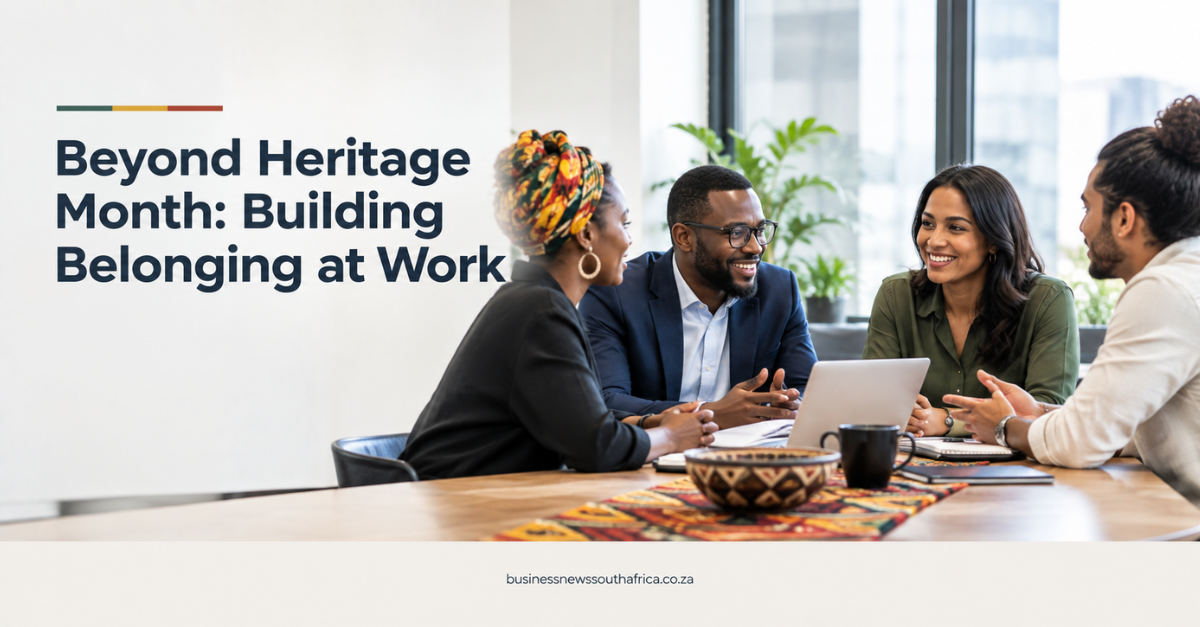
According to a Bizcommunity article, South African workplaces light up in traditional dress and share cultural dishes during Heritage Day and the surrounding month. The colourful displays are visible, but the article warns that visibility does not equal influence, and inclusion does not equal belonging.
Belonging, the piece explains, is the employee’s feeling of being accepted as a legitimate member of the group. It sits at the base of a “conditions stack” that also includes diversity (who is represented), equity (fair rules and resources), inclusive practice (being heard), valued uniqueness (being different without pressure to conform) and psychological safety (being able to speak up without fear). The theory comes from Baumeister and Leary’s need-to-belong research (1995) and Shore’s inclusion model, both of which argue that genuine inclusion requires both belonging and valued uniqueness.
For small and medium-size enterprises, the stakes are clear: employee engagement is a top business priority, yet the article notes that engagement is decided long before any campaign is launched. If the foundational conditions are missing, employees may attend meetings out of obligation rather than desire, limiting productivity and retention.
Three large South African companies are cited as moving the needle. Woolworths places belonging within its “Inclusive Justice Initiative” alongside safety, respect, fair pay and anti-discrimination actions. Standard Bank describes belonging as the outcome of diversity, equity and inclusion working together, using employee forums to feed experiences into policy. Exxaro frames its DEI strategy around “Belonging Powers Possibility” and involves employees and unions in shaping employment equity plans.
While the article concedes that these examples do not prove a direct link to financial performance, they illustrate that organisations can treat belonging as a measurable condition. For SMEs, the same approach can be scaled without the need for large-scale programmes.
Practical steps for SME owners
1. Measure experience, not just representation. Conduct anonymous surveys that ask directly about belonging and psychological safety, then break the data down by site, level, tenure and demographic group.
2. Trace voice to influence. Identify who speaks in meetings, whose ideas shape decisions and who receives credit. Look for patterns that may indicate hidden barriers.
3. Audit pressure to assimilate. Review promotion criteria, language norms, flexibility policies and access to informal networks for signs that employees are expected to conform.
4. Put gaps into accountability. Assign an owner, set a clear action and deadline, and report back to staff on what changed.
5. Include neurodiversity. Ensure that the definition of belonging covers cognitive differences as well as cultural ones.
By turning the post-heritage month period into a time for deep listening and systematic change, SMEs can move from a one-off celebration to a workplace where every employee can say, without hesitation, “I belong”.
For more guidance on building inclusive policies, see our SME & Entrepreneurship resources.
Bizcommunity reported that in 2026 a growing number of South African firms are shifting belonging from a seasonal celebration to a permanent organisational condition, with executives assigning it to governance structures rather than leaving it to ad-hoc programmes. This shift is reflected in the way Woolworths, Standard Bank and Exxaro have each embedded belonging within broader initiatives such as the “Inclusive Justice Initiative”, the “outcome of diversity, equity and inclusion working together” and “Belonging Powers Possibility”. By moving the concept into formal policy language, these companies signal that belonging will be monitored, reported and held to the same standards as safety, respect and fair pay.
Bizcommunity reported that the “conditions stack” described in the article, diversity, equity, inclusive practice, belonging, valued uniqueness and psychological safety, is presented as a hierarchical model where each layer supports the next. The source stresses that if the lower layers are weak, employees may attend meetings out of obligation rather than desire, limiting productivity and retention. This framework helps businesses pinpoint which foundational elements need reinforcement before expecting higher-order outcomes such as voluntary engagement or innovation.
Bizcommunity reported that employee forums at Standard Bank serve as a conduit for feeding lived experiences into policy, while Exxaro involves unions and employees in shaping employment-equity plans. These mechanisms illustrate how organisations can translate anecdotal feedback into measurable action items. By linking belonging to workforce-planning and transformation, firms create a feedback loop that can be audited, adjusted and aligned with broader DEI goals.
In practice, the process of measuring belonging begins with anonymous surveys that ask directly about feelings of acceptance and psychological safety, then segment the data by site, level, tenure and demographic group. The next step is to map who contributes ideas in meetings, whose proposals are adopted and who receives recognition, providing a clear picture of voice-to-influence. Finally, organisations audit promotion criteria, language norms and access to informal networks to detect any pressure to assimilate, ensuring that valued uniqueness is protected.
For South African business owners, the key watch points are the establishment of a clear ownership model for belonging, the integration of survey results into regular reporting cycles, and the alignment of belonging metrics with existing DEI dashboards. As more companies treat belonging as a measurable condition, SMEs that adopt similar structures can demonstrate progress to investors, comply with emerging regulatory expectations and create a workplace where every employee can say, without hesitation, “I belong”.