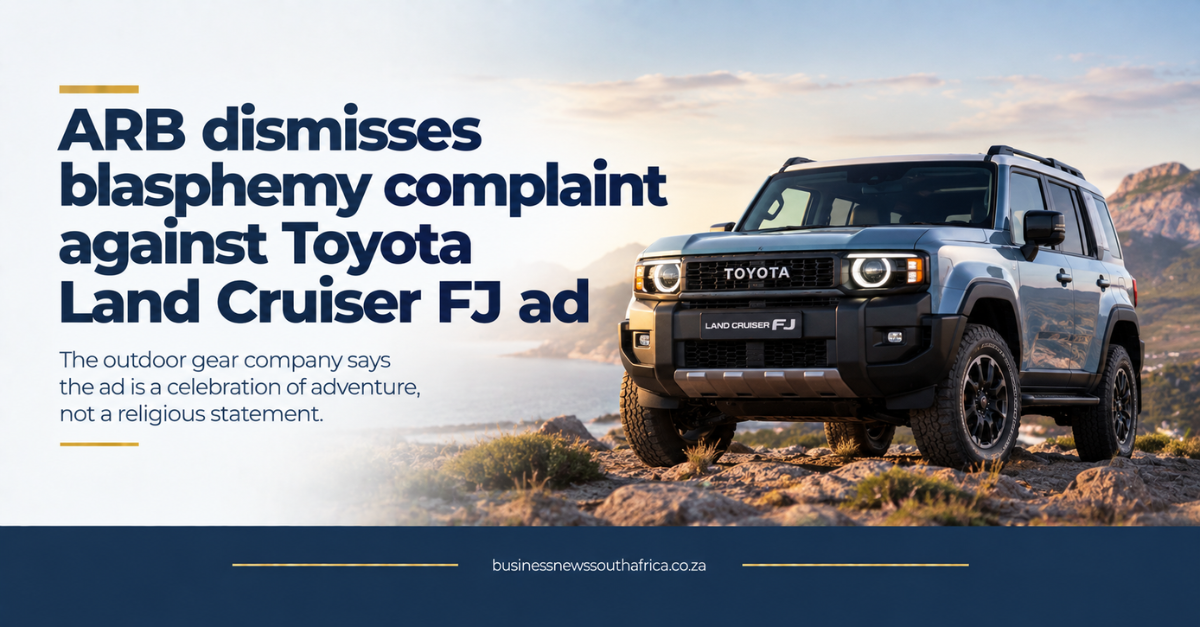
On a dusty out-back road, a shiny new Land Cruiser FJ sits beside a simple caption: “The all new Landcruiser FJ I am what I am”. The image sparked a single complaint that the phrase borrowed from the biblical “I am that I am”, potentially offending Christians. The Advertising Regulatory Board (ARB) ruled on 15 September 2026 that the ad does not breach the Code of Advertising Practice.
The ARB’s directorate explained that the wording contains no icons, images or other elements that would likely be read as a biblical reference. In plain terms, the phrase is seen as a statement of confidence rather than a religious allusion. The board noted that the phrase is common in popular culture, from songs to the cartoon Popeye’s “I yam what I yam”, and is not usually regarded as sacred.
Toyota South Africa’s agency, Publicis Groupe Africa, defended the line by pointing to a series of “I am …” statements used across the campaign, “I am majestic”, “I am intriguing”, “I am sophisticated”, “I am driven”, “I am capable”, “I am unbreakable”. According to the agency, the tagline was meant to bundle these attributes and convey the vehicle’s versatility and individuality.
What this means for small advertisers
For SMEs that rely on limited marketing budgets, the ruling offers a useful precedent. The ARB’s decision shows that a single complaint, even when framed as a religious offence, will not automatically halt a campaign. Advertisers must still ensure that copy does not directly quote or mimic sacred texts, but the board appears willing to consider context and overall impression. In practice, a small business can reference popular sayings without fearing an automatic breach, provided the message is not overtly derogatory.
The directorate also highlighted that only one complaint was lodged, unusually low for a religious-offence case. This suggests that the public may not view the phrase as offensive, reducing the risk of widespread backlash. Nonetheless, the ARB cautioned that advertisers should avoid language that could be interpreted as belittling any faith, as the board can still act if a pattern of complaints emerges.
SME owners who draft their own ads can use the ARB’s guidance as a checklist: avoid direct quotations of scripture, steer clear of religious symbols, and test whether a phrase could be read as a mockery. The board’s compliance tool, available through the Compliance Document Generator, can help small firms document their review process and demonstrate good faith if a complaint does arise.
While the Toyota case does not change any regulation, it reinforces the ARB’s balanced approach, protecting freedom of expression while guarding against genuine offence. For entrepreneurs, the key takeaway is that thoughtful wording, backed by a clear intent, can survive even a pointed complaint.
The source material noted that the ARB’s directorate ruled on 15 September 2026 that the Toyota South Africa advertisement did not breach the Code of Advertising Practice, emphasizing that the wording contained no icons, images or other elements likely to be read as a biblical reference. It also recorded that the phrase “I am what I am” was interpreted as a statement of confidence and self-reliance rather than a direct quotation of the biblical “I am that I am”. The directorate further pointed out that the phrase is not typically regarded as sacred, citing its use in popular culture such as songs and Popeye’s famous line.
In South Africa, the ARB operates a complaint-driven system where any member of the public may lodge a grievance about an advertisement. Once a complaint is received, the directorate assesses the material against the Code of Advertising Practice, focusing on context, visual cues and potential offence. If the ad is found compliant, the complaint is dismissed; if not, the board can order amendment, withdrawal or impose penalties. For business owners, understanding that a single complaint does not automatically halt a campaign is key, but maintaining records of internal reviews can demonstrate good faith if a dispute arises.
The source material also highlighted that only one complaint was lodged, which the directorate described as unusually low for a religious-offence case. This low volume suggests that the broader public may not view the phrase as offensive, reducing the likelihood of sector-wide backlash. The directorate concluded that the advertisement was unlikely to cause serious, widespread or sectoral offence under Clause 1 of Section II of the Code, reinforcing the view that context and public perception are decisive factors in ARB determinations.
For advertisers, the next step is to monitor any emerging patterns of complaints, as the ARB indicated it could act if a series of grievances develops. Small firms should therefore keep an eye on social media sentiment and be prepared to adjust copy quickly if a trend of discontent appears. Regularly consulting the ARB’s compliance tools, such as the Compliance Document Generator, can help document the decision-making process and provide evidence of due diligence should the board request further information.
Finally, the ruling underscores that South African businesses can safely employ confident, self-affirming language provided it does not directly quote sacred texts or employ religious symbols. Entrepreneurs should continue to test taglines with target audiences, ensuring that the intended message aligns with the cultural context. By staying aware of ARB guidance and tracking public reaction, advertisers can balance creative expression with the responsibility to avoid inadvertent offence.