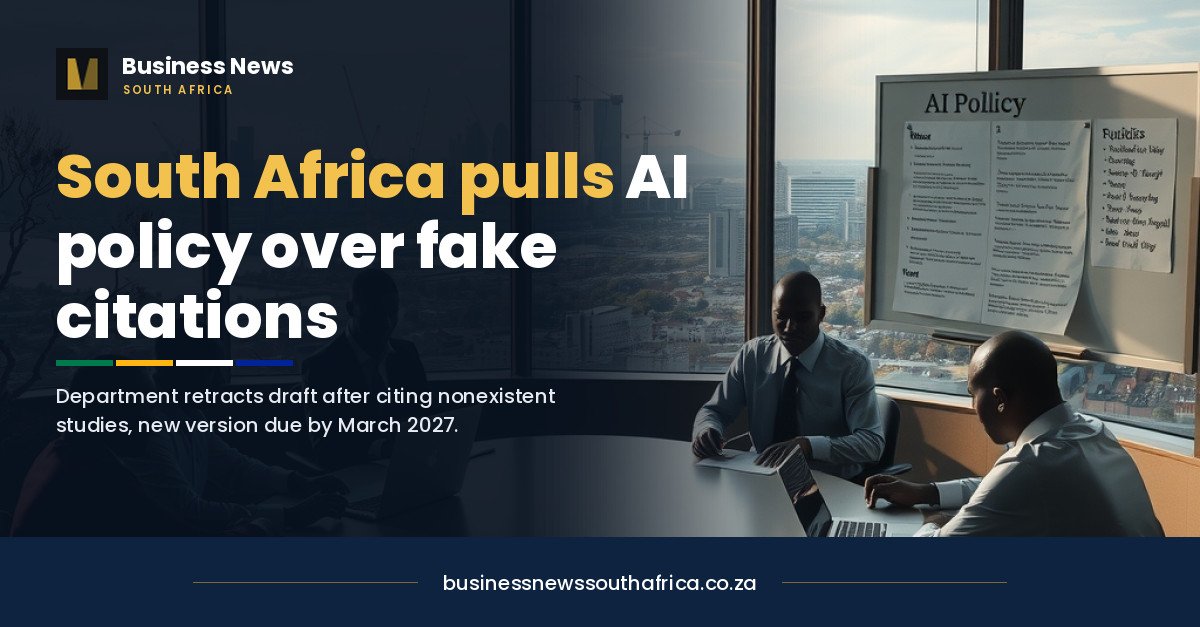
The irony was hard to miss: a government policy meant to guide how South Africa regulates artificial intelligence turned out to have been drafted, at least in part, using artificial intelligence that made things up. The Department of Communications and Digital Technologies published its draft National AI Policy for public comment on 10 April 2026 and withdrew it just sixteen days later, on 26 April, after it emerged that the document’s reference list cited academic journal articles that do not exist, according to a summary of the episode. Several of the credited authors had never written on the subjects attributed to them.
Four officials, including the department’s chief director, were suspended pending an investigation, and the ANC’s own parliamentary caucus issued a public statement on the episode. Minister Solly Malatsi has since said the rewritten policy is now on track to reach Cabinet by the end of the financial year, meaning March 2027, Daily Maverick’s Lindsey Schutters reported on 21 September, following a briefing on the policy’s status.
What Malatsi actually said
Speaking about the original failure, Malatsi framed the response as the more important part of the story: “When [mistakes] happen, be transparent. Take responsibility and then also deal with how you correct to ensure that there is no repetition of the same mistakes.” Whether that transparency extends to a full public account of how the fabricated citations made it into an official government document in the first place is still an open question; the reporting so far has focused on the fix, not a detailed post-mortem of the failure.
The rebuild
The rewrite is being led by an expert panel chaired by Professor Benjamin Rosman of the Wits Mind Institute, alongside Professor Vukosi Marivate, Professor Alison Gillwald, Heather Irvine, Dr Tshepo Feela, Dr Jabu Mtsweni and advocate Lufuno Tshikalange, a genuine cross-section of AI research, law and governance expertise rather than a single department working alone. Their task is to reconstruct the policy to reflect South Africa’s own circumstances and specifically to avoid a repeat of the citation failure that sank the first draft.
The original document was not a light-touch policy. It set out a risk-based approach that would have categorised AI systems by potential harm, established regulatory sandboxes for startups, created sector-specific working groups for manufacturing, energy, infrastructure, transport and trade, and proposed seven new regulatory bodies, among them a National AI Commission, an AI Ethics Board and an AI Ombudsperson. Whatever the rewritten version keeps or drops from that list is the detail South African businesses building AI products, or simply deploying AI tools at scale, will need to watch for.
Why this matters beyond the embarrassment
A five-month delay to a national AI framework is not, on its own, a crisis: plenty of policy documents take longer than that in the ordinary course of drafting. What makes this one worth tracking is the reason for the delay. A department tasked with writing the rules for trustworthy AI use in South Africa was caught not verifying the AI-assisted work behind its own flagship policy, the exact failure mode any business now has to guard against in its own AI deployments. Fabricated citations in a policy document and a fabricated fact in a company’s AI-drafted report are the same underlying risk, just with very different stakes attached.
Businesses building products that will eventually sit inside whatever regulatory framework emerges, from AI tool vendors to companies simply deploying generative AI at scale, now have a firmer date to plan around: expect a genuinely new draft, not a patched version of the withdrawn one, some time before March 2027. In the meantime, the gap between how fast South African businesses are adopting AI and how carefully they are governing it internally is the more immediate risk; we cover what that gap already costs without waiting for a national policy to close it.