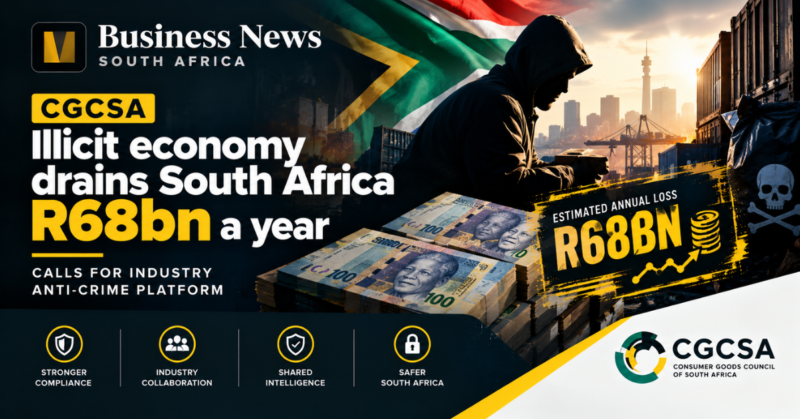
According to a study titled Shadow State Rising by Frans Cronje Private Clients, the value of South Africa’s illicit economy is roughly R84.6 billion each year. The figure represents a sizeable slice of the nation’s gross domestic product and, because it generates no tax revenue, it translates into a direct fiscal loss for the Treasury.
The study groups together activities such as smuggling, the sale of counterfeit goods and illegal mining. It notes that illicit tobacco and alcohol sales make up the largest share, followed by illegal mining operations. While the formal and informal sectors may appear to function in similar ways, moving goods, employing people and generating cash, the illegal side does not contribute to public coffers.
Why the numbers matter to small and medium enterprises
For owners of small and medium enterprises (SMEs), the shadow economy creates a distorted competitive landscape. Legitimate retailers that pay excise duties on tobacco and alcohol face higher costs than counterfeit-laden rivals that evade those taxes. Illegal miners undercut lawful operators by avoiding licensing fees and safety compliance, which can depress market prices for raw materials. The result is reduced profit margins for law-abiding businesses and a potential deterrent for new entrants.
The Global Organised Crime Index, which ranks countries on the prevalence of illegal activities, placed South Africa seventh out of 193 countries with a criminality score of 7.43 out of 10. Within Africa, the country holds the second-highest score and tops the 13 Southern African nations. The index also gave South Africa a resilience score of 5.67, the third-highest in Africa and 44th globally, citing a strong legal framework but noting that governance problems erode public trust.
Key weaknesses identified by the index include gaps in border controls that allow counterfeit clothing, footwear, electronics and pharmaceuticals to flow across the Mozambique-South Africa border. Law-enforcement agencies, including the South African Police Service, are described as being under strain from corruption, mismanagement and limited funding. The ongoing Madlanga Commission, an inquiry into governance failures within crime-prevention agencies, has been extended by President Cyril Ramaphosa, underscoring the political attention the issue receives.
Private-sector initiatives are also part of the response. Business Against Crime South Africa (BACSA) acts as an intermediary between government and industry, while the Consumer Goods Council of South Africa (CGCSA) has called for a stronger public-private partnership through an Anti-Crime Platform. The platform would build on BACSA’s work to deliver “prevention, disruption, enforcement and measurable outcomes”. However, the index warns that violent crime, deteriorating infrastructure and regulatory uncertainty continue to dampen business confidence.
For SME owners, the practical implications are clear. Higher rates of counterfeit goods can damage brand reputation and increase the cost of policing supply chains. Illegal mining can lead to safety incidents that affect nearby legitimate operations and strain community relations. Moreover, the fiscal drain from lost tax revenue limits the government’s ability to fund services that businesses rely on, such as reliable electricity and transport infrastructure.
While the study provides a snapshot of the scale of the problem, many details remain uncertain. Exact figures for how much each illicit activity contributes to the R84.6 billion total are not disclosed, and the effectiveness of proposed public-private initiatives has yet to be measured. Nonetheless, the data suggests that tackling the shadow economy is not just a law-enforcement issue but a competitive one for South Africa’s formal sector.
SME owners who want to protect their businesses can start by strengthening supplier verification, investing in anti-counterfeit technologies and engaging with industry bodies such as BACSA. They may also consider lobbying for clearer enforcement of excise duties and better border management, which could level the playing field and restore some of the lost tax revenue.
For a deeper look at how organised crime is measured, see the original study report. Further guidance on compliance and risk management for SMEs is available in our Regulatory & Policy section and the Compliance Document Generator tool.
BusinessTech reported that the Organised Crime Index highlighted South Africa’s resilience score of 5.67, the third-highest in Africa and 44th globally, yet flagged financial constraints that limit investigative capacity across law-enforcement bodies. The same index warned that funding shortfalls curtail prevention programmes and lead to inconsistent implementation, while also noting that the Border Management Authority has struggled to curb illicit trade despite its mandate. Seizures of counterfeit clothing, footwear, electronics and pharmaceuticals were cited as evidence of a pervasive market, and the report reiterated that weak border enforcement fuels the flow of illegal goods across the Mozambique-South Africa corridor.
For a South African business owner, the interaction between legal frameworks and resource availability determines how effectively illicit competition can be challenged. A strong legal framework offers tools such as excise duties and licensing requirements, but without adequate funding these tools remain under-used, leaving legitimate firms exposed to under-priced counterfeit products and unregulated miners. Owners should monitor budget allocations to the South African Police Service and any parliamentary decisions affecting the Border Management Authority, as shifts in funding often precede changes in enforcement intensity. Keeping abreast of such signals helps SMEs anticipate periods of heightened risk and adjust supply-chain safeguards accordingly.
BusinessTech also pointed out that gaps in border controls enable the influx of counterfeit goods, with the index describing the counterfeit market as “pervasive, driven by weak border enforcement and the involvement of criminal networks operating across the Mozambique-South Africa border.” It noted that seizures of counterfeit items illustrate the scale of the market and that despite the existence of the Border Management Authority, illicit trade in excise goods, particularly tobacco and alcohol, remains significant. The report further emphasized that governance challenges, including corruption and maladministration, erode public trust even where legal provisions are robust.
The practical effect of border-control weaknesses is that illegal shipments can bypass duties, undercutting compliant retailers and inflating the shadow economy. South African firms can mitigate exposure by tightening import verification, employing traceability technologies, and engaging with industry groups such as BACSA to share intelligence on suspect consignments. Watching for announcements of new border-security initiatives or revisions to customs procedures will indicate whether enforcement is likely to tighten. Early awareness allows businesses to adapt procurement policies before illicit goods gain a foothold in the market.