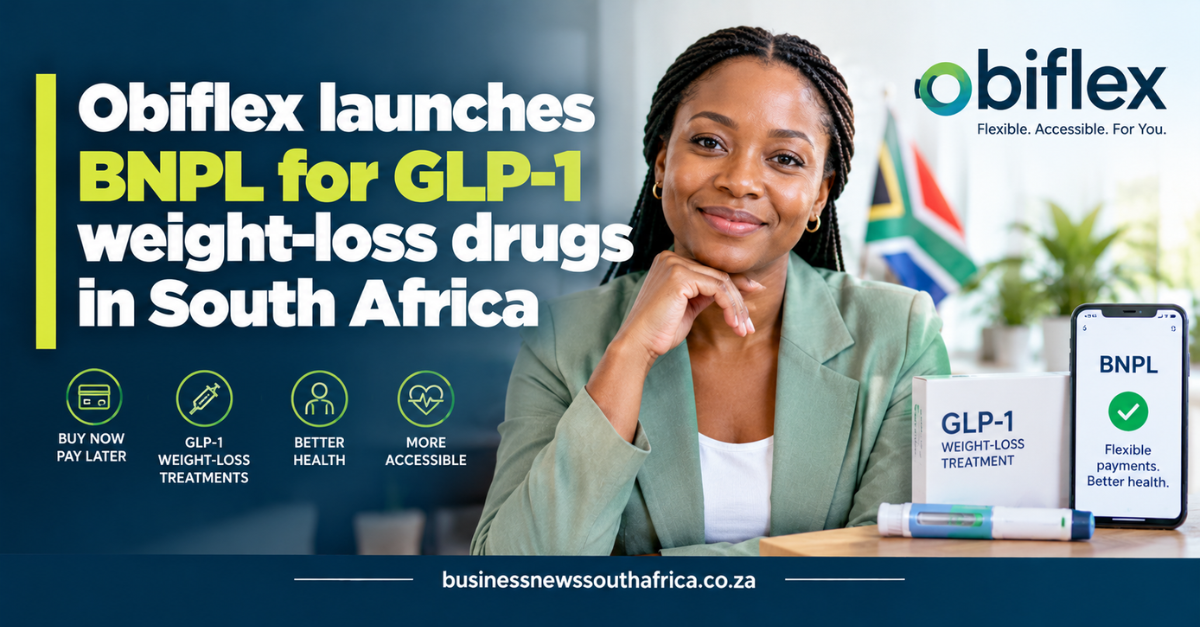
South Africans can now pay for GLP-1 weight-loss medicines in instalments. Obiflex, a doctor-led health-management programme, offers virtual consultations with doctors who can prescribe the medicines, which were initially developed to treat diabetes, and lets patients spread the monthly cost with buy now, pay later (BNPL) credit, Moneyweb reported. The report does not name the BNPL provider.
BNPL products are interest-free credit that let consumers split a purchase into fortnightly or monthly instalments. The merchant pays a fee to the BNPL provider and the consumer receives the product up front. Missed instalments can trigger penalties that add up quickly.
Why demand is running ahead of affordable supply
GLP-1 medicines cost between R2 500 and R6 000 a month, depending on the dose. Obiflex says demand has surged so much that some people have bought illegally acquired or manufactured drugs. Shaun Barns, co-founder and CEO of Obiflex, says the crackdown on illegal supply makes affordable, regulated access more pressing. “Affordability pushed so many patients towards cheaper, illicit or unregistered alternatives,” he said.
“Now that route has been shut down by Sahpra and Sapc, so unless there’s legitimate, affordable access, that demand doesn’t disappear, but it risks people seeking other unregulated or illicit options.”
Shaun Barns, co-founder and CEO, Obiflex
The crackdown he refers to followed a joint inspection by the South African Health Products Regulatory Authority (Sahpra) and the South African Pharmacy Council (SAPC) at Sentra Pharmacy in Silverton, Pretoria, on 11 May 2026. According to the government news agency, inspectors found injectable weight-loss products containing semaglutide and tirzepatide being made under the guise of compounding, with imported active ingredients, no testing for identity, potency or purity, and unsafe sterile conditions. All the products were seized and the company was told to recall what it had distributed. Authorities reported adverse events, including hospitalisations, linked to the products.
How the programme works
Obiflex is backed by investment firm Grovest. Barns co-founded it with Dr Riaz Motara, Grovest’s Jeff Miller and Moshe Unterslak. Motara, a cardiologist, has led the training of the doctors who consult with patients virtually, so that they address the underlying causes of unhealthy weight change rather than only prescribing a medication, the firm said. The programme pairs low-dose GLP-1 treatment with structured coaching, targeting up to 10% body-weight loss over six months. Lower doses are more affordable but usually lead to slower weight loss.
Obiflex says a growing body of international research shows that combining medication with lifestyle support improves the likelihood of maintaining weight loss over the longer term, compared with medication alone. That is the company’s claim, and we have not independently verified it.
Cost is the pressure point
Obesity and being overweight are not prescribed minimum benefits that medical schemes must cover, so schemes are generally not obliged to pay for GLP-1 medicines used for weight loss.
Prices could come down. Aspen, Africa’s largest drugmaker, distributes Eli Lilly’s Mounjaro locally, and sales of the medicine accounted for roughly 40% of the growth in South Africa’s private pharmaceutical market over the past year, according to Moneyweb. Aspen CEO Stephen Saad told Bloomberg he expects GLP-1 medicines could eventually become Aspen’s biggest product category, and that the company has applied to the regulator to manufacture a generic version of semaglutide, the active ingredient in Ozempic.
What changes for BNPL users in February 2027
The National Credit Regulator has ordered BNPL providers to report consumers’ payment behaviour to credit bureaus from February 2027, through the South African Credit and Risk Reporting Association (Sacrra), so instalments will appear on credit files, TimesLIVE reported. Happy Pay’s chief executive, Wesley Billett, said the change “doesn’t require any significant operational changes” for his company because it had already built reporting systems.
TransUnion research cited by Moneyweb shows 62% of consumers surveyed had used a BNPL product, 37% had used one repeatedly, and roughly two-thirds of BNPL loans are for amounts below R2 500. The reporting could help first-time borrowers build a credit record, but it also gives lenders a clearer view of total debt, potentially flagging over-indebtedness.
For employers, the practical point is that from February 2027 staff who use BNPL for anything, including medicines like these, will have that borrowing visible to other lenders. Staff who take salary advances or loans from their employer may want to understand that before they sign up. Related coverage is in Regulatory & Policy and Markets & Finance.