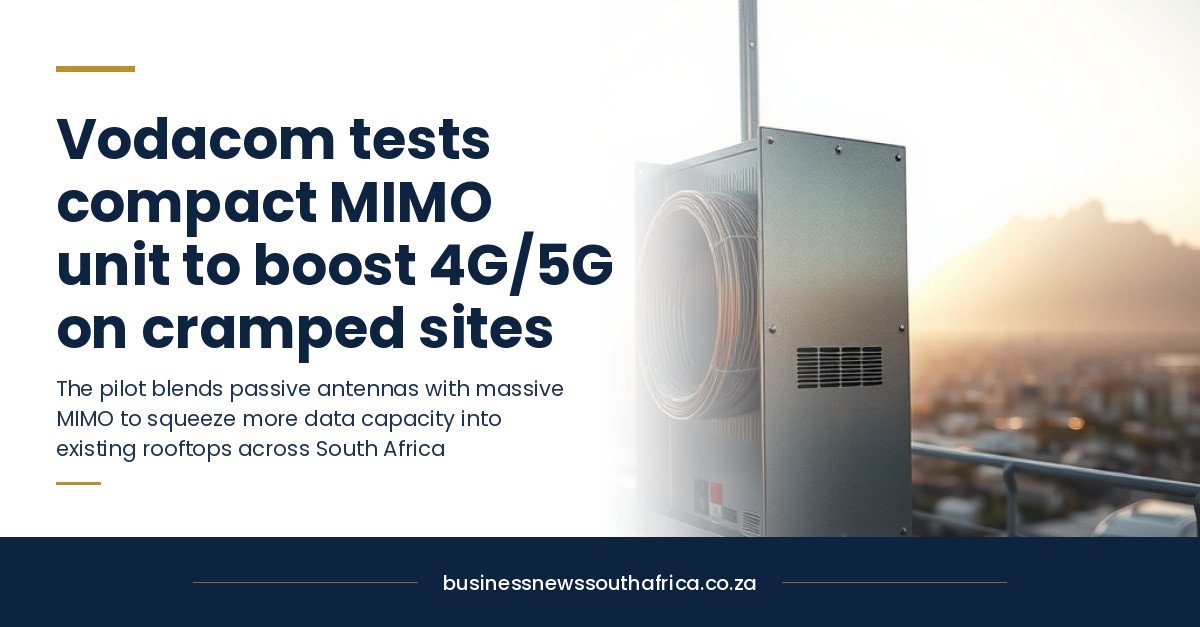
Vodacom and Nokia are testing a compact antenna that packs extra 4G and 5G capacity into sites that have run out of room, TechCentral reported. Vodacom announced on Tuesday that the unit combines conventional passive antennas with active “massive MIMO” radios in a single enclosure.
What the pilot tested
Massive MIMO (multiple-input, multiple-output) uses large arrays of small antenna elements to steer signals towards individual users instead of broadcasting in every direction, which lets one site carry more traffic. Vodacom’s pilot unit runs massive MIMO on two spectrum bands at the same time, 2.6 GHz and 3.5 GHz, and is designed for sites where limited space or existing infrastructure makes a conventional upgrade difficult. Putting the passive and active parts in one box means an operator does not have to find room for separate equipment. The trial took place in the Western Cape. Vodacom describes it as a world first for an integrated passive-active massive MIMO unit, and it follows the company’s August 2025 launch of what it called Africa’s first dual-band massive MIMO radio.
Beverly Ngwenya, technology director at Vodacom South Africa, said: “As demand for mobile data continues to grow, we need to continuously evolve our network to deliver the quality and consistency of experience our customers expect.” Vodacom said the benefits would be greatest in dense urban areas, where tower space is at a premium and expanding the network is more complex.
What Vodacom has not said
The company did not say how many sites took part in the pilot or how much extra capacity it delivered. The next step is deployment at “identified sites where additional capacity is needed”, with no timeline or site count given. Until independent measurements are published, the capacity gains remain Vodacom’s claim.
Why it matters
Mobile operators are squeezed from two sides: data demand keeps growing, and building new sites is slow, expensive and subject to municipal approvals. The scale of the build-out shows the pressure: Vodacom Group added 6,160 5G sites and 3,041 4G sites in the year to 31 March 2026, on capital expenditure of R23.6 billion, figures that cover all its African markets rather than South Africa alone. A unit that adds capacity without adding a new tower or a second set of equipment could reduce how often an operator has to build. For small businesses that rely on card machines, cloud accounting and video calls, the practical difference would show up as more reliable connections in busy city areas, although Vodacom has not said which areas will get the units first.
The announcement also lands as spectrum policy shifts. The communications minister has just withdrawn the reservation on the spectrum set aside for the Woan network, which frees frequencies that operators have wanted for capacity.