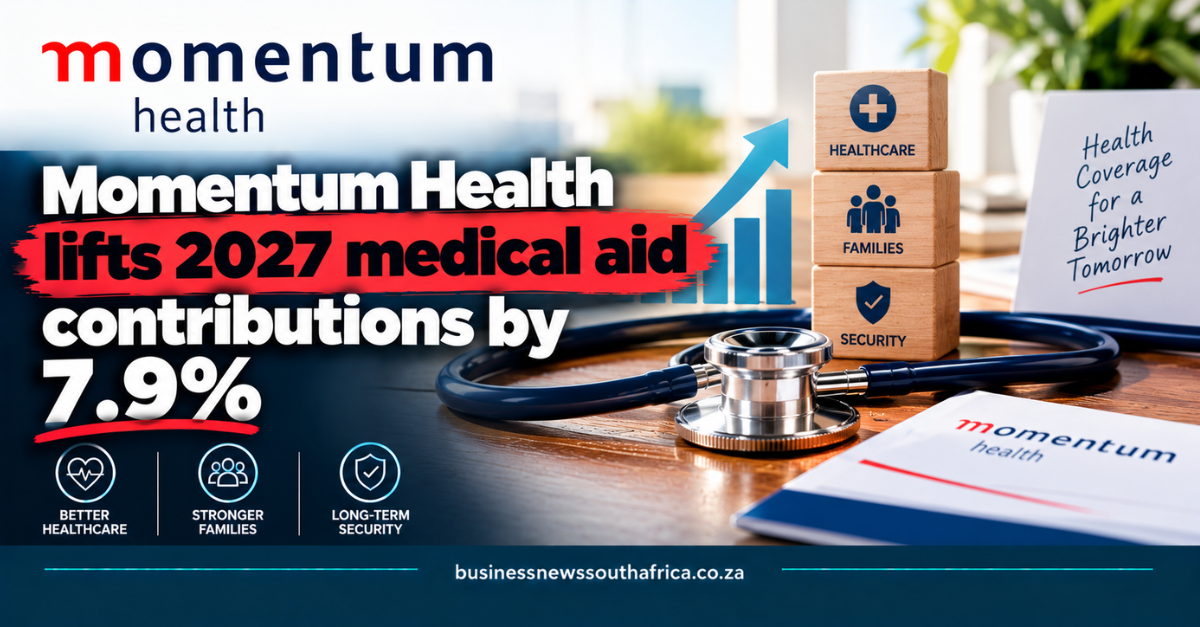
Momentum Health announced on 1 October that contributions to its medical aid scheme will rise by an average of 7.9% in 2027. The statement was published on the businesstech website. Momentum is the third-largest open scheme in South Africa, covering more than 285 000 beneficiaries.
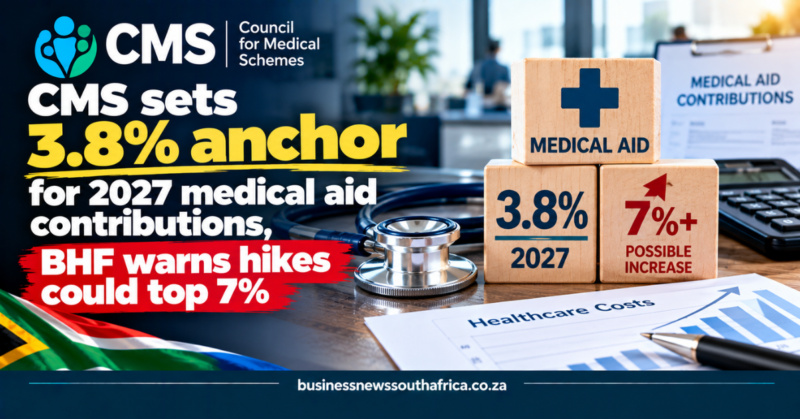
The Council for Medical Schemes (CMS) has recommended an anchor increase of 3.8% for 2027, linked to the Consumer Price Index. Historical data suggest a “reasonable” rise of between 5.8% and 7.3%. Momentum’s 7.9% figure therefore sits above the CMS anchor and the historical range, but below the industry-wide weighted assumption of 8.1% cited by the CMS.
The scheme points to a contracting market, the total private medical aid market fell by 3% between 2019 and 2024, and an ageing member base, with the average age moving from 35 to 37 years. Fewer young South Africans are joining, which puts pressure on the risk pool and the affordability of cover.
Damian McHugh, chief medical officer of Momentum Health, said the increase reflects rising delivery costs and the need to preserve meaningful benefits. He also outlined three benefit changes for 2027: higher specialist benefit limits, the replacement of under-used COVID-19 screening benefits with an over-the-counter pharmacy medicine benefit, and the introduction of a third tier for general practitioner (GP) visits.
For small-to-medium enterprises that provide medical aid as part of employee remuneration, the higher contribution could raise payroll costs at a time when wage growth is already constrained by high inflation. The added benefit tiers may offset some of the cost pressure, but the net effect will depend on how members utilise the new GP and specialist limits.
Global advisory firm WTW projects medical aid costs to rise by 10.3% worldwide in 2026 and by 11.3% in the Middle East and Africa region. Those forecasts, based on a survey of 91 countries, place Momentum’s 7.9% increase within the lower end of international expectations, according to the company’s statement.
The Board of Healthcare Funders (BHF) has warned that the CMS does not define “reasonable utilisation”, which could lead to unrealistic expectations for schemes. Momentum’s claim that the increase balances affordability, innovation and cover reflects the tension between rising health-care costs and the need to keep premiums within reach of members.
What remains unclear is how the higher contribution will affect enrolment numbers in the coming years and whether other schemes will follow a similar pricing path. The sector will likely watch the impact on member retention and on the broader debate about the sustainability of private health-care financing in South Africa.
For more coverage of financial developments affecting businesses, visit the Markets & Finance section.
In September the Council for Medical Schemes released its contribution-increase guidelines for 2027, reaffirming the 3.8% anchor that ties hikes to the Consumer Price Index. The document makes clear that the anchor is a baseline only and does not incorporate any estimate of “reasonable utilisation”, leaving schemes to determine how utilisation trends affect pricing. This approach gives each scheme discretion to set rates above the anchor, provided they can justify the increase against delivery cost pressures and member benefit expectations.
The Board of Healthcare Funders warned that the CMS’s omission of a definition for “reasonable utilisation” could create unrealistic expectations for medical-aid providers. Without a benchmark, schemes may face scrutiny from members and regulators when they set contributions above the anchor, especially if utilisation patterns shift unexpectedly. The BHF’s comment underscores the tension between regulatory guidance and the need for schemes to manage cost pressures while maintaining affordable cover.
Global advisory group WTW projected medical-aid costs to climb 10.3% worldwide in 2026, with the Middle East and Africa region expected to see an 11.3% rise. Their forecast attributes the upward trajectory to a mix of drivers, including the rollout of new medical technologies, higher pharmaceutical prices, changing utilisation patterns, and concerns around fraud, waste and abuse. These factors combine to push medical-aid inflation beyond historic norms, providing a backdrop for Momentum’s 7.9% increase.
Momentum highlighted that hospital cover remains the largest expense for medical-aid schemes, reinforcing the need for stronger prevention and early-intervention programmes. By shifting focus toward pre-emptive care, the scheme aims to curb costly hospital admissions and improve long-term sustainability. The emphasis on prevention reflects a strategic response to rising hospitalisation costs, which have historically dominated scheme outlays.
In its statement, Momentum noted that wage inflation is under pressure while healthcare costs continue to rise, prompting a product review for 2027. The review sought to balance affordability with the delivery of meaningful benefits, ensuring the scheme can adapt to evolving member needs without compromising financial stability. This rationale ties the contribution increase directly to broader macro-economic trends affecting both employers and employees.