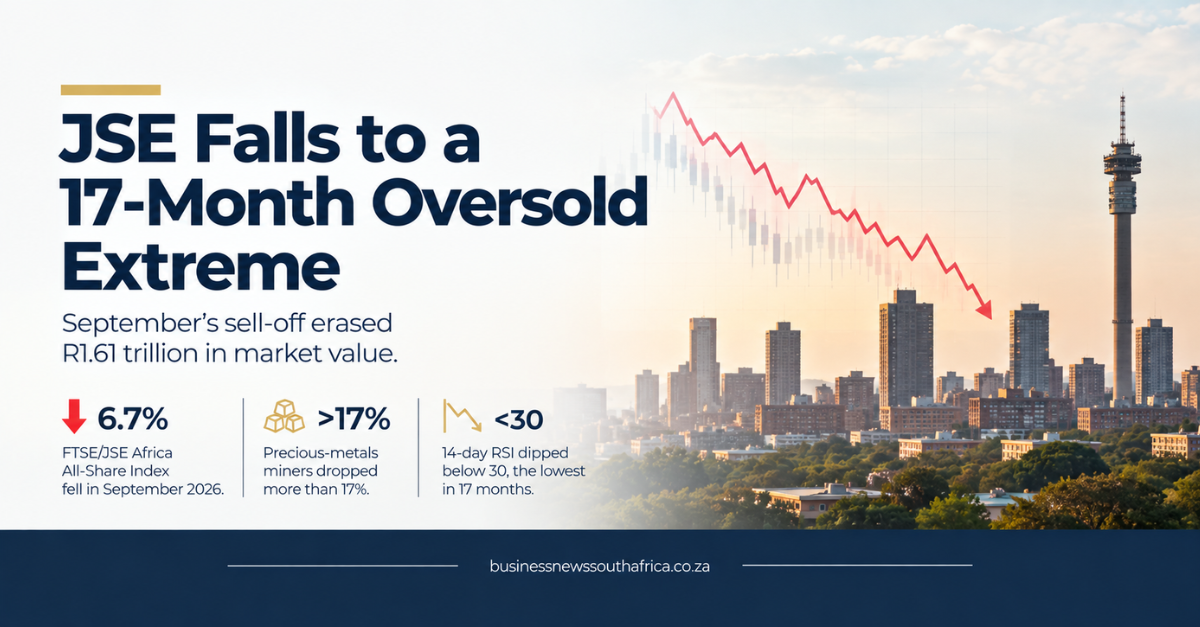
According to BusinessTech, South Africa’s benchmark stock index recorded its most oversold reading in 17 months after a near R1.6 trillion sell-off in September.
The FTSE/JSE Africa All-Share index dropped 6.7% in the month, with precious-metal miners losing more than 17% as gold and platinum prices fell. Bloomberg data shows the sell-off erased more than R1.61 trillion from the index’s market capitalisation.
The 14-day relative strength index (RSI, a momentum indicator that measures the speed and magnitude of recent price moves) fell below 30 this week, the first sub-30 reading since April 2025. Technical analysts often view an RSI under 30 as a sign that a market may have fallen too far, too fast and could be due for a bounce.
Robert Naess, a portfolio manager at Nordea Investment Management, said the decline appears driven by sentiment and capital flows rather than fundamentals. He noted that earnings expectations have held up better than share prices and that a technical bounce is likely, but a lasting recovery will depend on a softer dollar, lower real yields to support gold, and China’s economic performance, the biggest importer of South African commodities.
For most small and medium enterprises, the market move does not change day-to-day operations. However, a prolonged equity slump can raise the cost of capital for listed companies, affect pension fund valuations and dampen investor confidence, which may indirectly tighten financing conditions for growing businesses.
The index recovered slightly on Friday, erasing a loss of up to 1.5% and trading 0.3% higher as of 14:14 local time in Johannesburg.
What this means for investors
While the technical signal suggests a possible short-term rebound, any sustained rally will likely require the macro-economic factors highlighted by Naess, a weaker dollar, supportive gold prices and a rebound in Chinese demand.
Read more market analysis in the Markets & Finance section.
The September slump marked the first time the 14-day relative strength index fell below the 30 threshold since April 2025, a level that historically precedes sharp recoveries; the previous sub-30 reading was followed by an 11-month rally that lifted the index by 57% before being halted by the Iran conflict, according to the data set referenced. This pattern underscores why some traders view the current oversold condition as a potential catalyst for a pronounced upside, even though the broader market environment remains strained.
South African equities have lagged behind other emerging-market benchmarks in recent months, a divergence attributed to sustained high oil prices and a downturn in metal prices that have eroded the nation’s terms of trade. The combination of these external pressures has amplified volatility in the FTSE/JSE Africa All-Share index, reinforcing the sentiment-driven nature of the recent sell-off.
Naspers, a heavyweight constituent of the index, exhibits a strong correlation with Tencent Holdings, reflecting its 23% ownership stake in the Chinese technology giant. This linkage means that fluctuations in Tencent’s performance can reverberate through the South African market, adding another layer of sensitivity to global tech trends and Chinese economic developments.
The calculation of the market-capitalisation loss hinges on Bloomberg’s aggregation of individual company valuations within the index; when the gauge shed more than R1.61 trillion, it represented the cumulative decline across all listed constituents, not merely the most volatile sectors. This methodology provides a comprehensive view of the equity base’s contraction during the September rout.
Technical analysts monitor the relative strength index as a momentum gauge that compares the magnitude of recent gains to recent losses over a set period, with a sub-30 reading suggesting that selling pressure may have been excessive. When the RSI rebounds above this threshold, it often signals that buying interest is returning, potentially prompting short-term traders to initiate positions in anticipation of a corrective move.
Following the Friday rebound that erased a loss of up to 1.5%, the index settled 0.3% higher at 2:14 p.m. local time. Market participants will now watch for subsequent price action to confirm whether the technical bounce sustains, while also gauging any shifts in the dollar, real yields, gold prices and Chinese demand that could influence the longer-term trajectory.