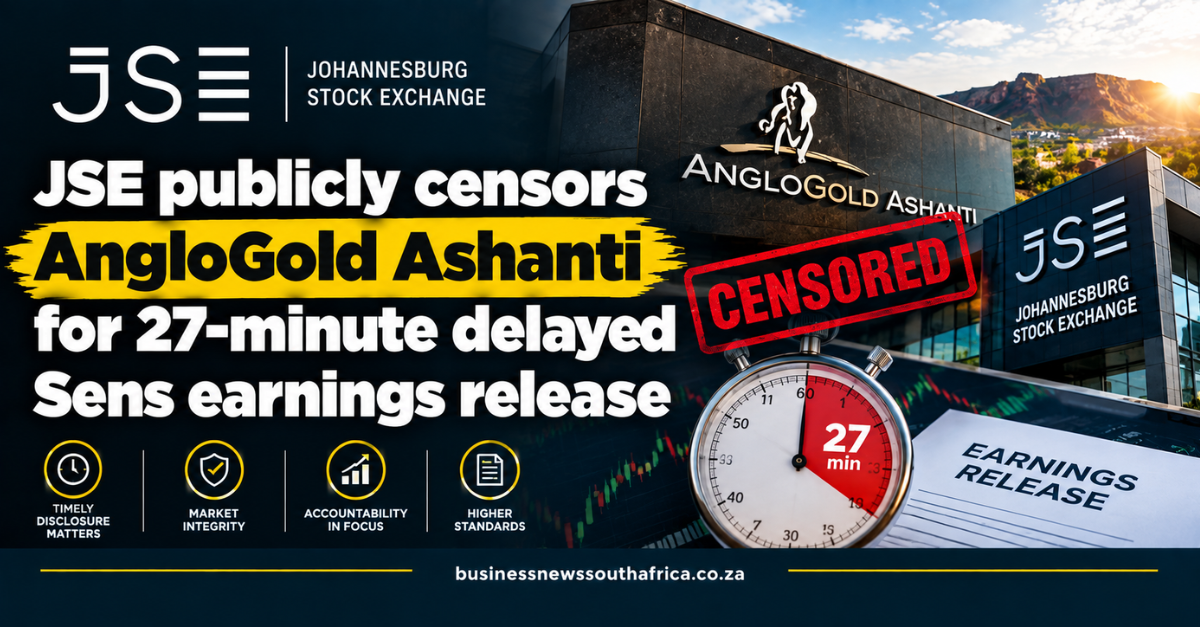
The Johannesburg Stock Exchange (JSE) has issued a public censure against AngloGold Ashanti plc after the company released its second-quarter and half-year results on Bloomberg 27 minutes before the same information appeared on the JSE’s electronic news service, Sens. The regulator said the breach violated paragraph 18.21(b) of the JSE Listings Requirements, which obliges dual-listed entities to publish price-sensitive announcements on Sens at the same time as, or no later than, their release on foreign exchanges.
Price-sensitive information is any data that a reasonable investor would use to make a buying or selling decision. In South Africa, such information must be disclosed on Sens, the platform that feeds all listed-company announcements to local investors. By allowing the results to appear on Bloomberg during the NYSE pre-opening session, AngloGold Ashanti gave overseas investors access to the data before South African shareholders could react on the JSE floor.
Why the timing matters
When the JSE was open for active trading, the local market operated for 27 minutes with a material information gap. The exchange noted that the NYSE pre-opening session started at 12:30 pm, while core trading on the JSE began at 3:30 pm. During that window, local investors could trade on the basis of information that was already public abroad, creating an uneven playing field.
The JSE’s statement stressed that equal access to information underpins market fairness, transparency and confidence. Any delay, even of a few minutes, can lead to trades that are not based on the same data set, which the regulator says erodes trust in the market.
Company’s response and regulator’s view
AngloGold Ashanti argued that achieving simultaneous or near-simultaneous disclosure across both exchanges was not feasible. After a formal investigation, the JSE concluded that compliance with the simultaneous disclosure rule was “reasonably achievable” and therefore the company’s explanation did not excuse the breach.
The public censure is a formal reprimand that appears on the company’s record with the JSE. While it does not carry a monetary fine, it signals to investors that the firm failed to meet a core governance requirement. The regulator’s finding may prompt the company to review its internal processes for coordinating announcements across time zones.
Implications for other dual-listed firms
AngloGold Ashanti’s case serves as a reminder that any company listed on both a foreign exchange and the JSE must have systems in place to release price-sensitive information at the same moment on both platforms. The rule applies to all dual-listed entities, not just large miners, and non-compliance can lead to similar censures.
For South African investors, the censure is a reminder that a company listed on more than one exchange can disclose on one market before the other. Clear, on-time disclosure is what the Sens system exists to provide, and the JSE’s public censure is the sanction it chose for a 27-minute lapse.
AngloGold Ashanti has not indicated whether it will appeal the censure. The JSE’s decision is final unless the company seeks a review through the exchange’s appeals process.
Read more about market-integrity rules in the Markets & Finance section.
The regulator’s finding, released on Friday, notes that an external party first alerted the JSE that AngloGold Ashanti’s results had appeared on Bloomberg 24 minutes before the Sens posting, prompting the exchange to open a formal investigation. The investigation concluded that the simultaneous-disclosure rule was “reasonably achievable”, rejecting the company’s claim that timing across time zones was impossible. By documenting the precise timeline of the breach, the JSE created a factual record that will form part of any future appeal the miner might lodge, and that record now sits alongside the public censure on the company’s compliance history.
Paragraph 18.21(b) of the Listings Requirements obliges dual-listed entities to publish price-sensitive announcements on Sens at the same time as, or no later than, their release on foreign exchanges. When a breach is alleged, the JSE first verifies the allegation, then issues a regulatory finding that details the nature of the breach and the applicable rule. If the finding confirms non-compliance, the exchange may impose sanctions such as a public censure, which is recorded on the company’s JSE file but does not involve a monetary penalty. The company may then seek a review through the exchange’s appeals process.
The JSE’s statement underscored that equal information access is fundamental to market integrity, quoting that “timely and equivalent dissemination of information ensures that all investors, irrespective of their location or the exchange through which they access information, have equal and simultaneous access to such information.” This rationale links the specific breach to the broader principle that any delay could allow some investors to trade on information not yet available to the wider market, thereby eroding confidence in the fairness of the exchange.
In practice, once a public censure is issued, the affected company must update its internal disclosure procedures to prevent recurrence. The regulator expects the firm to align its announcement workflow with the NYSE pre-opening schedule of 12:30 pm and the JSE’s core trading start at 3:30 pm, ensuring that any price-sensitive release reaches Sens before the foreign exchange disseminates it. Compliance monitoring continues, and any further deviation could trigger additional regulatory action under the same Listings Requirements.