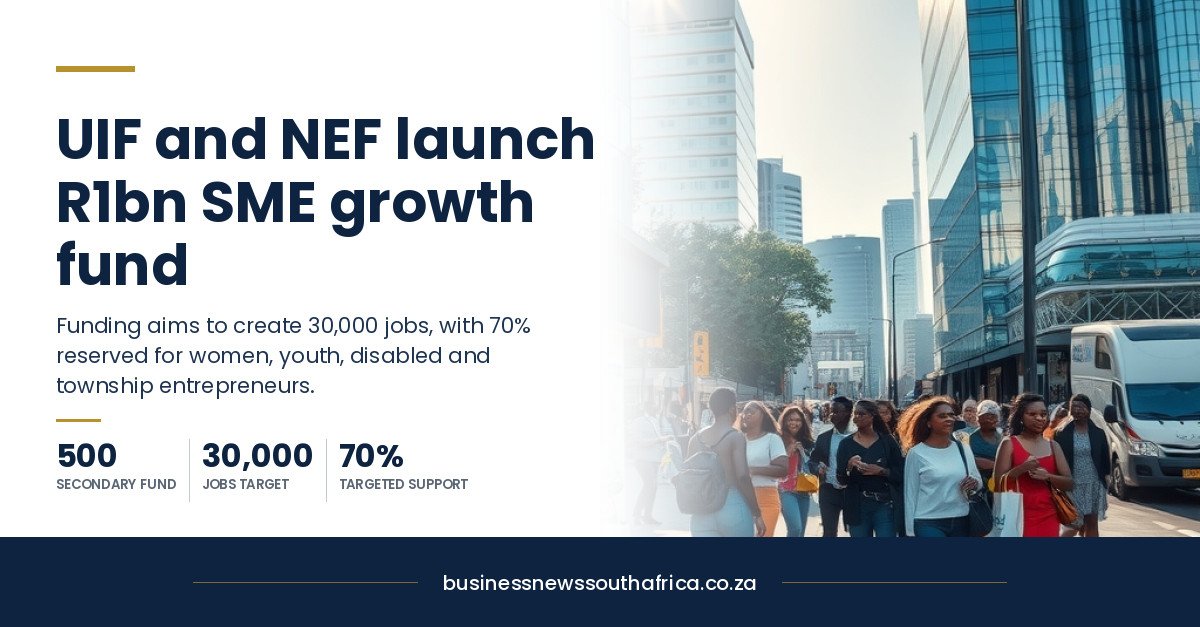
The Unemployment Insurance Fund (UIF) and the National Empowerment Fund (NEF) have jointly committed R1 billion, R500 million each, to a five-year programme aimed at growing small and medium enterprises and creating 30,000 jobs, with the NEF implementing the scheme.
At least 70% of support under the programme is reserved for businesses owned by women, young people and people with disabilities, along with enterprises based in townships and rural areas, a built-in skew that matters for owners who have historically struggled to access funding instruments weighted toward urban, male-led and already-established businesses. The programme also names four priority sectors: tourism, agriculture, beauty, and digital businesses.
Why two different funders are combining budgets
The UIF, better known for paying out unemployment benefits and the Temporary Employer-Employee Relief Scheme (TERS) payouts that kept businesses afloat during COVID-19 lockdowns, is an unusual name to see backing a small business growth fund. The logic connecting the two roles is straightforward: an unemployment fund has a direct financial interest in fewer people needing unemployment benefits in the first place, and a small business that survives and scales is one that keeps people off the UIF’s own books rather than on them.
“This instrument therefore aims to respond to the plight of small businesses,” said Thulani Tshefuta, the UIF’s acting commissioner. The NEF, a state-owned development finance institution focused on black economic empowerment, brings the enterprise-development infrastructure the UIF does not have in-house: combining the money with mentorship, skills training and technical support for the businesses it backs, rather than disbursing a cash grant and leaving owners to execute alone.
What this is not
A R1 billion fund sounds large until it is set against the target: 30,000 jobs over five years works out to roughly R33,000 of fund capital per job created, which includes the enterprise-development and mentorship cost, not just disbursed capital, over the life of a loan or investment rather than a one-off grant per job. It is a modest per-job figure by the standards of large industrial incentive schemes, which is the point: this is pitched at small businesses that can absorb a few hundred thousand rand of growth capital and a handful of new hires, not large capital projects.
Deputy Minister of Trade, Industry and Competition Zuko Godlimpi connected the fund to a broader policy goal rather than treating it as a standalone initiative: “South Africa must also expand the number of enterprises capable of creating those opportunities,” he said, framing job creation as downstream of first having enough viable small businesses in existence to do the hiring.
The sectors chosen, and what they signal
Tourism and agriculture are established small-business sectors in South Africa with existing supply chains and seasonal cash flow challenges that a growth fund paired with mentorship could genuinely ease. Beauty is a less conventional choice for a government-backed fund, but it is a sector with low barriers to entry, high representation among women-owned township and rural businesses, and limited existing access to formal growth finance, which fits the 70% targeting criteria closely. Digital businesses rounds out the list as the sector least tied to a physical location, making it the most plausible route for a rural or township-based entrepreneur to reach customers well beyond their immediate area without the transport and logistics costs that weigh on physical retail or agricultural businesses in the same areas.
What the programme has not yet published is the operational detail that determines whether it works in practice: how a business applies, what documentation the NEF requires, and what the actual loan or investment terms look like for an individual small business owner rather than at the fund’s aggregate level. Those details, once published, will determine whether this becomes another funding line SME owners have heard about but struggle to access, or one that reaches businesses that other instruments do not.