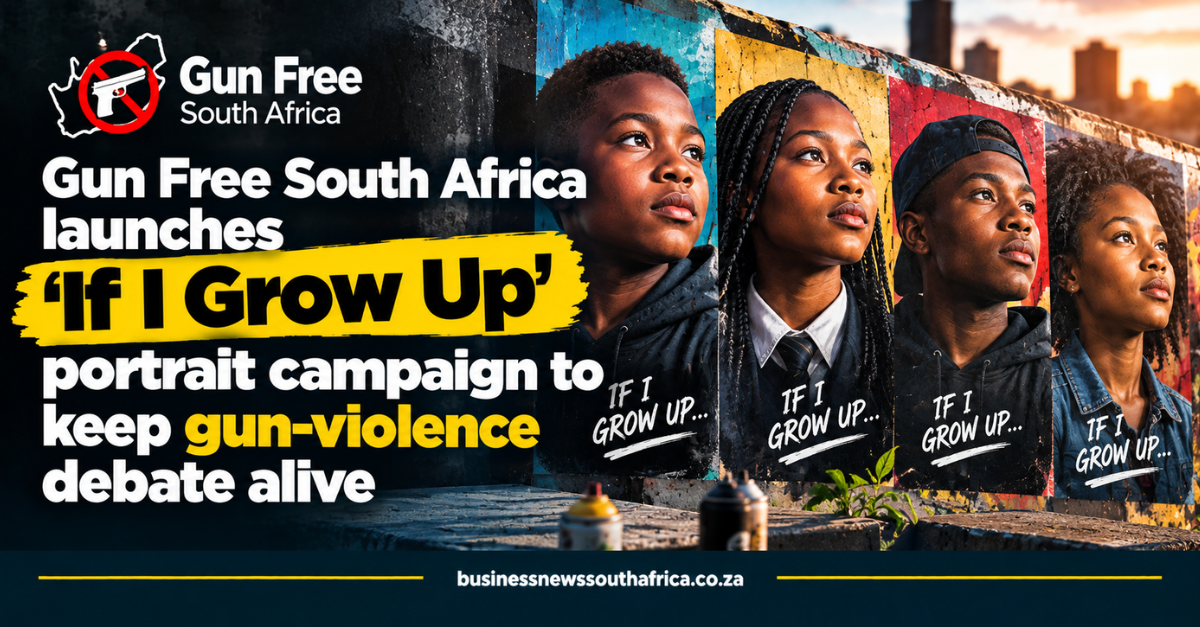
Gun Free South Africa (Gun Free SA) has rolled out a new public-awareness drive called “If I Grow Up”, according to a press release on Bizcommunity. The campaign replaces graphic images of shootings with striking portraits of real children, each stating what they hope to become, doctor, teacher, athlete, and the simple line “If I Grow Up”. The aim is to keep gun-violence in the national conversation and build public support for stricter firearm regulations.
Dr Stanley Maphosa, executive director of Gun Free SA, said the objective is to keep gun violence on the agenda and continue building public support for stronger gun-control measures. He noted that nearly 200 children are killed each year in South Africa, and the campaign is designed to make the human cost impossible to ignore.
Delano Chengan, creative director at M+C Saatchi Abel, explained that the campaign is a reminder that reducing gun violence is not just about saving lives, but about protecting children’s futures. M+C Saatchi Abel managing director Masego Motsogi added that the campaign is intended to sustain awareness, generate media coverage and reinforce Gun Free SA’s position as the leading voice advocating for safer communities.
The campaign will be delivered across digital, print and social-media channels, with plans for exhibitions and community-engagement events. According to the release, the multi-channel approach is meant to reach a broad audience, from policymakers to parents, and encourage collective action to protect children’s futures.
What this means for the policy debate
Gun Free SA’s strategy is to shift the conversation from abstract statistics to personal stories, hoping that the emotional impact of children’s aspirations will translate into pressure on legislators. While the release does not cite any specific legislative proposals, the organisation has historically lobbied for tighter licensing, stricter background checks and measures to remove illegal firearms from circulation.
For businesses and community leaders, the campaign signals a continued push for a regulatory environment that could affect security costs, insurance premiums and workplace safety protocols. Companies operating in high-risk areas may need to monitor any forthcoming policy changes that could arise from increased public pressure.
All statements from Gun Free SA, M+C Saatchi Abel and the quoted individuals are claims made by those organisations and have not been independently verified.
Read more about similar advocacy efforts in the Regulatory & Policy section.
The portrait series deliberately replaces graphic depictions of shootings with images that foreground children’s ambitions, a tactic that the campaign’s creators say forces viewers to confront “the heartbreaking reality that for many South African children, growing up is not a guarantee”. By pairing each child’s hopeful statement with a simple line, the visual narrative creates a tension between hope and reality that audiences can instantly grasp, according to the campaign brief. This approach is intended to move the conversation beyond statistics and make the human cost of gun violence unmistakable, reinforcing the message that every child deserves a future free from stray bullets.
Delano Chengan highlighted that the campaign’s core aim is to protect children’s futures, not merely to save lives, emphasizing that “reducing gun violence isn’t just about saving lives, it’s about protecting children’s futures”. The creative team believes that by showcasing aspirations such as becoming doctors, teachers or athletes, the portraits strike directly at the heart of what is at stake. This focus on personal dreams is meant to generate a visceral response that can translate into broader public pressure for policy change, aligning with Gun Free SA’s long-standing advocacy for stricter licensing and background checks.
Masego Motsogi explained that sustaining awareness requires “meaningful media coverage” and that the multi-channel rollout is designed to keep the issue in the public eye. By deploying digital, print and social-media touchpoints alongside planned exhibitions and community-engagement events, the campaign seeks to reach a diverse audience ranging from policymakers to parents. The breadth of the distribution strategy is intended to ensure that the message resonates widely and encourages collective action to safeguard children’s futures across the country.
The campaign’s structure follows a typical advocacy cycle: first, a high-impact visual element is introduced to capture attention; second, the message is amplified through coordinated media releases and social sharing; third, community events provide a platform for dialogue and grassroots mobilisation. Once public sentiment builds, the organisation can leverage that pressure to lobby legislators for tighter firearm regulations. The timeline for these steps is aligned with the campaign’s launch, with media bursts scheduled over the coming weeks and exhibition dates to follow, keeping the issue continuously visible.
Anele Mjali, a copywriter on the project, framed the effort as a challenge for the audience to question why “growing up has become such an uncertainty for so many children”. By urging South Africans to see gun violence as a changeable condition rather than an inevitable part of daily life, the campaign hopes to spark a conversation that can lead to concrete legislative proposals. The underlying premise is that heightened public awareness will create the momentum needed for policymakers to consider stricter controls and measures to remove illegal firearms from circulation.