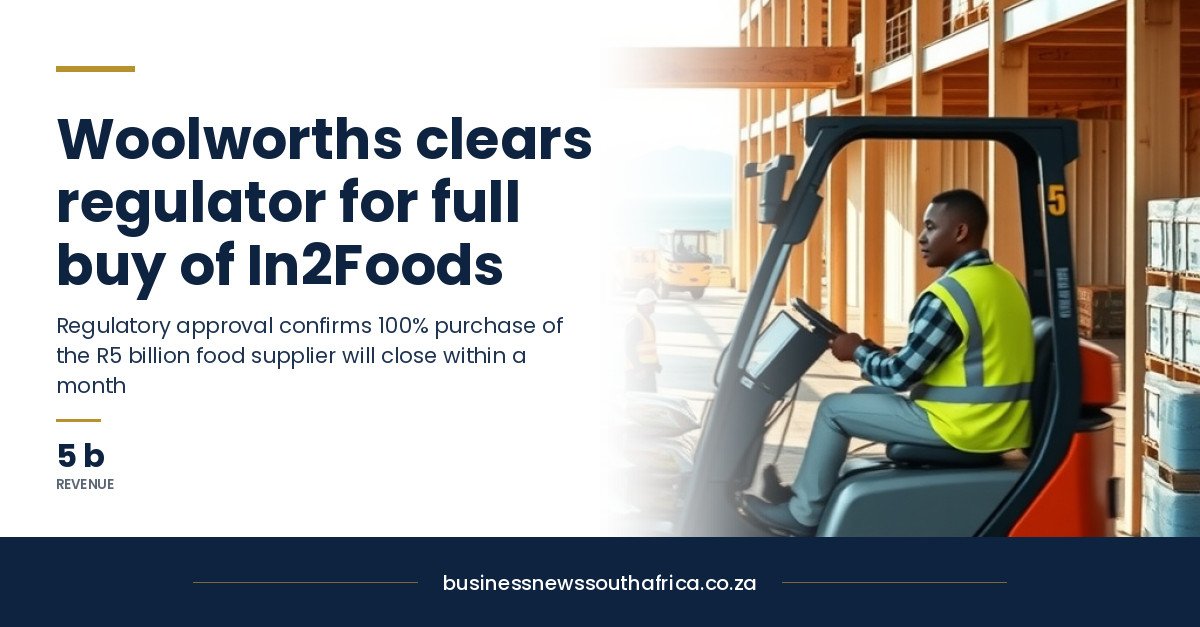
Woolworths said on the JSE Stock Exchange News Service that all regulatory suspensive conditions for its 100% acquisition of In2Foods have been satisfied, and the transaction is expected to close in the coming month. The announcement was first made in March 2026 and the full statement can be read on the source article.
Regulatory suspensive conditions are clauses that must be met before a deal can be finalised. In this case the Competition Commission of South Africa had to give its approval because the deal is classified as a large merger, a transaction involving two companies whose combined turnover exceeds a set threshold. The commission’s sign-off means Woolworths can proceed, but only if it complies with a set of conditions designed to protect competition and jobs.
In2Foods is a major player in the South African food industry, generating roughly R5 billion in annual revenue. Woolworths has been its biggest customer for more than three decades, buying a large share of the supplier’s output for its own stores. The size of both firms triggered the large-merger classification, which brings stricter scrutiny.
The commission’s recommendations include two key requirements. First, Woolworths must continue to purchase from other food suppliers for a defined period after the merger, ensuring that smaller producers are not squeezed out of the market. Second, the parties agreed not to retrench any employees as a result of the transaction for the duration of a moratorium period, protecting jobs at In2Foods.
Woolworths said the purchase will strengthen its food business, which it describes as its primary growth engine and its strongest source of competitive advantage. The company expects the deal to be earnings-accretive, meaning it should lift earnings per share, and to generate additional benefits as integration efficiencies are realised over time.
For small and medium-sized food manufacturers, the competition-authority condition could be a double-edged sword. On the one hand, the requirement for Woolworths to keep buying from other suppliers may preserve market access for niche producers. On the other hand, the closer tie between Woolworths and In2Foods could raise the bar for suppliers who need to meet higher volume or quality standards to stay in the retailer’s favour.
The employment moratorium offers a clear safeguard for In2Foods staff. By prohibiting retrenchments linked to the merger, the condition reduces the risk of job losses that often accompany large acquisitions. This is likely to be welcomed by unions and local communities that rely on the supplier for employment.
After the transaction closes, In2Foods will become a wholly-owned subsidiary but will continue to operate as a standalone business within Woolworths’ broader ecosystem. The current senior leadership team is expected to remain in place, preserving the entrepreneurial culture that the company attributes to its success.
Woolworths has been sharpening its focus on premium food, a strategy that has driven recent store remodels and new product launches. The In2Foods acquisition marks the latest step in that vertical integration, giving the retailer greater control over its supply chain and the ability to respond more quickly to changing consumer tastes.
Woolworths disclosed that the acquisition paperwork was lodged with the Competition Commission on 18 March 2026, a day after the public announcement on 17 March. The commission’s initial recommendation to approve the deal, together with its conditions, was issued at the start of September, signalling that the regulator had completed its substantive review well before the final clearance. By satisfying the “customary” regulatory suspensive conditions, Woolworths has cleared the final hurdle that typically delays large-merger closures, allowing the transaction to move toward completion within the next month as outlined in its Stock Exchange News Service filing.
The competition authority’s conditions focus on two core safeguards. One mandates that Woolworths continue to source from rival food producers for a defined period after the merger, a measure intended to keep market entry viable for smaller manufacturers. The other imposes a moratorium on any retrenchments linked to the acquisition, ensuring that the workforce at In2Foods remains intact throughout the transition. These provisions are designed to preserve competitive dynamics and protect employment, addressing the regulator’s concerns about market concentration and job security.
Following the closing, In2Foods will become a wholly-owned subsidiary yet will retain its status as a standalone entity within Woolworths’ broader ecosystem. The retailer affirmed that the current senior leadership team will stay on board, a move aimed at safeguarding the entrepreneurial culture that has driven In2Foods’ success since the 1990s. Maintaining this continuity is expected to ease integration, allowing the supplier to keep its existing client relationships, including those with several local and international food groups.
Woolworths highlighted several strategic gains from the deal. It expects the acquisition to be earnings-accretive, bolstering earnings per share while unlocking efficiencies over time. By bringing In2Foods into its premium food ecosystem, Woolworths aims to diversify its product portfolio, strengthen supply-chain resilience and enhance speed-to-market. The company argues that greater integration will increase agility across the chain, improving responsiveness to shifting consumer tastes and supporting its focus on growth in the food segment.