According to a press release posted on Bizcommunity, Hoorah, a marketing consultancy that builds internal and hybrid agency capabilities, argues that in-housing is no longer an experiment and that the future lies in hybrid models that blend internal teams with external partners.
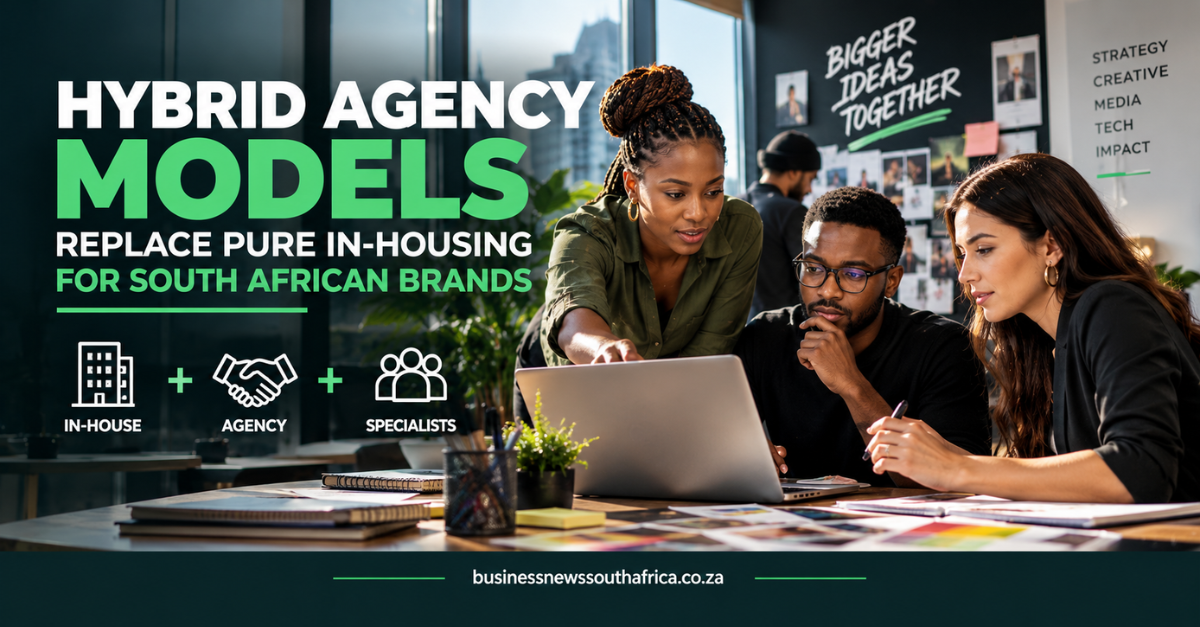
A hybrid model, as defined by Hoorah, means a brand keeps certain capabilities, such as content creation, data analysis or social media, inside its own organisation while still contracting specialist agencies for big-idea strategy, complex production or niche technology. The goal is to keep work that benefits from close proximity to the business in-house, but to call on outside expertise where it adds value.
International research supports the trend. The Association of National Advertisers (ANA) in the United States found that 82% of organisations surveyed already run some form of in-house agency. Later ANA studies show internal teams are increasingly seen as strategic partners rather than low-cost production units. The data suggests the debate has moved from “if” to “how” brands allocate work.
Examples from large brands
AB InBev’s DraftLine model, now operating across ten African markets with roughly 100 staff, is a flagship internal creative operation. PepsiCo has built a central content team that serves multiple brands. Hoorah cites work it has done for Nestlé, Private Property, Avon, Alexforbes, Heineken Beverages and AB InBev, creating internal studios or hybrid structures tailored to each client’s size and needs.
These cases illustrate that there is no single template. One company may need a full-scale studio, another a small embedded team, and some may simply need better processes for allocating briefs between internal and external resources.
The rapid adoption of generative AI adds both opportunity and risk. AI can generate many variations of a campaign quickly, allowing brands to personalise content at scale. However, Hoorah warns that AI does not replace creative judgement or brand governance. Companies must still set up clear workflows, data-ownership rules and quality controls to avoid producing large volumes of low-value material.
For South African brands, the shift means faster briefing cycles, closer access to data and the ability to retain talent within the organisation. Cost savings are most evident for high-volume, always-on work such as social posts or performance-driven creative. At the same time, brands risk turning internal studios into order-taking units that lose outside perspective if they do not maintain strong leadership and external partnerships.
SMEs should note that the hybrid approach is most common among large, multi-brand organisations that can justify dedicated internal teams. Smaller firms may find it more practical to outsource most work while keeping a lean internal function for brand-specific tasks. The key decision is not whether to in-source, but which capabilities deliver the greatest strategic advantage when kept close to the business.
For further reading on how hybrid models are being adopted locally, see the SME & Entrepreneurship section.
Hoorah’s “Inside” offering has been the vehicle for most of the South African hybrid builds, delivering bespoke internal studios for brands ranging from Nestlé to Heineken Beverages. The firm’s global partner Monks has also contributed to the rollout, having previously supported T-Mobile, Manulife and Sprint with embedded teams and capability-building programmes. By leveraging the Inside platform, Hoorah can map a brand’s existing talent pool, identify gaps and then design a structure that blends permanent staff with external specialists. This approach allows organisations to avoid the “one-size-fits-all” pitfall and instead create a flexible hub that can scale up or down as campaign demands shift.
The practical steps of moving work in-house begin with a brief-management audit, where each type of request is categorised by strategic importance and execution complexity. Brands then allocate “core” functions, such as social media, CRM or localisation, to internal owners, while routing “big-idea” strategy, specialist production or niche technology to external agencies. Governance frameworks are drafted to define ownership of creative quality, intellectual property and data, ensuring that both sides understand their responsibilities. Once the split is documented, workflow tools are configured to route briefs automatically, providing visibility and reducing hand-off friction.
AI’s rapid adoption has reshaped the economics of content creation, enabling a single campaign to be spun into hundreds of variations across audiences, formats and languages. Generative tools can accelerate localisation and performance-driven creative, but they also generate large volumes of low-value output if unchecked. Hoorah stresses that granting marketers access to AI does not automatically create an AI-enabled organisation; robust governance, clear data-ownership rules and a strong creative leadership layer remain essential. The technology should be viewed as a multiplier for talent, not a substitute for human judgement, with brand systems and architecture dictating how generated assets are stored and reused.
Proximity to the business brings tangible advantages: internal teams develop institutional knowledge, enjoy direct stakeholder access and can shorten briefing cycles, allowing brands to react swiftly to market opportunities. Cost efficiencies emerge especially for high-volume, always-on work such as social posts or performance creative. However, without disciplined leadership, internal studios risk becoming order-taking factories that lose external perspective. Balancing speed, relevance and commercial efficiency while safeguarding brand integrity is therefore the central challenge of any hybrid model.