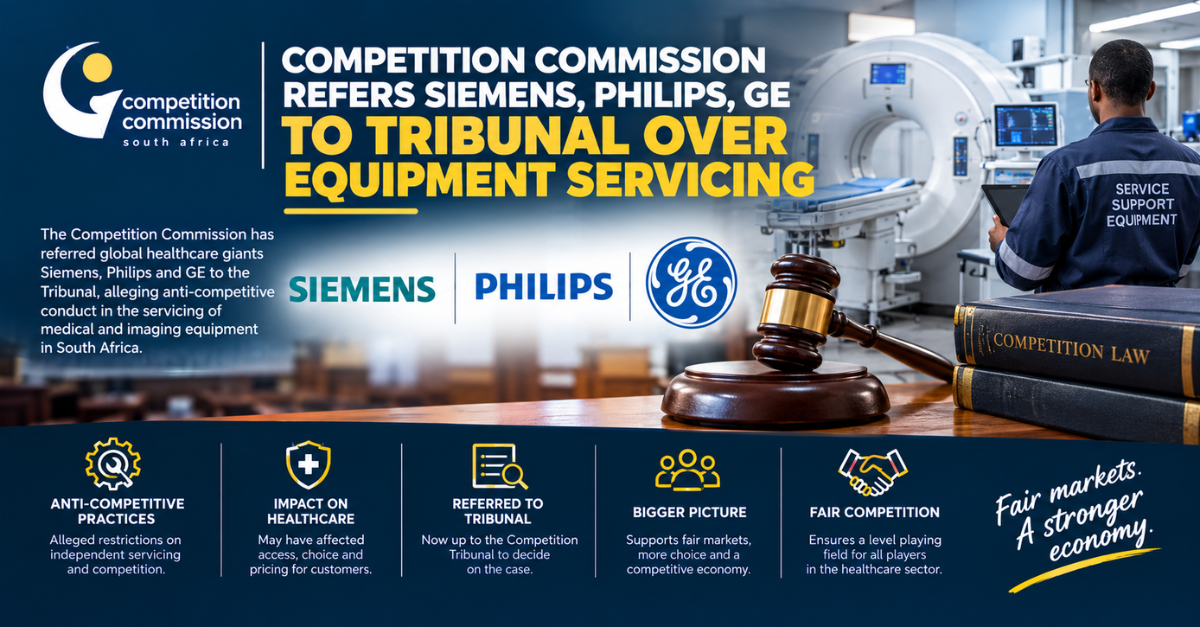
The Competition Commission has referred GE South Africa, GE Medical Systems South Africa, Siemens Healthcare and Philips South Africa Commercial to the Competition Tribunal for possible breach of the Competition Act. The referral, reported by BusinessTech, centres on alleged anti-competitive conduct in the servicing, repair and maintenance of diagnostic medical imaging (DMI) equipment, the X-ray, ultrasound, magnetic resonance imaging (MRI), computed tomography (CT) and PET/CT systems used in South African hospitals.
The commission says the four respondents are accused of denying or restricting independent clinical engineers, often small-scale service firms, access to spare parts, diagnostic software, service keys, technical information and specialised training. By limiting these inputs, the companies allegedly make it difficult for third-party engineers to compete in the aftermarket for DMI servicing.
DMI equipment costs millions of rand and is typically kept in service for 10 to 15 years. When a scanner or X-ray machine breaks down, hospitals need rapid repairs, software updates and preventive maintenance to keep the device operational. The commission warns that prolonged downtime can delay diagnosis and treatment, especially in public and rural facilities where alternatives are scarce. This can worsen outcomes for patients battling cancer, cardiovascular disease, diabetes, hypertension, HIV and tuberculosis.
Legal framework
The commission alleges the conduct breaches section 8(1)(c), which bars a dominant firm from engaging in exclusionary acts, or alternatively section 8(1)(d)(ii) of the Competition Act. The latter specifically prohibits a dominant firm from refusing to supply scarce goods or services to a competitor when doing so is economically feasible. If the tribunal finds a breach, it can impose remedies such as divestiture of assets, mandatory licensing of parts or software, or financial penalties.
For independent service providers, a tribunal ruling against the four firms could open the market to more competition, potentially lowering repair costs and reducing equipment downtime. For hospitals, especially those in the public sector, cheaper and quicker servicing could translate into better patient throughput and lower overall healthcare expenditure.
Conversely, the respondents argue that their service models are designed to ensure safety and quality, claiming that unrestricted access to proprietary software and service keys could compromise equipment integrity. The tribunal will have to balance these safety concerns against the competition concerns raised by the commission.
The case highlights a broader issue in South Africa’s healthcare supply chain: the reliance on a few multinational manufacturers for both equipment and after-sales support. As the sector seeks to expand diagnostic capacity, especially in under-served regions, the outcome of this referral could shape how future contracts are structured and whether local service firms can play a larger role.
Stakeholders, including hospital procurement officers and independent engineering firms, are watching the proceedings closely. The tribunal’s decision will set a precedent for how competition law is applied to high-value, long-life medical assets and could influence the cost structure of diagnostic services across the country.
Read more about the regulatory context in our Regulatory & Policy coverage.
The commission highlighted that the four firms “operate nationwide, supplying and servicing diagnostic medical imaging equipment”, underscoring the breadth of their market reach. It added that “this equipment is essential diagnostic infrastructure, enabling South Africa’s healthcare practitioners to see inside the body, detect and monitor diseases, make accurate diagnoses, plan appropriate treatment and, in some cases, prevent disease”. By linking access to functional DMI systems with the constitutional right of access to healthcare services, the regulator framed the issue as not merely commercial but also a matter of public policy and patient rights.
After the referral, the Competition Tribunal will conduct a formal inquiry to decide whether the conduct breaches section 8(1)(c) or section 8(1)(d)(ii) of the Competition Act. Both sections target exclusionary conduct by a dominant firm, with the latter focusing on the refusal to supply scarce goods or services when feasible. Should the tribunal find a breach, it may order remedies such as mandatory licensing of parts or software, divestiture of assets, or impose financial penalties, thereby reshaping the aftermarket dynamics for DMI servicing.
The commission’s investigation uncovered allegations that the respondents denied independent clinical engineers access to spare parts, diagnostic software, service keys, technical information and specialised training. By restricting these key inputs, the alleged conduct “limits competition in the aftermarket for servicing and repairs, contributing to higher costs and fewer repair options for healthcare facilities”. This restriction, according to the commission, directly inflates the cost of maintaining equipment that costs millions of rand and remains in service for 10 to 15 years, affecting overall healthcare expenditure.
Procedurally, the tribunal will invite written submissions from the respondents and any interested parties, followed by oral hearings where evidence is examined in detail. The process can extend over several months, allowing the commission, the firms and independent service providers to present arguments and expert testimony. Once a judgment is rendered, any imposed remedies become enforceable, and compliance will be monitored to ensure that spare parts, software and training become readily available to qualified third-party engineers.