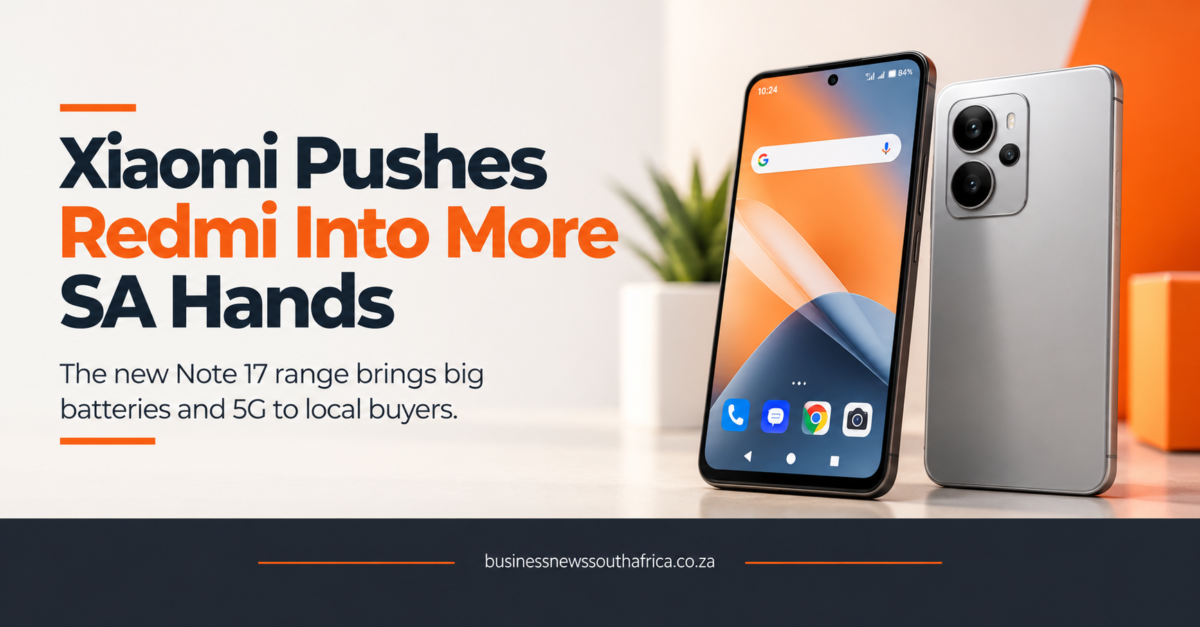
Xiaomi’s new South African country manager, Tianshi Lv, wants to repeat the share gains he says he delivered in Peru, and the Chinese electronics maker is launching the Redmi Note 17 smartphone range here to do it, TechCentral reports. Lv, who took over the South African role in March 2026, said Xiaomi now regards the country as “an important market and strategic market”. In his first media interview in the role, he declined to say what share Xiaomi holds locally or what it is aiming for.
The Peru playbook
Lv spent six years running Xiaomi in Peru, where he says its smartphone share grew from 1% to 30%, making it the country’s biggest phone brand. According to TechCentral, the approach has three parts and all of them will be applied in South Africa: build awareness of the brand, sell a complete range of products across price points, and sell through every channel, meaning mobile operators, retailers and online stores.
Lv said South African consumers know their technology and are brand loyal, so Xiaomi has to “tell our story” before it can expect people to switch. The research firm Omdia, as reported by TelecomLead, put Xiaomi first in Peru in the second quarter of 2026 with 28% of shipments, ahead of Samsung on 25%. That is close to, but not the same as, the 30% Lv cited. The two figures may measure different things and different periods, and Lv did not say which source he used.
Asked why Xiaomi is confident in a market with weak economic growth and little disposable income among consumers, Lv did not address the economy directly. He said South Africa has a large number of technology-literate consumers and that Xiaomi is here for the long term. He was also reluctant to say whether operator contracts are losing ground to cash purchases and e-commerce. “The market is still very diverse,” he said.
A hard quarter for Xiaomi
The push comes at a difficult moment. According to Omdia, Xiaomi’s global smartphone shipments fell 26% year on year to 31.2 million units in the second quarter of 2026, against a 6% fall in the overall market to 272 million units. Xiaomi held third place globally, behind Samsung with 60.5 million units and Apple with 55.1 million, Cyprus Mail reported.
Omdia said more than half of Xiaomi’s shipments sell for under US$200, which made it the top-five vendor most exposed to higher memory chip costs. Demand fell sharply in emerging Asia-Pacific and Latin American markets, where higher entry-level prices hurt buyers. Omdia expects high component costs to keep limiting supply and keeping prices high for the rest of 2026, with shipments continuing to decline over the next two quarters, though more slowly.
Asked how Xiaomi is coping with higher component costs, and whether the new range costs more than its predecessors, Lv did not answer directly. He pointed instead to the specifications, saying Xiaomi is bringing flagship features to mid-range devices.
The Redmi Note 17 range
Three models went on sale in South Africa last week through Vodacom, Takealot, Incredible Connection, HiFi Corp and TFG. TechCentral lists the Redmi Note 17 Pro Max 5G at R15 999, or from R599 a month on a 36-month contract. It did not give prices for the other two models.
The Pro Max is the first Redmi Note phone to carry the Pro Max name. It has a 10 000mAh silicon-carbon battery, which TechCentral describes as the largest Xiaomi has put in a smartphone, and Lv said it supports 100W charging. It runs on Qualcomm’s Snapdragon 6 Gen 5 chip. The Pro has an 8 340mAh battery with 67W charging and the standard model a 7 700mAh battery with 45W charging. Both Pro models have IP66, IP68, IP69 and IP69K ratings, which certify resistance to dust, submersion and high-pressure water jets.
Xiaomi’s Kenyan launch of the same three phones, reported by Capital FM, adds that the Pro models have 6.83-inch AMOLED screens, that all three phones have a 50MP main camera, and that Xiaomi promises up to six years of security updates. The performance, battery and durability claims there are Xiaomi’s own, based on its internal testing.
Beyond phones
According to TechCentral, Xiaomi also sells robot vacuums, smart TVs and its Electric Scooter 6 range in South Africa. The scooters will cover entry-level to high-end price points and are aimed at lifestyle buyers and enthusiasts. The wider range fits Xiaomi’s “Human x Car x Home” strategy, which ties phones, cars and smart-home devices together through a single software platform.
Lv had nothing to announce on Xiaomi-branded retail stores, which the company operates in many other markets, including Peru. There are also no plans to assemble products locally, as Hisense does with televisions at its factory in Atlantis outside Cape Town, though Lv said Xiaomi intends to become “more and more localised”.
Xiaomi’s electric vehicles have been its biggest success story of the past two years, TechCentral says. Cumulative deliveries passed 800 000 on 7 September, according to CnEVPost citing founder Lei Jun, about 29 months after the first SU7 sedans were handed over in April 2024. Lei has confirmed the company will enter Europe in 2027. South Africa is not on that list. “We don’t have specific information right now,” Lv said.