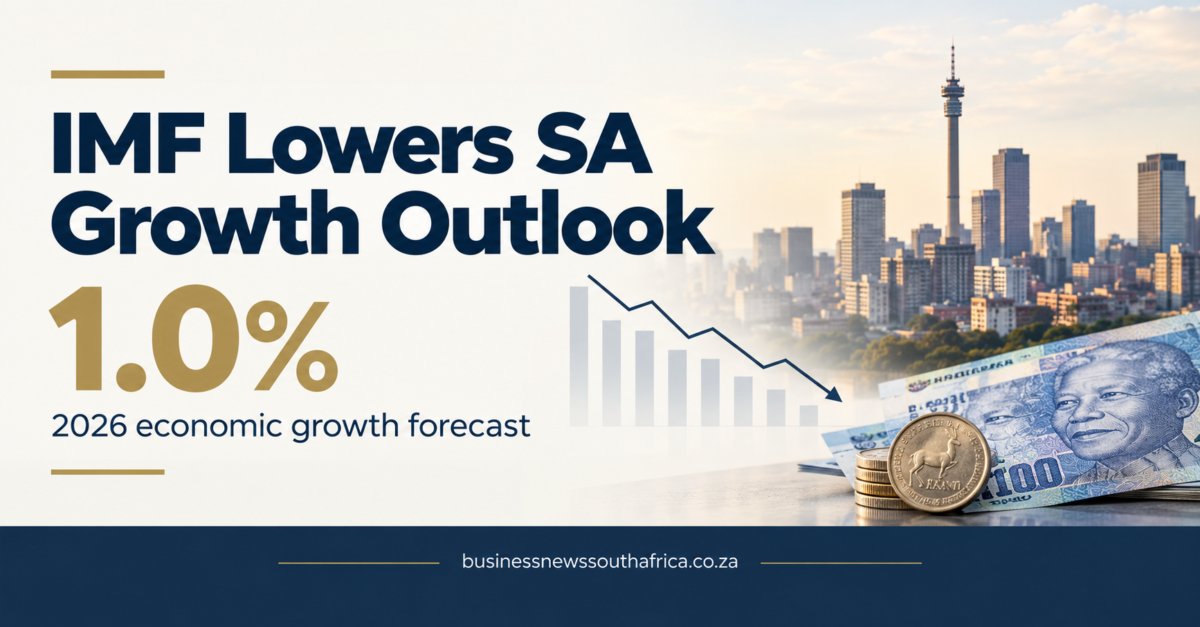
The International Monetary Fund (IMF) has put South Africa’s 2026 growth at 1.0%, well short of the roughly 3% a year the government says it needs to make a real dent in unemployment. The figure comes from the fund’s October World Economic Outlook, as BusinessTech reports, and it is 0.1 percentage points below the 1.1% the IMF pencilled in in July.
The forecast has moved in a short loop. Before the war involving Iran began in late February 2026, the IMF expected South Africa to grow 1.4% this year. It cut that to 1.0% in April, lifted it to 1.1% in July while a ceasefire was being negotiated, and has now returned to 1.0% after peace talks collapsed. For 2027 it expects 1.3%. The Bloomberg consensus of economists sits slightly higher for 2026, at 1.1%.
What is driving the cut
The cause is energy. In its April outlook, which BusinessTech also covered, the IMF tied the cut to the US and Israeli attack on Iran at the end of February and Iran’s closure of the Strait of Hormuz, the narrow sea passage through which a large share of the world’s oil moves. Oil rose from under US$60 to above US$110 a barrel at one point, and South African pump prices rose by record amounts in April.
The October assumptions are no more relaxed. According to a Bernama report carried by The Star, the IMF assumes the Strait reopens around March 2027, with a return to pre-war conditions broadly by October 2027, and it describes a “gradual restoration of production, shipping, insurance, and payment arrangements”. It expects the 2026 average oil price to be US$96 a barrel, 16% above its April reference forecast, and says energy prices should stay above pre-war levels. It also assumes policy and geopolitical uncertainty stays elevated through 2027.
South Africa is a net fuel importer, so the oil price reaches the economy directly. BusinessTech notes that the next 12 months are likely to be difficult for fuel costs. The effect is already visible in local data. Business Day reported in June that petrol in Gauteng and other inland areas had risen by R7.76 a litre since the start of April, and diesel by between R9.54 and R10.17 a litre. The Reserve Bank raised its repo rate, the rate at which it lends to commercial banks, by 25 basis points to 7% in May, citing inflation risks from higher oil prices.
The domestic picture
The economy was not collapsing before the latest cut. Stats SA figures show GDP grew 0.5% in the first quarter of 2026, up from 0.4% in the fourth quarter of 2025 and above what economists expected, according to Business Day. Mining improved on higher platinum group metals, gold, chromium ore and diamond output, while manufacturing fell 0.8%, with five of its 10 divisions contracting. Household consumption grew only 0.1%, its weakest pace in eight quarters.
Standard Bank economist Shireen Darmalingam told Business Day she expects slower growth in coming quarters because of the Middle East conflict and higher fuel costs, and that the full effect had not yet appeared in the data. Finance Minister Enoch Godongwana forecast 1.6% growth for 2026 in February, and Business Day said he was expected to cut that in October’s medium-term budget policy statement.
Jobs are the reason the gap to 3% matters. BusinessTech puts unemployment at 33.6%, and says sustained growth of about 3% is needed before joblessness moves meaningfully. Business Day reported the government’s revised industrial strategy also says growth of about 3% a year is needed to reduce unemployment meaningfully, with affordable and reliable electricity and fixes to ports, rail and telecoms as priorities.
The global backdrop
The IMF expects world growth to slow from 3.5% in 2025 to 3.1% in 2026 before recovering to 3.4% in 2027. Fortune reported that the 3.1% is up from the 3.0% the fund forecast in July, and that emerging and developing economies are projected to grow 3.7% in 2026, down from 4.5% in 2025, before rebounding to 4.4% in 2027. Global inflation is projected at 4.7% in 2026, easing to 4.1% in 2027.
The fund also said growth is concentrating. Fortune reported that 32 countries now account for 95% of global growth, up from 54 countries as of April, and quoted IMF research director Silvana Tenreyro: “The outlook is highly uneven.” The AI boom is offsetting some of the energy-price damage, but its benefits fall mainly on the United States and China, which Fortune said account for more than three-quarters of net demand for AI-related chips and equipment. South Africa’s 1.0% sits below the 3.7% projected for emerging economies as a group.
The IMF’s own statement on South Africa, as relayed by BusinessTech, is that the near-term outlook is expected to remain stable and improve gradually over the medium term, supported by policy frameworks and structural reforms. The 1.3% projected for 2027 depends on the energy shock easing on the IMF’s assumed timetable, and in April the fund said downside risks dominate its outlook.