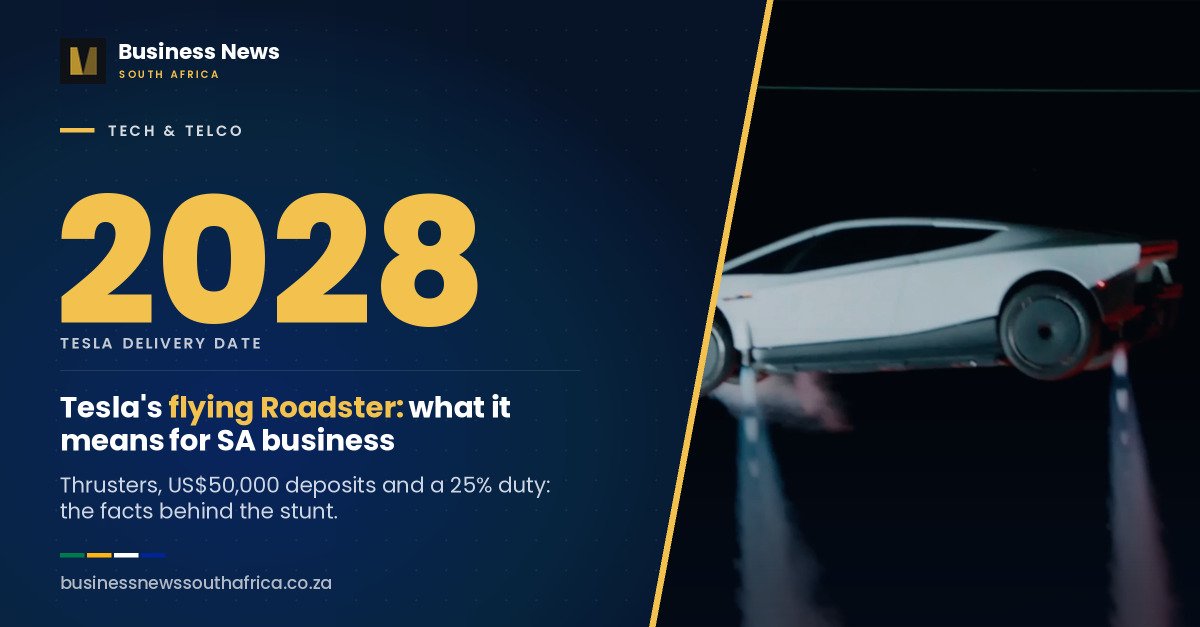
Tesla showed its next-generation Roadster on Thursday 15 October at a SpaceX test site in McGregor, Texas, and the car left the ground, Fox Business reported. It drove up a curved ramp, used a fan-based suction system to stay attached until it was fully upside down, then used cold-gas thrusters developed with SpaceX to launch off the ramp, flip in mid-air and land. In a second run it jumped over a lineup of cars and a semi-truck. “Flying cars are real,” said Lars Moravy, Tesla’s vice president of vehicle engineering.
It is a spectacle with a small business payload. Here is what is established, what is only claimed, and what it means for a South African company that buys, imports or runs vehicles.
What the demo showed
The thrusters are not wings or rotors. Tesla says ten thrusters draw on 600 litres of compressed air that can be recharged, according to TechCrunch. Cold-gas thrusters push by releasing compressed gas, so what the car did was a short, controlled jump rather than sustained flight. Electrek describes the car as flying for short distances.
Tesla’s reservation page lists a US$50,000 payment for the Performance version and US$250,000 for the Thrust version, Fox Business reported. A one-seat Rocket version with a full flight system is invite only. No price has been published. At R16.56 to the dollar, the rate on our rand exchange rates page today, those deposits are about R828,000 and R4.14 million.
What is only a claim
Every performance figure so far comes from Tesla. It says 0 to 60 mph in about one second, a top speed above 230 mph and a range above 300 miles. Electrek points out that the range is half the 600 miles Tesla promised in 2017. Its technical review also finds a claimed 4,700 kg of downforce implausible for a car under 2,000 kg, and argues that the thrusters and gas tanks add weight and complexity. Tesla says the Rocket version is “not approved for public road use”, Electrek reported.
The timeline has slipped before. Executives now say production begins in 2028. When Tesla showed a prototype in 2017 it said deliveries would start in 2020 and quoted a base price of US$200,000, according to Fox Business.
Why it is not a South African fleet decision
Tesla is not officially selling cars in South Africa. TopAuto reported in April that Tesla’s plan to launch here in 2026 had been “put on ice”, citing a source who pointed mainly to tension between South Africa and the United States. Tesla did not respond to TopAuto’s request for comment.
The cost structure is the bigger obstacle. TopAuto reports that South Africa charges 25% import duty on all vehicles except those built in the UK and EU, which pay 18% on petrol and diesel models. All electric vehicles pay 25% whatever their origin. An ad valorem luxury tax then rises with the value of the car, which widens the gap further for expensive models. With no published price for the Roadster, a landed cost in South Africa cannot be worked out.
The aviation side is a long way off
The only flying-vehicle rule change we found from the South African Civil Aviation Authority is narrow. Law firm Deneys Reitz reported in March that the regulator had proposed adding a definition of vertical take-off and landing aircraft to Part 71 of the Civil Aviation Regulations, the remote pilot certificate rules, to support a new VTOL rating for remote pilots. The firm describes the change only as proposed. That is a definition for remote pilots, not a way to certify a road vehicle that flies, and we did not find published South African rules for one.
What a South African business should take from it
Change nothing in fleet planning. Tesla’s own date for first deliveries is 2028, and its 2017 promise was 2020.
Read the refund terms before paying any deposit. Tesla is asking for US$50,000 to US$250,000 on a car with no published price. The coverage we reviewed does not set out the refund terms, so find them before paying a deposit on any imported vehicle, and confirm who carries the duty and the luxury tax.
Treat launch demos as marketing until they are tested. The performance figures are Tesla’s own, and the promised range has already halved since 2017.
Judge electric vehicles on the costs you will actually pay. For a South African fleet it is the duty and the luxury tax, not a thruster demo, that drive the price gap between an electric car and a petrol one, TopAuto notes.
If your business works with drones or air mobility, watch the Civil Aviation Authority’s VTOL amendment, not Tesla’s stunt.