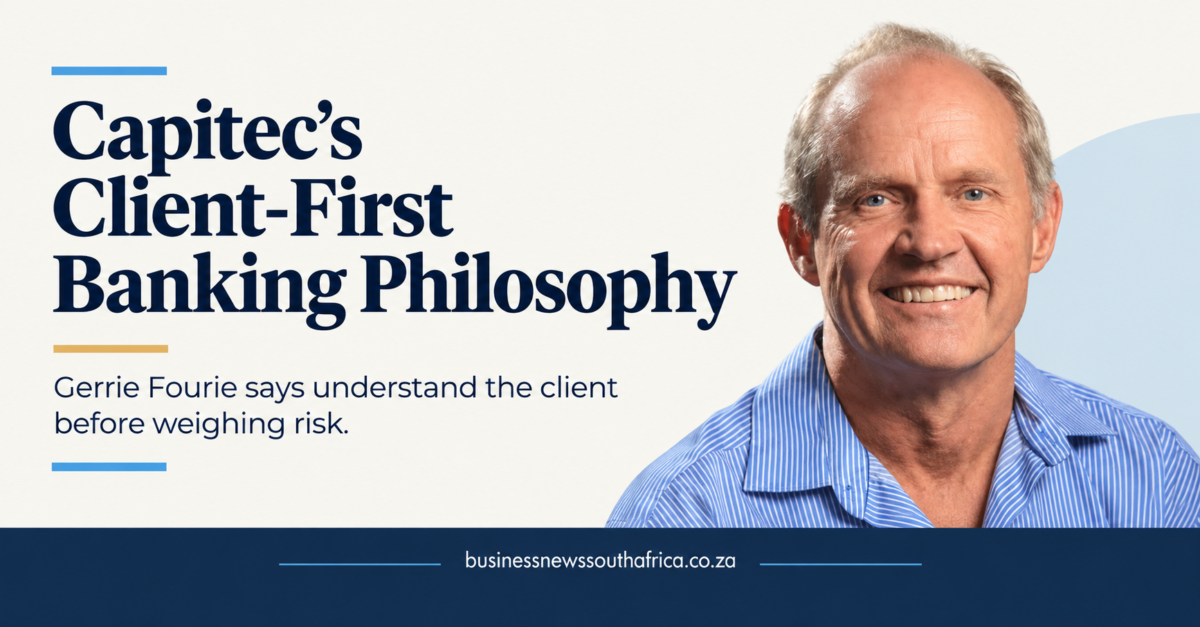
Gerrie Fourie, Capitec’s former chief executive, says the bank was built on a simple order of thinking: “We’re retailers. We think client, then risk.” He made the point in an episode of the Building Conviction podcast, hosted by Jacques Conradie of Peregrine Capital, which Moneyweb published on 19 October 2026. Everything attributed to Fourie below is his own account from that interview, not an audited statement.
Who Fourie is
According to Moneyweb, Fourie came from Stellenbosch Farmers’ Winery, with liquor distribution experience and no banking background, when Michiel le Roux asked him to help build a bank. He was part of Capitec’s founding team in 2001, became chief executive in 2014 and retired from that role in July 2025 to a non-executive position. Graham Lee succeeded him. The interview was recorded on 14 July 2026.
Fourie’s account of the client-first approach
Fourie contrasts Capitec with bankers who, in his words as reported by Moneyweb, look at risk first and the client afterwards. He says the bank set out to serve 95% of South Africans from the start, that the market treated it as a microlender, and that he estimates it took about 12 years for investors to understand the business.
He describes a deliberately plain offer. Every client received the same gold card regardless of income, fees were kept to a handful of flat charges, and branches opened from 7am to 10pm. When Capitec acquired Mercantile Bank it inherited 64 products, and Fourie says he gave the team three weeks to cut that number. Moneyweb notes that he revealed how many remained but does not state the figure.
Capital discipline and the 2018 short-seller attack
Fourie says everything was priced to a 25% return on equity and that he resisted pressure to return capital to shareholders. His argument is that the buffer helped the bank through the 2018 attack by short seller Viceroy Research and through the Covid-19 pandemic.
On Viceroy, Moneyweb reports that the firm accused Capitec of concealing bad debts and that the share price fell about 30% in a single day. Fourie says the hardest part was that the accusation went to the bank’s integrity. These are his recollections of the episode, and the allegations were Viceroy’s.
Artificial intelligence and life after the chief executive role
Fourie says artificial intelligence has changed internal work. In his account, a valuation that took three or four days now takes about an hour, and credit committee reviews that ran to 40 pages over two weeks can be done in half an hour. On stepping back, he says a former chief executive can strategically challenge things but should stay away from the detail.
He puts Capitec at about 26 million clients, nearly 900 branches and roughly 40% of the personal banking market, with a share in business banking, insurance and value-added services in the low single digits. He names international expansion as the next step. Moneyweb notes that the bank had more than 24 million clients when he retired.
What Capitec’s latest results show
Capitec’s own figures give a check on those claims. BusinessDay reports that for the six months to 31 August 2026 headline earnings rose 19% to R9.5 billion and operating profit before tax rose 21% to R12.6 billion. Active clients rose 7% to 26.6 million and fully banked clients rose 11% to 10.4 million. An interim dividend of 3,110 cents per share was declared, up 19%.
BusinessDay also reports that personal banking headline earnings rose 17% to R6.3 billion and the gross loan book passed R100 billion for the first time. Business banking headline earnings rose 52% to R609 million. Net non-interest income made up 70% of income from operations after credit impairments, up from 65%. The company has also changed its name from Capitec Bank Holdings Limited to Capitec Limited.
A sponsored piece produced by Capitec and published on BusinessDay gives a return on equity of 31%, a cost-to-income ratio of 36% against 40% a year earlier, and a split of group earnings of 37% from personal banking, 29% fintech, 27% insurance and 6% business banking. It quotes Lee saying every one of the bank’s South African businesses grew earnings and that fees were kept unchanged for a second year. Treat those as the company’s own statements.
The client numbers match Fourie’s rough figure of 26 million. The results do not test his personal recollections, such as the product count or the Viceroy episode, which rest on his word.
His closing advice
Moneyweb’s write-up ends with what the podcast calls a conviction card. Fourie’s message is to go and execute on what you believe in, and he says it is the people who deliver, not the ideas, that count.