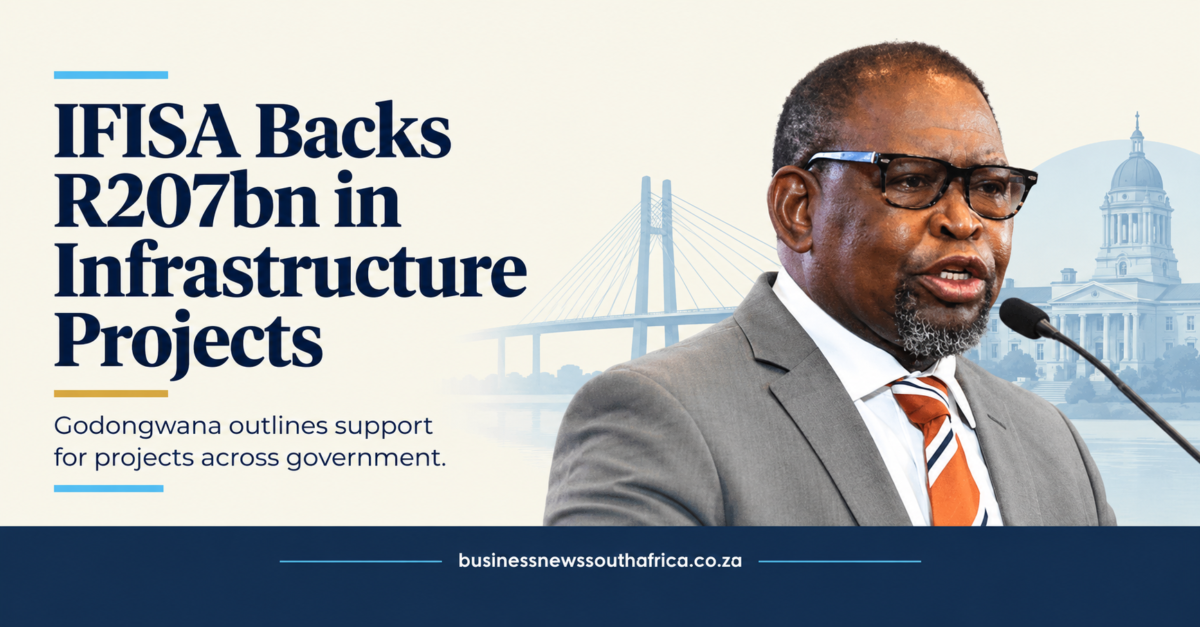
Government’s infrastructure pipeline is already large, and the agency created to prepare it is now busy. In his 21 October Medium-Term Budget Policy Statement, Finance Minister Enoch Godongwana said the Infrastructure Finance and Implementation Support Agency (IFISA) is already supporting projects across all spheres of government with a potential investment value of more than R207bn, according to the full speech text published by EWN.
The figure needs careful reading. It is the potential value of projects IFISA is working on, not a new allocation of public money and not a spending target. Godongwana said the projects are meant to mobilise private capital and expertise, improve risk sharing and bring infrastructure to market faster.
What IFISA is and what it does
IFISA was announced in the February Budget and began operating on 1 April 2026. The minister said it brings infrastructure advisory, project preparation and financial structuring under one roof, which he expects to reduce fragmentation, improve project quality and shorten the time between project conception and implementation. BusinessTech, drawing on the government’s SAnews service, reported that National Treasury’s MTBPS document names project preparation and implementation as a priority, to reduce underspending, speed up delivery and make sure investment becomes productive assets.
Public bodies that need help can turn to the agency. Godongwana said IFISA “stands ready to assist with project preparation and the development of funding proposals”, and that it is already working with criminal justice institutions, in particular the police, to prepare projects for future windows of the Budget Facility for Infrastructure.
The funding channels around it
Several other instruments sit alongside the agency, and the minister gave updated numbers for each.
The Budget Facility for Infrastructure (BFI) directs scarce public resources to well-prepared, implementation-ready projects. Fiscal support approved through it now stands at more than R100bn. An infrastructure bond, first issued in December 2025, has raised over R14bn, earmarked for projects in the BFI pipeline. Godongwana urged more public institutions to use the BFI when developing large projects.
Public-private partnerships are being fast-tracked, especially in municipalities, where backlogs and service-delivery pressure are most severe. Of the 68 projects in the PPP pipeline, 31 are municipal. The amended Municipal PPP Regulations have been submitted to Parliament for the required 30-day scrutiny period, which the minister called the final step before implementation. He said the regulations will simplify processes, cut transaction costs and make it easier for municipalities to partner with the private sector.
There is also the Credit Guarantee Vehicle, a tool meant to draw private money into infrastructure. According to the speech, it was incorporated in August 2026 and has applied to the Prudential Authority for an insurance licence. Development partners including the World Bank have given conditional commitments of US$553m towards its capital, and it is expected to be operational by 2027.
Grant spending under review
The MTBPS also put a hard number on a long-running complaint about municipal and provincial delivery. National government transferred R887bn in infrastructure conditional grants between 2017/18 and 2023/24. A review found that while most funds are spent, projects are often delayed, incomplete or fail to deliver the intended benefits. The grant system will be reformed to strengthen planning, accountability and oversight. In the minister’s words, conditional grants “are exactly that, conditional”.
Maintenance gets its own warning: Godongwana said every maintenance project deferred today becomes a larger repair bill tomorrow, and he listed better project selection, stronger implementation capacity, improved asset management and private-sector partnerships as the way to turn investment into growth and jobs.
What it means for business
For construction, engineering, finance and professional services firms, the announcements point to a pipeline that is being prepared more formally, with clearer routes for private participation, particularly in municipal PPPs once the regulations take effect. That is an inference from the policy direction, not a promise of contracts: the speech does not say how many of the R207bn of projects will reach the market, when, or how they will be financed. Whether municipalities can attract private partners will depend on the final regulations and on their own finances.
The infrastructure push sits inside a weak growth picture. Treasury has cut its 2026 growth forecast to 1.2% from 1.6% in February, and Godongwana said structural reform and infrastructure delivery are central to lifting it, with growth projected at 1.6% in 2027 and 2% by 2029. The same speech announced draft fiscal anchor legislation and fuel levy relief, covered in our Regulatory & Policy section. The Moneyweb commentary on the statement argues that growth is the missing ingredient for the public finances.
Still unknown are the projects’ sector breakdown, the split between public and private money, and the timetable for the PPP regulations to clear Parliament. Treasury’s full MTBPS documents, when read in detail, should answer some of that.