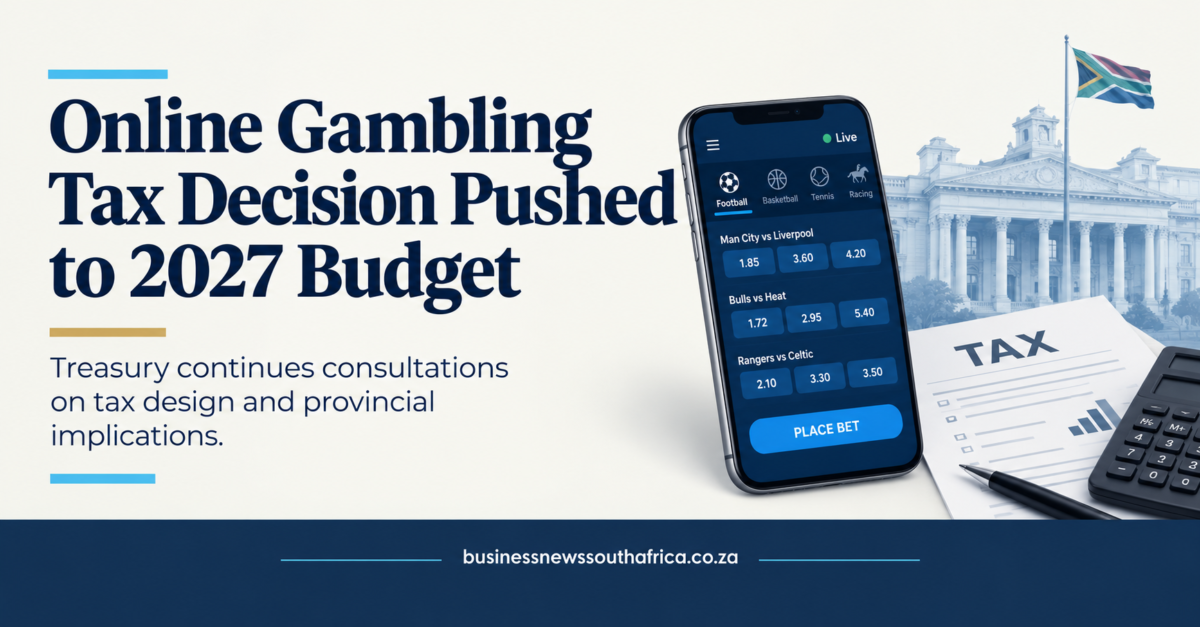
The proposed 20% national tax on online gambling is not yet law and its final shape is still open. In his Medium-Term Budget Policy Statement (MTBPS) on 21 October 2026, Finance Minister Enoch Godongwana did not announce a rate. He told Parliament that consultations are continuing and that the design will be settled in the February 2027 Budget. The 20% figure comes from a National Treasury discussion paper published last year, which proposed a levy on the gross gambling revenue of online betting and interactive gambling operators.
What the minister actually said
The MTBPS speech devotes a short section to the tax. According to the speech text published by Treasury, the submissions received on the discussion paper “generally recognised the need to address the growth of online gambling and its associated harm.” Godongwana said consultations are ongoing on the proposed tax design, its links to the existing regulatory framework, and the implications for provinces and the currently regulated market. His commitment was brief: “An announcement of the final design will be made in the February 2027 Budget.”
Reporting by eNCA and ITWeb reads the statement the same way: the proposal stays alive, but nothing has been signed off.
How the proposed levy would work
Gross gambling revenue (GGR) is the amount bet minus the winnings paid out. The discussion paper proposed that 20% of that figure be paid to national government by online betting and interactive gambling operators. ITWeb reports that licensed bookmakers already pay value-added tax and provincial gambling taxes totalling about 18% to 19% of their gross gaming revenue, and that the new tax would be charged on top of those existing charges. The same report says Treasury estimates the extra tax would “translate into over R10 billion in additional revenue for national government.”
That revenue estimate is Treasury’s own and is a projection, not a collection. Treasury has also framed the tax as a response to harm from gambling, not only as a way to raise money, according to BusinessTech, which described the aim as generating more than R10 billion a year while addressing the social risks of growing gambling addiction.
Why the sector has grown into a tax target
BusinessTech reports, citing the South African Reserve Bank, that gross gambling revenue rose from R26.3 billion in 2015 to R74.5 billion in 2024. It also notes that South Africans were widely reported to have spent R1.5 trillion on gambling in 2024/25, a turnover figure that does not subtract payouts and winnings. The article attributes the shift to technology and wider internet access, which have made betting available almost anywhere and at any time.
Separate reporting adds to the picture. BusinessTech cited a written parliamentary reply from Trade, Industry and Competition Minister Parks Tau showing more than 400 registered bookmakers in South Africa, up from 288 in 2020 to 402 in 2025. That count was released after a request from RISE Mzansi MP Makashule Gana, whose party says the country lacks a national licence for online gambling.
Where the proposal is contested
The industry has pushed back. ITWeb reports that South Africa’s online gambling industry argues the tax is unconstitutional and would push punters and companies deeper into the illegal market. In an earlier parliamentary reply to Gana, reported by BusinessTech, Godongwana described several themes in the public submissions: differing views on the rate, from too low to too high; concern about the social and public-health effects of online gambling; fears that a heavier tax burden could expand the illegal or offshore market; legal and constitutional concerns about regulatory sequencing and provincial authority; and questions about enforcement and administrative feasibility.
The minister also said at that stage that the public comment period closed on 27 February 2026, that Treasury would hold a workshop with those who submitted comments, and that a revised proposal was expected to feed into draft legislation. Provinces, which regulate and tax gambling today, are named in Godongwana’s October remarks as one of the groups whose position is still being worked through.
What it means for operators, punters and investors
For licensed operators, the question is the final rate and how it combines with the taxes they already pay. Nothing in the MTBPS changes their obligations today. If a 20% levy on GGR were adopted as proposed, the extra cost would have to be absorbed in margins or passed on, and the Treasury paper cited by ITWeb pairs that cost with a revenue target well above R10 billion. How operators would respond is a forecast, and no source gives a figure.
For provincial authorities, the open question is how a national levy fits alongside provincial taxes and licensing. For investors in listed betting and gaming groups, the date to watch is the February 2027 Budget, when Treasury has committed to announcing the final design.
No wider tax changes in the statement
The gambling work sat alongside a stronger revenue outlook. BusinessTech reports that the MTBPS is not usually a revenue-raising document, and that no changes to the general tax or VAT regime were mentioned. Godongwana said gross tax revenue for 2026/27 has been revised up by R17.1 billion compared with the February estimate, driven by higher corporate tax, dividends tax and VAT collections. A large part of the improvement comes from higher commodity prices, and those gains are expected to fade over the medium term. Gross tax revenue is projected to rise from R2.14 trillion this year to R2.53 trillion in 2029/30.
What remains unknown
Treasury has not said whether the rate will stay at 20%, whether the base will change, when the tax would take effect, or how revenue would be shared with provinces. Those details are due, at the earliest, in the February 2027 Budget. More coverage of fiscal policy is in the Regulatory & Policy section.