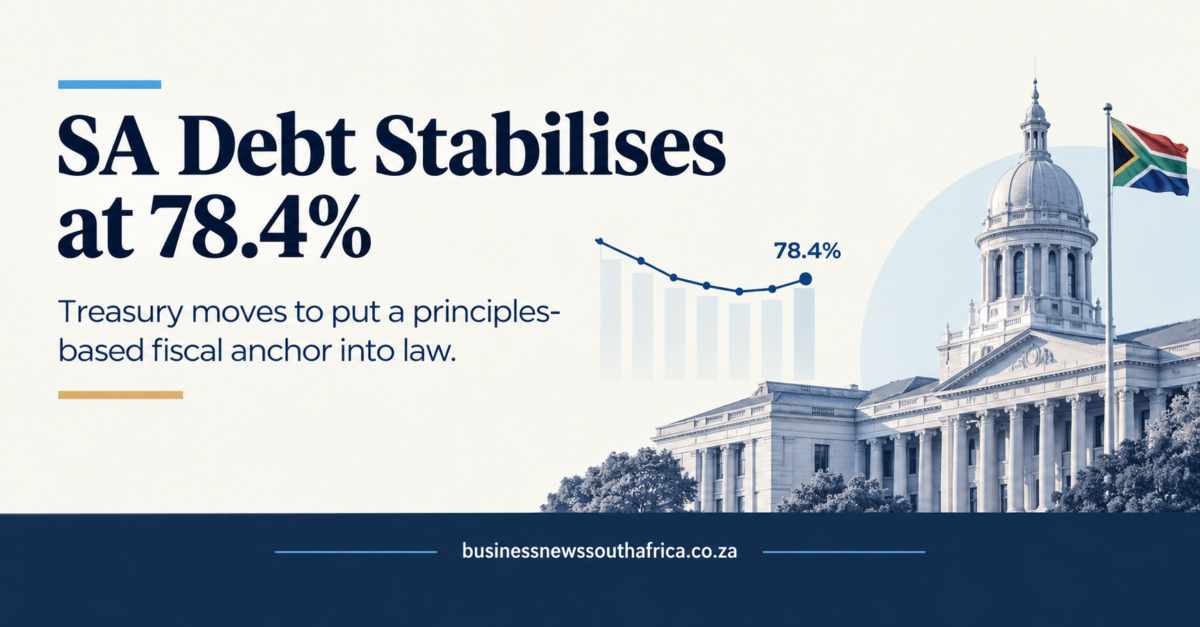
South Africa’s debt-to-GDP ratio has stopped climbing for the first time in almost two decades, and Finance Minister Enoch Godongwana used the 2026 Medium-Term Budget Policy Statement on 21 October to try to lock that in with a new law. He told Parliament that debt stabilised at 78.4% of GDP in 2025/26, and that government has published draft fiscal anchor legislation for public comment, with the bill expected to be tabled in Parliament in 2027, according to the full speech text published by EWN.
Bond investors liked what they heard. Bloomberg, in a report carried by BusinessTech, said the yield on the 10-year government bond fell 12 basis points to 8.84%, its lowest in more than a month, while the rand traded 0.1% stronger at R16.37 to the dollar by 2:45pm in Johannesburg.
The anchor is a process, not a debt ceiling
Many had expected a hard cap on debt. The draft legislation does not contain one. According to Godongwana, it writes fiscal sustainability into the Public Finance Management Act as a standard “instead of a rigid numerical rule”. Each administration must commit to its own fiscal objectives, report against them at every Budget and explain any material deviation to Parliament. EWN’s reporting adds that the incoming Cabinet after each general election must prepare a fiscal plan with objectives, targets and risks, and that the Financial and Fiscal Commission will independently assess whether the framework is consistent with that plan. Treasury described the reform as part of the most extensive reconfiguration of the public finance system since 1999.
That differs from the route the International Monetary Fund has recommended. Moneyweb editor Ryk van Niekerk wrote in a column that the IMF proposed a concrete debt anchor of 70% of GDP by the early 2030s as an interim target, moving towards 60% over the long term. He called the South African proposal “a very good start” but said it is hard to judge before the legislation’s details are seen, and that the proof lies in implementation. Daily Maverick noted that the government’s approach rules out something like a 70% cap.
Where the debt path goes next
Daily Maverick reported that from the 78.4% peak, debt is projected to fall to 76.6% of GDP by 2030 and 66.6% by 2035. The route there runs through the primary surplus, which is revenue minus non-interest spending. Godongwana said the surplus will rise from 1.7% of GDP this year to nearly 3% by 2030, which he said will allow government to reduce borrowing and contain debt-service costs. He also said the deficit is better than expected in February. Outlets differ on the exact numbers: the speech text carried by EWN and Daily Maverick give 4.3% of GDP this year against 4.5% forecast in February, while IOL’s text of the speech and Bloomberg give 3.9% against 4.0%. We have not been able to confirm from Treasury’s tables which figure applies to which measure.
Part of the improvement comes from revenue. Gross tax revenue for 2026/27 has been revised up by R17.1bn compared with February, with higher corporate tax, dividends tax and VAT collections. Godongwana cautioned that a large part of this reflects higher commodity prices, and said those gains are expected to dissipate over the medium term.
Cheaper borrowing is the prize for the state, and for companies that borrow
Interest is the pressure point. Van Niekerk put debt-service costs at 21c of every rand of government revenue, and EWN reported Treasury’s own warning that interest will take more than health, social development or basic education over the medium term. Lower yields therefore matter for the budget, and they also feed into what banks and corporates pay to borrow, since government bond yields are the benchmark for local-currency lending. That link is general market practice rather than something stated in the budget documents.
Van Niekerk pointed to a refinancing cycle that starts around 2030, when about R1.5 trillion in government bonds mature between 2030/31 and 2034/35. A stronger fiscal position and better credit ratings could help refinance that debt at lower rates, he argued. Treasury’s director-general Duncan Pieterse told Daily Maverick that the department expects ratings agencies to note the improvement, and that Fitch and Moody’s will both update their South Africa reviews before the end of the year. Godongwana said all three major agencies took positive rating actions earlier in 2026.
Bloomberg quoted Adam Furlan, a portfolio manager at Ninety One SA, saying Treasury “has cut weekly issuance by far more than the market expected, thanks to strong revenues and a change in the funding mix” and has included bond buybacks. He called it “a good, bond-friendly budget”. Bloomberg also reported that the borrowing requirement for the current year rose by R54.3bn against the February projection, mainly to fund a domestic buyback programme meant to smooth out redemptions. BusinessTech’s version of the report gave total 2026/27 borrowing of R443.2bn against R380bn in February, but those figures do not reconcile with the R54.3bn increase, so treat them with caution until Treasury’s documents are checked.
Growth and fuel relief temper the story
The weak spot is growth. Treasury now forecasts real GDP growth of 1.2% in 2026, down from 1.6% in February, with 1.6% expected in 2027 and 2% by 2029. Godongwana pointed to the Middle East conflict and its effect on oil prices, and flagged El Niño as a further risk.
Government is using some of its extra room for motorists. The fuel levy will be cut by R3 a litre on diesel and R1.50 on petrol from 4 November to 1 December 2026. After that, relief continues at a lower level, R1.50 on diesel and R1 on petrol, until 5 January 2027. Godongwana said the measures cost R10bn in foregone revenue, funded by returning R10bn that had been transferred to the Central Energy Fund. Bloomberg quoted Pieterse as saying future interventions would have to remain fiscally neutral, so that fiscal targets take priority over relief.
What is still unknown is the text of the anchor as it will be tabled, how the Financial and Fiscal Commission’s role will work in practice, and whether rating agencies treat a principles-based rule as equal to a numerical one. For further coverage, see Markets & Finance.