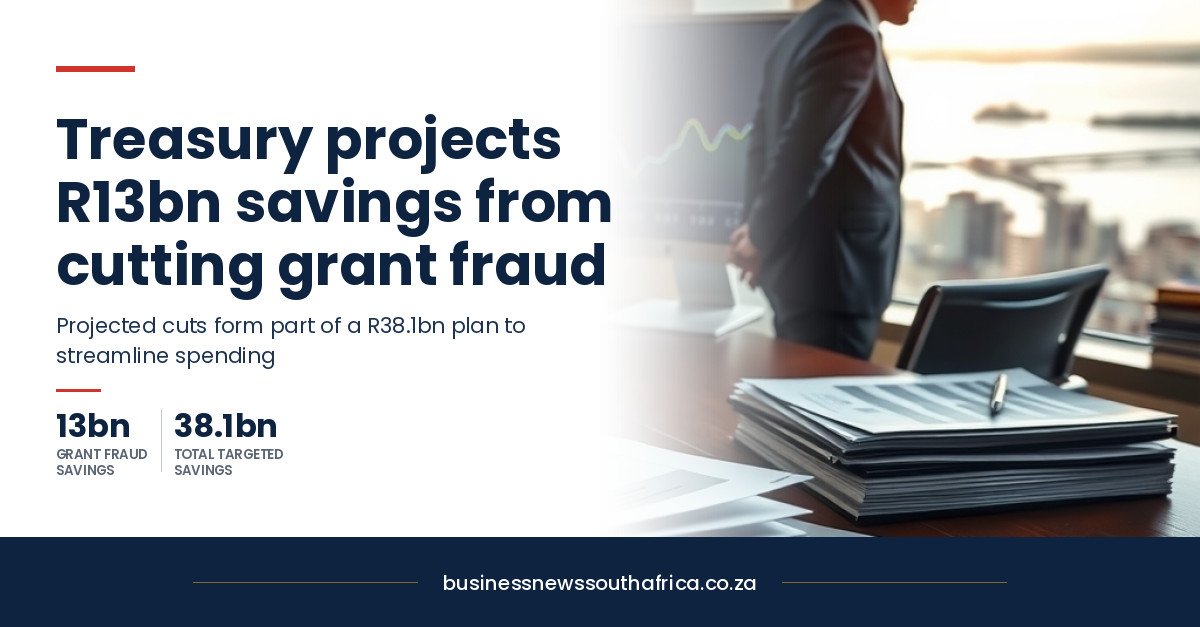
Treasury expects to save R13 billion by reducing fraud in social grants over the next three years. That is a projected saving built into the medium-term budget, not a sum of stolen money the state has recovered or proven was paid out fraudulently. Finance Minister Enoch Godongwana set out the figure on 21 October 2026 in the Medium-Term Budget Policy Statement (MTBPS), as one part of R38.1 billion in “targeted and responsible savings” identified over the 2027 medium-term expenditure framework (MTEF) period.
Where the R38.1 billion comes from
According to the speech text published by National Treasury, the R38.1 billion is in addition to the R12 billion identified in the 2026 budget. It breaks down as follows:
- R11.7 billion from low-priority programmes, reduced duplication and administrative inefficiencies in national departments;
- R13 billion from reducing fraud in social grants;
- R7.8 billion from the human settlements development grant, where programme inefficiencies and rent seeking mean that less is being spent on building houses; and
- R5.5 billion from surpluses in public entities.
The four listed items add up to R38 billion, and the sources do not explain the remaining R0.1 billion. The same BusinessTech report, published under the SA News byline, lists the same four components.
What the grant-fraud saving is based on
The wording matters. The Treasury speech describes the R13 billion as coming “from reducing fraud in social grants.” ITWeb, reading the budget documents Treasury released alongside the speech, reports a figure of R13.1 billion in savings and attributes it to enhanced biometric enrolment and beneficiary verification. The bulk of that verification, ITWeb says, has been for the social relief of distress grant.
The documents also tie the saving to a falling headcount. As quoted by ITWeb, Treasury expects the number of social grant beneficiaries to decline from 17.8 million in 2026/27 to 17.1 million by 2029/30 “as a result of strengthened verification measures,” generating savings of R6.2 billion. Those savings are to be reprioritised to prevent gender-based violence and femicide, and to support health interventions against child malnutrition and stunting. The R6.2 billion is described as part of the verification effect; the sources do not say how it relates to the R13 billion headline, so the two should not be added together.
Treasury also said the same verification approach will be applied to National Student Financial Aid Scheme bursaries and housing subsidies, according to ITWeb. For context, ITWeb reports that the state pays old-age, disability, child support and other grants to 18.1 million beneficiaries through the South African Social Security Agency (SASSA), an entity under the Department of Social Development.
Other savings lines
Daily Investor reports that the R7.8 billion from human settlements reflects a pause in the Human Settlements Development Grant while a restructured delivery model is designed under an updated housing White Paper. It says the R5.5 billion in public-entity surpluses will be returned to the National Revenue Fund from 2027/28, and that Treasury is working on a consistent legal framework for public-entity cash management. These details come from that outlet’s reading of the documents and are not in the speech text itself.
Godongwana also said efficiencies can be found in provincial budgets. His example was that more effective remuneration policies for healthcare workers could be used to employ more health professionals.
How Treasury says it chose the cuts
The BusinessTech report quotes the MTBPS document as saying savings are identified by assessing programmes on a common basis. The questions include whether programmes are legally required, whether they are aligned with policy priorities, whether they deliver measurable outputs and outcomes efficiently, whether there is persistent underspending or poor performance, and whether the same objective could be reached at lower cost or through a better institutional arrangement. Treasury said government will continue to reduce leakage and fraud by improving administration and verification, redesigning programmes that fail their objectives, redirecting funds from low-priority or duplicated activities, and addressing accumulated cash surpluses in public entities. The savings have been reprioritised across the fiscal framework.
What this means for businesses and taxpayers
The savings do not change what taxpayers pay. The statement also contained no changes to the general tax or VAT regime, and gross tax revenue for 2026/27 was revised up by R17.1 billion against the February estimate. For suppliers and contractors who work with the state, the practical signal is that Treasury will keep testing programmes for duplication and underperformance, and that conditional grants such as human settlements can be paused. For grant recipients, the signal is tighter verification, which Treasury expects to reduce beneficiary numbers over the period.
What remains unclear
The sources do not say how many individual fraudulent claims lie behind the saving, how much has been paid out unlawfully in the past, or how much of the projected R13 billion depends on the beneficiary decline. Savings of this kind are estimates until they show up in actual spending. More fiscal coverage is in the Regulatory & Policy section.