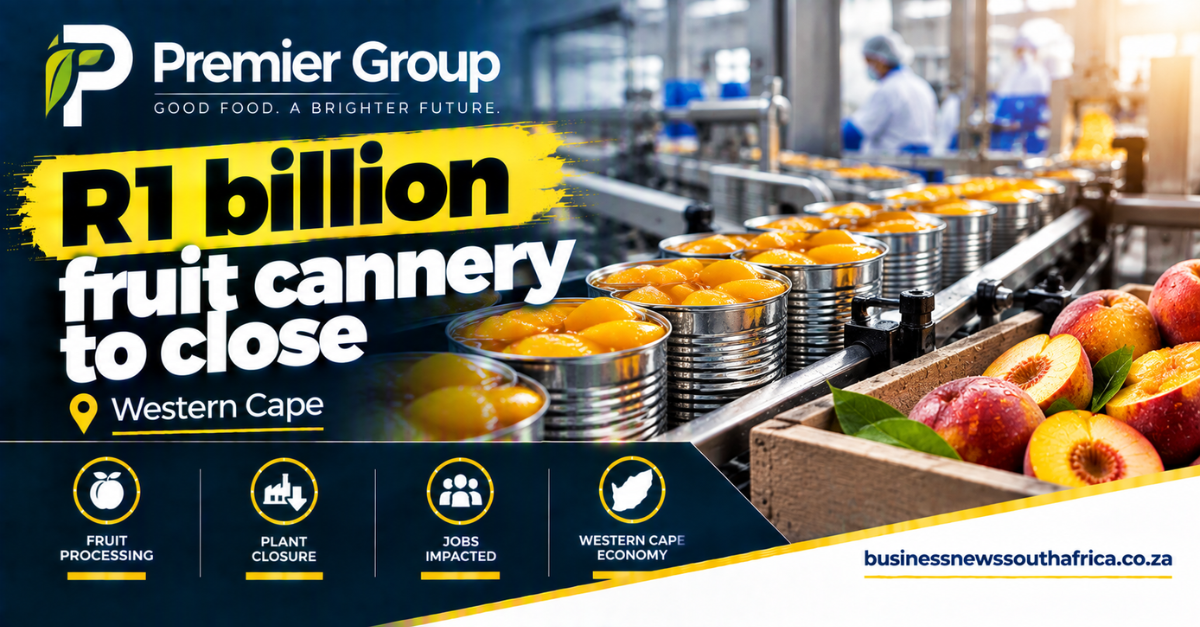
Premier Group Limited announced that its Tulbagh fruit-processing facility, valued at roughly R1 billion, will remain shut for the upcoming harvest season. The decision, set out in the group’s trading statement for the six months to 30 September 2026, follows a board assessment that the global canned-fruit market no longer supports the plant’s economics.
The factory, known as Fruit Processing Western Cape (FPWC), has operated since the 1940s and once supplied canned fruit to Europe and North America. After a series of owners, from SA Preserving to Del Monte Fruits South Africa and Rhodes Food Group, the site became part of Premier this year when the consumer-goods group completed a R6.5 billion acquisition of RFG Holdings. Premier stresses that the closure is unrelated to that purchase; it is a response to “significant structural economic challenges” in the canned-fruit sector.
Why the plant is no longer viable
Premier’s statement points to a long-term decline in demand for canned fruit, with canneries shutting down worldwide. About 90% of FPWC’s output is exported, and the company says export prospects have deteriorated rapidly to the point where the facility is no longer economically viable. The group also notes that the industry’s downturn is a “global” phenomenon, not a local supply issue.
In practical terms, the plant will not process fruit for the 2026/27 harvest. Instead, Premier will shift any fruit that can be processed profitably into pulp and purée at its Groot Drakenstein site. The company also plans to compensate growers for any shortfall between the volumes they contracted to supply and the volumes actually processed.
Premier has launched a Section 189 consultation, the legal process for large-scale retrenchments, affecting 424 employees. The group says it remains open to selling the operation as a going concern and is in talks with Langeberg Foods, South Africa’s other deciduous-fruit cannery, about transferring supply contracts and equipment.
The Tulbagh site could be repurposed for alternative products if a viable global market emerges, according to the statement.
While the closure will generate a loss for Premier, the group does not expect it to materially alter its overall financial guidance. Revenue for the half-year to September is projected to rise by 35% to 45% on the back of the RFG acquisition, and headline earnings per share, profit per share stripped of one-off items, are expected to increase by 22% to 32%.
The Competition Commission is reviewing the closure after a complaint from the South African Clothing and Textile Workers’ Union. The complaint questions whether the retrenchments breach a three-year no-retrenchment condition attached to the RFG acquisition, which was approved in March 2026. Premier says it is fully cooperating with the regulator.
For local fruit growers, packaging suppliers and logistics firms, the shutdown removes a major export channel. Those businesses will need to find alternative buyers or adjust to lower volumes, a challenge that mirrors the broader squeeze on South Africa’s fruit-canning sector. The situation also highlights the risk of heavy reliance on a single overseas market, a lesson for SMEs that export a narrow product range.
In the longer view, the plant’s fate may signal a shift in South Africa’s agro-processing landscape. If demand for canned fruit continues to fall, other canneries could face similar pressures, prompting a re-evaluation of capacity and a possible move toward higher-value products such as fruit purées, juices or dried fruit, which have shown steadier demand in recent years.
South Africa’s canned fruit export industry has faced years of pressure from lower-cost producers in other fruit-growing regions and softer global demand for tinned produce, a combination that has squeezed margins across the Western Cape’s agri-processing sector. Plant closures of this kind tend to ripple beyond the direct workforce, affecting seasonal fruit pickers, local transport operators and smaller suppliers that depended on a single large buyer for their harvest. The Department of Agriculture, Land Reform and Rural Development’s own sector reports track employment and output trends across agri-processing more broadly. For related coverage, see this site’s Agri-Business coverage.