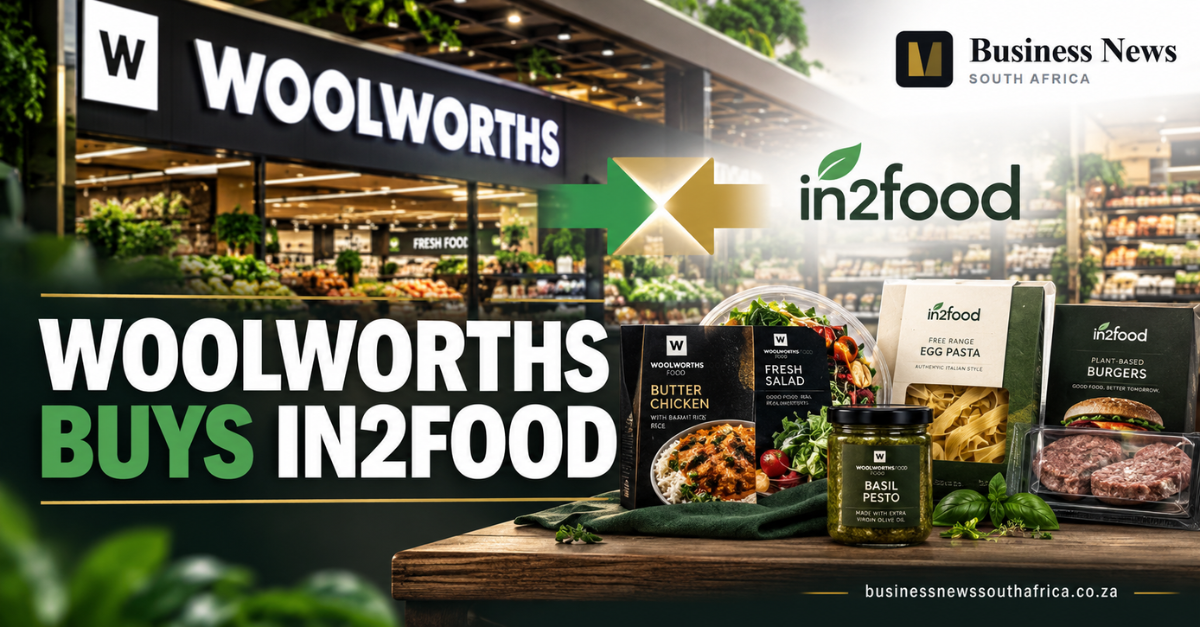
Walk into any Woolworths store and you will see the familiar private-label food range, everything from ready-made meals to bakery items bearing the retailer’s own brand. Behind those shelves sits in2food, the manufacturer that has been feeding the Woolworths brand for three decades.
In March the retailer announced that it had signed an agreement to acquire 100% of in2food Holdings from its founders, Old Mutual Private Equity and other shareholders. in2food is a South African food manufacturer that generates more than R5bn in annual revenue and produces over 3.2 million packs a week across eight factories. Its portfolio includes freshly prepared convenience meals, fresh produce, long-life ambient goods and bakery products, with Woolworths already its largest customer.
Woolworths says the proposed acquisition will support product quality, innovation and availability. The retailer expects the deal to strengthen supply-chain resilience, the ability to keep product flow steady despite disruptions, improve speed-to-market, meaning new items can reach shelves faster, and create greater agility and efficiencies across the value chain. It also sees an opportunity to grow in2food’s existing food-service and export businesses.
The Competition Commission has reviewed the transaction and issued a recommendation with conditions. Woolworths will have to continue procuring from competing suppliers for a set period after the merger, and both parties are placed under a moratorium on retrenchments, a temporary ban on layoffs that might result from the deal.
What the deal means for the market
For Woolworths, owning the manufacturer that supplies most of its private-label food gives tighter control over costs, quality and product development. It also reduces reliance on external suppliers, which can be a competitive advantage in a market where price and freshness matter.
For other food producers, especially small and medium-sized manufacturers, the deal underscores the importance of offering something beyond price, such as unique product innovation or niche capabilities, to stay on the retailer’s shelf. The Commission’s conditions also mean that competition will remain in the short term, giving other suppliers a window to compete for Woolworths contracts.
Finally, in2food will continue to operate as a standalone business within Woolworths, with its senior leadership team staying in place. This is intended to preserve the entrepreneurial culture that has driven its product development for decades, while giving the retailer a direct line to the factory floor.
Vertical integration of this sort is not new in the retail sector, but it is relatively rare in South Africa where the retail landscape has traditionally been dominated by a network of independent manufacturers and distributors. By bringing a key supplier inside its corporate structure, Woolworths joins a small group of retailers that have chosen to internalise production in order to gain greater predictability over supply and to protect margins against volatile commodity prices.
The strategic rationale behind such moves often rests on the ability to align product development cycles with marketing plans. When the manufacturer sits under the same corporate umbrella as the retailer, decisions about new flavours, packaging formats or seasonal promotions can be made more quickly, without the need for lengthy negotiations or contract amendments. This speed can be decisive in a fast-moving consumer goods environment where trends shift rapidly.
From a risk-management perspective, owning the production capability also provides a buffer against external shocks. South Africa’s logistics network can be affected by infrastructure constraints, port congestion or power interruptions. A retailer that controls its own factories can prioritize its own product lines during such events, ensuring that shelves remain stocked and that brand reputation is protected.
Supply-chain resilience has become a buzzword in recent years, especially after periods of global disruption that highlighted the fragility of relying on third-party suppliers located far from the point of sale. By integrating in2food, Woolworths can monitor inventory levels in real time, adjust production schedules on the fly, and reduce the lead time between raw material receipt and finished-goods dispatch.
The role of the Competition Commission in this transaction illustrates how South African competition law seeks to balance the benefits of efficiency against the need to preserve market contestability. The Commission’s review process typically examines whether a merger would substantially lessen competition, create a dominant position, or foreclose market access for rivals. In this case, the conditions imposed , continued procurement from other suppliers and a temporary hiring freeze , are designed to mitigate any short-term anti-competitive effects while allowing the parties to realise the long-term efficiencies of integration.
For business owners who operate in the food-manufacturing space, the Commission’s approach sends a clear signal. While vertical integration can be approved, regulators will look closely at how the combined entity will affect downstream competition. Maintaining open channels for other manufacturers to supply the retailer can be a way to demonstrate that the merger will not lock out competitors.
In practice, the moratorium on retrenchments serves two purposes. First, it protects workers from immediate job losses that could arise from overlapping functions after the acquisition. Second, it gives the new corporate structure time to assess where redundancies might be justified without compromising the stability of the workforce. This aligns with broader labour-market policies that aim to balance economic efficiency with social responsibility.
From a financial perspective, the acquisition is likely to have an impact on Woolworths’ balance sheet and earnings profile. By internalising a supplier that already contributes a significant portion of its private-label sales, the retailer can capture a larger share of the value added in the production process. This can improve gross margins, provided that the integration is managed effectively and that cost synergies are realised.
In addition to the direct benefits for Woolworths, the deal may have ripple effects across the broader South African food sector. Competitors may respond by seeking their own strategic partnerships, investing in technology to improve product differentiation, or expanding into new categories to reduce dependence on any single retailer. Such dynamics can stimulate innovation and ultimately benefit consumers through a wider choice of high-quality products.
For entrepreneurs considering similar moves, the key lessons are to ensure that the target manufacturer has a strong brand, a proven track record of quality, and a culture that can be preserved within a larger corporate environment. The success of in2food’s integration will hinge on maintaining the entrepreneurial spirit that has driven its product pipeline, while leveraging Woolworths’ distribution reach and market intelligence.
In the context of South Africa’s broader economic goals, the transaction aligns with government objectives to strengthen local manufacturing and reduce reliance on imports. By expanding the capacity of a domestic food producer, the deal supports job creation, skills development and the growth of ancillary industries such as packaging, logistics and raw-material supply.
Overall, the acquisition of in2food by Woolworths represents a strategic step toward greater control over the private-label value chain, a commitment to supply-chain robustness, and an example of how competition authorities can shape the terms of integration to safeguard market health. For South African business owners, the case illustrates both the opportunities and the regulatory considerations that accompany vertical integration in a competitive retail environment.