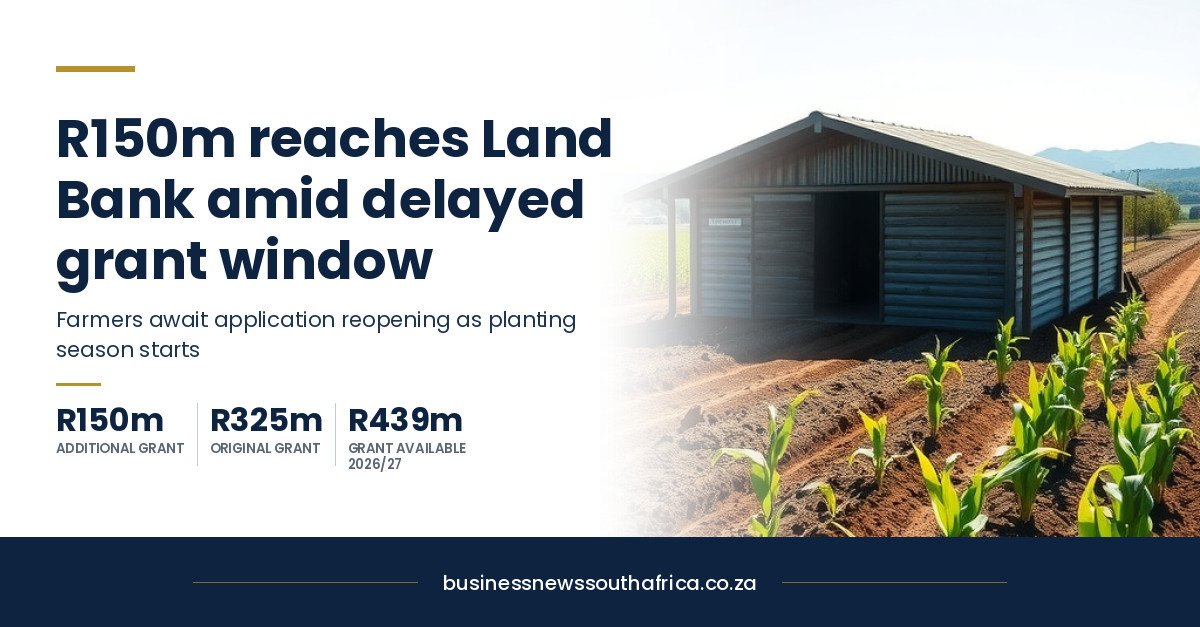
The Department of Agriculture has confirmed that an extra R150 million has reached Land Bank for its Blended Finance Scheme (BFS), but farmers still have no date for when new applications will reopen, according to Farmer’s Weekly. With summer planting under way, the timing matters as much as the money.
This follows our 5 October report on the pause, when the extra money had been announced but not yet confirmed as paid.
Why the scheme stalled
On 29 September Land Bank told Parliament’s Portfolio Committee on Agriculture that it had paused new BFS applications because the R325 million grant allocation for 2026/27 was already committed to applications received. Minister Willie Aucamp announced the extra R150 million in a statement on 2 October, over and above the R325 million, and his spokesperson, Joylene van Wyk, has now confirmed that the transfer took place.
The department set out what the scheme can cover rather than how the new money will be spent: buying agricultural land or commercially viable agricultural businesses, expanding operations on private or land reform farms, start-ups on greenfield and brownfield sites, especially on communal land, capital equipment and infrastructure, working capital and production loans. It also provides subsidised insurance, capped at 6% of each total grant approved.
The numbers do not yet reconcile
Aucamp’s two amounts add up to R475 million. But in a written reply to Farmer’s Weekly, the department said it had made R439 million in grant funding available to Land Bank for 2026/27. That is R36 million less than the minister’s combined figure, and the department did not explain the difference.
It also did not say how the R150 million will be allocated, when it will reach farmers, how much will be reserved for production finance, or how pending applications will be prioritised. Nor did it give a date for reopening new BFS applications or spell out the terms of the interim loans Aucamp referred to. “Land Bank has stated that in the interim, [it] is open for 100% loan funding for the agriculture sector,” he said, adding that the scheme has not been discontinued.
Planting windows
Farmers who spoke to Farmer’s Weekly anonymously said they had already incurred costs or taken on extra credit in anticipation of blended finance. ActionSA MP Athol Trollip, who sits on the agriculture portfolio committee, said delayed finance can undermine a farm even when the application is eventually approved. “Farming is a seasonal activity, and certain crops can only be successfully planted in specific window periods,” he said. He cited North West grain farms visited by the committee where, he said, maize finance arrived too late, and alleged that delays in harvest finance left fruit unpicked on some Eastern Cape citrus farms.
Trollip also questioned how beneficiaries are chosen, saying they are “not always selected appropriately”, and pointed to a North West pecan operation whose irrigation pivots he described as obsolete and non-functional. Land Bank said it has improved support before and after approval.
Land Bank’s own record
Since the scheme launched in November 2022, Land Bank says it has approved about 610 applications and funded 539 farmers. It puts its average time to reach a credit decision at 59 working days, roughly 12 weeks, a long wait against the planting windows Trollip describes. The department has also said it explored a partnership with the Department of Land Reform and Rural Development that would let Land Bank finance new applications through the end of 2026/27 and beyond, but gave no amount and did not say whether it has been approved.
The department’s own warning explains the squeeze: “The funds are not infinite, and the demand for blended finance exceed the resources we have.” It said Land Bank must manage its allocation and tell farmers in good time when the grant ceiling has been committed. For more on funding routes, see our Funding section.